
Translated material
October, great and small
October, great and small. Life after the October Revolution - it seems, what is life? Catastrophe. But not so: they loved, gave birth, went to the theater and thought how to best place money. The disaster has already happened, the Apocalypse was ready to spill around the country, but the country did not notice this: not with us, not here ...
Sergey Buntman
"Echo of Moscow" - specially
For The New Times
 |
The exchange did not respond to the Bolshevik revolution in St. Petersburg and the uprising in Moscow. Rather, I reacted, but calmly and businesslike. Unless she stated that "our ruble ceases to be value." The only real value will now be represented by dividend papers, houses, diamonds, gold, experts thought. With a reservation that while maintaining private property. But ... "For the destruction of this institute, the voices of even the most zealous Bolsheviks do not rise yet" ... It's funny. The word "so far" will be the key. Exchange analysts are not afraid of control over production and believe that workers will now be interested in maintaining enterprises and a possible raising of production.
The exchange will explode in two months, in December, when the Bolsheviks capture banks. The disappearing newspapers will write that “huge crowds of people continue to accumulate at banks,” and announcements appeared on the doors of some banks calling for citizens to protest against the illegal seizure of banks ... It's too late.
People are worried about people. But in a few months they got used to the revolution. The revolution is a new routine, a new habit, but the old habits do not die. Who went to the theater, he goes, who was eager for the "new film", he is torn. Despite the fact that theaters do not always make full fees, there are a lot of public, the circle of spectators democratized and expanded. Reviewers write about the "proletarizing bourgeois" and "Owarjuasowing proletarians." The repertoire may not seem very revolutionary, but in fact this is not entirely true. Alexander Tairov puts Oscar Wilde's Salome. Aestheticism? Feast during the plague? No, a breakthrough, because a year ago, censorship would have attended a production. The same Tairov is released by the long-prepared performance “King ARLEKIN”. The public and critics very accurately see in the comedy of the masks "The question of the essence of statehood itself." Harlequin, who killed the prince and becomes the ruler ... Meanwhile, the film critic literally “irons” the new role of faith in the cold. On the mountain, young fans, for whom faith is cold, and not Kerensky, Kornilov and Lenin with Trotsky will remain the most vivid, unquenchable memory of those years and days ...
All the Moloshevik newspapers are full of caricatures on Lenin and Trotsky. Trotsky is more. Lenin - until October 25 - even sometimes they cannot find out under the initials "N. L. " And after the coup, one of the newspapers puts a note that “the Bolsheviks, having mastered counterintelligence, first rushed to the Lenin case, which was stolen by them” ... which excites after the Petrograd and Moscow events, is the preservation of palaces, monuments and other values. First, newspapers are worried, publish reports of defeat in the Imperial apartments of the winter, about holes in the domes of the Blessed Vasily Temple, but then calmed down, especially since many values were taken out of palaces ... to exhibitions! Exhibitions work in the seventeenth year. And not only the “Diamond Valet”, for example, which is quite rhyming with the revolution, but also quite “bourgeois”, archaic.
A society with peaceful curiosity is following the news from Tobolsk, where the deposed emperor abides. Newspapers write in detail about the classes of the royal family, about the composition of the guard under which it is located, about the issuance of gr. Romanov and his household food cards. People are almost touched by photos in which the king saws firewood.
While the Bolsheviks take power in Petrograd and Moscow, the All -Russian Church Council elects the Patriarch. The first Patriarch in more than two hundred years is Metropolitan of Moscow Tikhon. And this is also the life of the revolution, the Orthodox citizens of the republic are waiting that the church will become different.
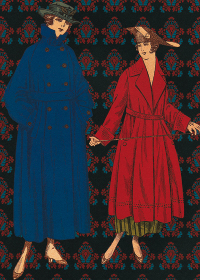
Fashionistas continue to be fashionable in the world. In the fall and winter, it was proposed to wear free and half -male, bright and joyful, like the revolution itself. Red color is a good tone of the season and year. Deprivations seem temporary, and adversaries are transient.
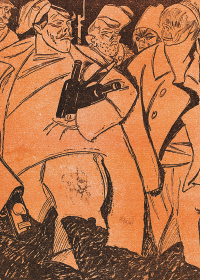 |
But the darkness is gradually thickening. Dry notes in the newspapers that the dead in Moscow hospitals are still crowded with corpses. From all sides the words "Civil War" are heard. True, the Bolsheviks believe that it has already ended, and call for the answer of its organizers, primarily a party of cadets. And in everyday life, all fights and excitement, all clashes throughout Russia are called a civil war. This is probably more precise. Nevertheless, in this phrase, a civilian is more heard than a military man. In the note about the fire after the fighting by the Nikitsky Gate, it is said that even on Bronnaya it was possible to read the newspaper at night - so they blazed at home. Very soon it will turn out that most newspapers cannot be read during the day: the Bolsheviks will end the freedom of print. But the habit of publicity is still alive, so meetings and rallies are held in defense of freedoms. At meetings such as in the Moscow circus of Salomonsky on Tsvetnoy Boulevard, the Bolsheviks do not dominate yet, they are represented by very loud, but few groups.
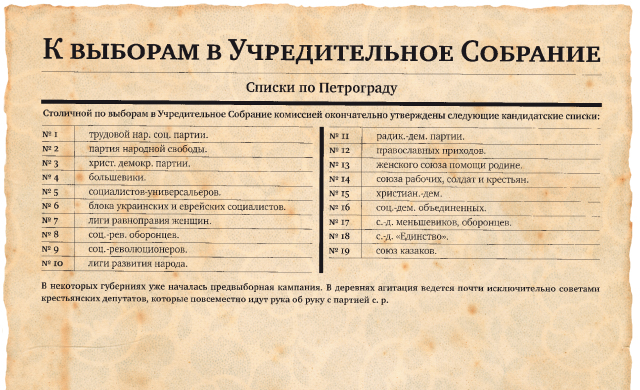
The society is waiting for the Constituent Assembly and, it seems, will believe in its reality, that Russia will still be settled by democratically, up to the Bolshevik decree of January 6. And all autumn and the beginning of winter argue about programs and lists, including the list No. 4, the Bolshevik party, does not receive most votes.
And, perhaps, in the hope of a quick arrangement, people do not so alarmly perceive the exact moves of the new government, which delay the stray on the neck of freedom. Is it so important that dramatic censorship is restored? Theaters continue to show performances. Can a new censorship close the pantomime “Box with toys” in the chamber or “Corsara” in Bolshoi? Is it so dangerous that martial law has been introduced in Moscow? This is better than brutal crowds of soldiers on the streets than night pogroms of wine warehouses. The Bolshevik military revolutionary tribunal is still touched by the layman with its sentences. The Countess Panin is sentenced to public censure.
I wonder how people would behave if they knew what awaits them? I think they would not believe. Indeed, on the eve of the coup in bold and exact articles describing the Bolsheviks, although it was said that they will probably come to power, because they want to take everyone now, and therefore promise to immediately give everyone what all those wishing, expressed the belief that Lenin, Trotsky and the company will fall asleep and leave "to their German owners." Well, who could believe that everything would disappear, and the portraits of the main people's commissar Ulyanov-Lenin will hang throughout the country and decades later? How could one believe that life was about to end-a familiar, everyday life-will end. And the great harvest will begin. And under the braid of the Bolshevik revolution, everything and everyone will go. Ah, to know and have time to jump on a white ship. They did not jump up.
No one expected the victories of the Bolsheviks in the elections
11/18/1917. Saturday. "Petrograd leaf", No. 4 (evening issue).
Mephistopheles
The huge, uncomfortable shed, called the Great Theater of the People’s House, was full of the public yesterday: Mephistopheles Boyto with F.I. Chaliapin in the title role. A highly -melting artist extremely spectacularly played the role of Mephistopheles, and, of course, with a huge success. However, the main power of Chaliapin is not in effectiveness, not in the external splendor of the performer, but in his deep truth. And for her, the stroke role of Mephistopheles does not give enough food ... The duet of Margarita and Faust was spoiled by G. Mosin, who instead of Mezza Voce gave some flat sound here. The elegant singing of Ms. Rioli was crushed. In general, the artist was a lovely Margarita, and G. Mosin was a good Faust ... he conducted G. Golinkin with excellent knowledge of the matter.
All this great small October can be felt ninety years later in the beautiful volume of the publishing project "Interros" "Russia. XX century. 1917 ".
19-21.11.1917. Tuesday. "Moscow Leaf", No. 252, "Early Morning", No. 255, "Morning of Russia", No. 267
The last day
Today is the last day of elections to the Constituent Assembly in the mountains. Moscow ... For two days, about 60% of voters entered in the lists came to the urns ... Along with this joy, the fact of deeply regrettable was noted: the freedom of the election was violated. Elections in Moscow take place in a situation that, largely excluding the possibility of freely identifying the will of voters ... here is the illegal campaign of officials, and countless facts of double voting, and intimidation of voters who do not want to give their votes of the party of the civil war ... This, of course, should have expected ... who has not yet taken part in the elections, should do this today. Electoral commissions will be open until 2 a.m. The late voters should use these few remaining hours, maybe the last in the history of the homeland, when there is still the opportunity to prevent its death and decomposition. To the urns, citizens!
Illustrations from the book "1917". M., 2007