
Translated material
The widow of Alexander Litvinenko filed a lawsuit against Russia in the European Court
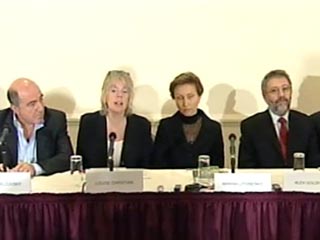
Representatives of the widow of the defector Alexander Litvinenko filed a long -prepared lawsuit in the European Court of Human Rights in an attempt to force the Russian government to recognize the responsibility for the murder of her husband and pay compensation. Exactly a year ago, Litvinenko died of poisoning with radioactive polonium-210.
As notes The Financial Times , this will give a new impetus to a dispute, which has already caused an unprecedented one since the end of the Cold War of the deterioration of relations between Russia and the UK. (Full text on the website inopressa.ru .) This step threatens to complicate the actions of Great Britain to eliminate the negative diplomatic consequences of the Litvinenko case.
The fact that the lawsuit has already been filed was reported at a press conference on Friday lawyers Marina Litvinenko, reports Sky News . One of them Luis Christian said that they "have evidence of indulgence or involvement of the Russian Federation in the murder of Litvinenko." Marina Litvinenko said that he simply “wants to find out who is behind the murder of her husband”: “I promise, the day will come, and we will know for sure who is responsible for this. Because we cannot feel safe without knowing this.”
As it is assumed, the lawyers of the widow Litvinenko will build their lawsuit in scientific testimonies and police reports, from which it follows that access to fatal polonium -210, with which Litvinenko was killed, could only receive a group supported by the state or individual criminal elements within such a group, and this is the state - Russia.
Luis Christian said that the plaintiffs had a prominent expert’s report that the Polonius that appears in the Litvinenko case could only be received from 450 km southeast of the Moscow Avangard plant, on which nuclear weapons were previously produced.
The press conference was also attended by Boris Berezovsky, a friend of Litvinenko Alexander Goldfarb, the emissary of Chechen separatists Ahmed Zakaev and father Alexander Litvinenko Walter.
Diplomatic complications
In July, as part of one of the first decisions taken by the Ministry of Foreign Affairs under Gordon Brown, in response to the Kremlin’s refusal to extradite Andrei Lugovoi, a former KGB officer, whom the English prosecutor’s office calls the main suspect in the murder of Litvinenko, the UK sent 4 Russian diplomats. A few days later, Moscow answered on the principle of "eye" by the expulsion of 4 British diplomats.
Since then, the Brown government actually prefers not to take new diplomatic steps against Russia regarding this matter. On Tuesday, the representative of the British Foreign Ministry said that at bilateral meetings, his department continues to urgently demand the issuance of meadow. However, he added: "From our point of view, this question should not be associated with other problems. This is an autonomous question."
The issuance of a meadow is prevented by the article of the Constitution, which prohibits the extradition of Russian citizens. In addition, according to the prosecutors from Moscow, the British colleagues did not give them specific evidence that would indicate a meadow, while sources in the judicial and diplomatic circles of Great Britain claim that they provided a detailed case.
Traces of polonium and meadow diverge
A year before the tragedy, Litvinenko contacted Lugovo from London to reduce with potential customers. Andrei Lugovoi went to London more than ten times over the year. On November 1, 2006, accompanied by his wife, three children, as well as Dmitry Kovtun's friend and partner, he came to London for the Arsenal match, CSKA, and before the match met with Litvinenko. This is the same famous meeting in the Millennium hotel bar at about 16:00. Litvinenko died on November 23, after agony, about which the media around the world was told. The next day, Lugovoi in the Russian media vowed that it was innocent, reminiscent of the French Le Figaro .
The father of four children, Lugovoi said that he was shocked by such a mediashumih. But months pass, and it becomes more and more self -confident and arrogant. After the British justice of the British justice on May 22, Andrei Lugovoi, convenes a real stellar press conference at Interfax. The suspect "number one" accused the British secret services of poisoning his own agent Litvinenko and to recruit him (meadow). He also accused Berezovsky, whom he calls the "criminal", despite the fact that he met him during his stay in London just a few days before the murder. As for the evidence of the charges, he said, he is forced to keep them secret.
Lugovoi and his friend Kovtun left traces of Poloniy-210 everywhere, where they were in London, starting with their previous trip on October 16-18, 2006. Their innocence, Lugovoi claims, proves the fact that no radioactive traces were found on the plane from Moscow to London on October 16. So, they were not brought to the poison. Q.E.D. He forgot to mention another hypothesis: if he or Kovtun is killers, they could well bring poison on the 16th - or earlier - in a sealed container. Alpha radiation in polonium is weak. Only when opening the container does the substance leaves slightly distinguishable traces.
Judging by the dose of radioactive radiation received by Alexander Litvinenko, and by other signs, it was poisoned on November 1, and not before. “Where are the video recordings of the Millennium bar?” He tells Lugovoi in his defense. “Our alibi is on the cassette. It would be very clear on it that we did not add anything to him.”