
Translated material
Los Angeles Times on the Pooputinsky Youth Organizations: the army of "street avengers", unexplored "ordinary fighters"
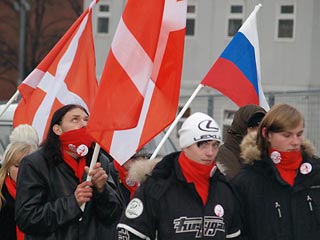
The Los Angeles Times calls the “symptom of time” Youth Prochrevsky organizations in Russia, which were formed approximately in the spring of 2005, after producing “color” revolutions swept through the former Soviet bloc. A special vanity around Putin’s figure, writes an influential American newspaper, is both non -Soviet and ruthless capitalist. In his material, the journalist describes the two organizations - “ours” and “Russia young”.
These are “Putin Street Avengers”, “Inexpressed Support Group”, “ordinary fighters”, as their journalist determines. Young people believe that the stability of their homeland depends on the crushing of the political opposition and the support of their beloved leader (full text on the website inopressa.ru ).
"Ours": career growth linked to the support of power - this is not a shame
The correspondent met with the commissar of "ours" Nikita Borovikov, who, recall, became the new leader of the movement in return for Vasily Yakemenko, who had gone into the executive branch. Borovikov is described as a student-activist who, thanks to his stylishly laid hair, sharp-nosed black boots and black jeans, seems to be a representative of bohemia.
Borovikov says that he had already met with the Russian leader twice. “And what?” He adds, as if defending himself. “Let me ask you a philosophical question: what's wrong with the support of the authorities?”
Members of the Borovikov organization, as Los Angeles Times formulates, bombard conversations about the danger of “fascists” - the organizers are scattered by this term, calling them all political opponents, including neo -Nazis and producing liberals, such as Harry Kasparov.
“We are trying to tell people about movements that they do not say that they are fascists, but they are fascists,” said Borovikov, deputy head of “ours”. According to him, people should understand what can happen if they support this or that political force.
The Kremlin and "ours" are often trying to proceed the proximity of their relationship. However, this organization receives most of the financing from the Public Chamber. The organization’s website is explained as the involvement of citizens and public organizations to the implementation of state policy.
But Borovikov protects his alliance with the Kremlin with all his might. “For some reason, it is believed that being related to the authorities or the state is bad, but the history of Russia shows that the country has achieved success only when the state was strong,” he says. “Career success has always been connected with the public service, and there is nothing shameful in this.”
A conversation with the members of the "ours", the newspaper continues, reveals the kaleidoscope of the fears that circle in Putin's Russia. Every now and then the topic of the alleged American conspiracy to penetrate into Russian politics, establishing control over natural resources and the dismemberment of powerful Russia into small, easier controlled countries.
“We are here in order to protect the sovereignty of our country,” says 20-year-old Zaur Aminov, an economy student and the leader of “ours”, who came among thousands of other students for a recent Pro-Putin rally on Red Square. When asked who threatens the sovereignty of Russia, Zaur answers quickly: "American State Department."
Most recruits are neophytes; Often these are naive youths from the provinces, which are not even able to explain why they chant the streets of Moscow.
“My boyfriend consisted in the organization, and I went to one of the actions with him and thought it was cool,” said a teenage girl in her lip, blue-black mascara and bleached hair that fell into her eyes all the time. Another rally has just ended, near the Georgian embassy.
“What are you talking about? You should say that you are worried about the fate of the country,” the young man shouted at her from the side, who took off his headphones to listen to the conversation.
"Russia young": aggressive racketeers
Unlike the relatively calm "ours", the movement "Russia is young" - radical missile activists. According to the newspaper, they are not so scrupulous in the question of whether it is worth getting your hands dirty.
Under the office "Rimolovtsy" occupied an excellent real estate object-an extensive building in which there was once a bar, spread out in the territory belonging to MSTU. Bauman. “We threw the owners,” the leader Maxim Mishchenko says easily, shrugging his shoulders. “It was a rotten place, there were drunken fights all the time.”
Mishchenko does not mind boasting the significant influence and wealth that this group of students with fierce views commands. As in the case of many other shadow figures in the black landscape of modern Russia, its power stems from banditry and connections. Mishchenko, who barely graduated from the law faculty, is expected to get a place in the new parliament. He was elected according to the lists of the pro -Kremlin party.
When the “young Russia” needs money, he honestly explains, they find local businessmen who can be shocked. If businessmen are reasonable and pay, "Russia young" will "" lobby for their interests in state authorities, "he says. If they skimp, then you can forget about it.
“We are talking about a civilized racket,” he says, without losing equanimity. “If they do not give us money, we will attack it.”
Attacks, he explains, suggest blocking roads or holding protests near stores, until the stubborn people are supplanted from business.
They are not afraid of serious consequences for such actions: when his activists introduced themselves as reporters and attacked the Estonian ambassador, they were taken to the police department. But no one was held accountable. Mishchenko vaguely explains that the "lawyer" came and proved that the accusations of hooliganism are fabricated.