
Translated material
The Daily Mail about Abramovich’s plans: with the help of the largest “Bure” in the world, it will connect Russia and the USA tunnel
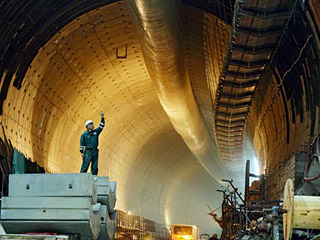
The Governor of Chukotka, Roman Abramovich, bought more than $ 160 million the largest “boo” on Earth - or rather, a tunnel -extension complex. Recall that the deal became known the day before . A new purchase made by the owner of Chelsea immediately gave rise to assumptions that it may be used to build the longest tunnel in the world that will connect Russia with America under the bottom of the Bering Strait, writes The Daily Mail .
This is not a device for the production of Black & Decker, which can be bought at any household store. Abramovich will have to collect the “drill” for another two years, while he can break through at least a thin layer of earth or stone. (Full text on the website inopressa.ru ).
In April 2007, the Minister of Transport of Russia Igor Levitin said that budget funds for the construction of a tunnel under the Bering Strait will not be spent. According to him, "the tunnel can be funded by private companies if they consider it profitable."
- Earlier, experts said: the project is completely implemented
- The history of the project dates back to the time of the Russian Empire
The huge Abramovich machine was 19 meters wide by 5 meters higher than the largest tunneling complex that is currently existing in the world - the creation of the German company Herrenknecht AG from Schwanau in Southern Germany. By the way, Abramovich ordered his car to the same company.
The complex will be used to modernize infrastructure in the vicinity of the Black Sea resort of Sochi, where the Winter Olympics will be held in 2014. However, there are also assumptions that the owner of Chelsea bought the complex, having conspired with Putin, in the hope of agreeing with America about the implementation of the plan, which, according to rumors, cherishes Putin and Abramovich for a long time.
We are talking about laying a tunnel, which will pass under the bottom of the Bering Strait and connect the ice deserts of Chukotka with Alaska. “This is one of Putin’s dreams, and he already leads secret negotiations with Washington on this topic,” says a certain source allegedly close to negotiations.
"He considers Russia the center of the whole world and wants Europeans to transport their goods, as well as Russian products, from end to end of his country and in the USA." Last year, the Russians proposed a project of this tunnel 64 miles (103 km).
He will connect the Russian Far East with Alaska, creating the prospects of the longest trip by rail from London to New York-the rails will cover three quarters of the earth. The tunnel will be twice as long as its brother near the La Channel, connecting the UK with France.
The implementation of the project will cost 35 billion pounds. The tunnel revolutionizes trade ties between Russia and its former opponents in the Cold War, and their scene will be one of the most inhospitable corners of the planet.
According to the project, a high -speed railway, fiber -fiber cable and pipelines for energy delivery will be laid. The project of the tunnel near the Bering Strait was first proposed a hundred years ago under Tsar Nicholas II, but forgotten when the First World War began, and then a revolution occurred in Russia.
After the collapse of the USSR, they returned to this idea, but the 1998 financial crisis in Russia again forced to put it in a long box. Russian officials claim that the tunnel can be built no later than 10 years later. They assure that construction costs will pay off by transporting 100 million tons of goods annually, as well as supplies of oil, gas and electricity from Siberia to the USA and Canada.
Critics, however, say that there is no economic need in the tunnel, since in Alaska there are great reserves of their own oil, and China’s colossal market is closer and profitable.
While the complex ordered by Abramovich has not begun to be used, the largest tunnels laid by Herrenknecht cars are tunnels a little more than 15 meters wide in Spain, which are part of the Madrid transport network. For comparison-tunnels laid under the La Channel to connect the UK with France, have only 7.6 m wide.
Experts have long believed: this is quite realized
Critics of the project claim that such a transport connection in itself exceeds modern technical capabilities. At the same time, its supporters say that the distance between the banks of the strait at the narrowest point is quite large (86 km), but the distance to the island of Ratmanov is significantly less than the length of the longest in the world (53.9 km) of the tunnel connecting the Japanese Islands of Honsu and Hokkaido, writes the New House .
Earlier, a project for the construction of a 180-kilometer underwater tunnel connecting Japan and South Korea was publicly announced. This gives reason to believe that the construction of 90-100 km of the tunnel under the Bering Strait is all the more implemented, given that the design of the tunnel between Eurasia and America looks much more simple in the degree of seismic danger and the necessary depth of occurrence.
It is argued that the costs of completing the Eurasian shoulder of the railway track from Chukotka to the Trans -Siberian Railway are disproportionately large and will never pay off (the completion of the missing sections of the railway in the USA and Canada looks significantly less costly, but also quite expensive).
These claims, in many respects, are true, however, critics, usually offer for consideration not quite correctly spent routes going through mountain Yakutia or along the coast of the Sea of Okhotsk through the Magadan.
Meanwhile, even according to the plans for the development of the railway network, which was approved during the USSR, the construction of BAM branch towards Yakutsk, (AMA), which was currently almost built (in order to join the Yakut railway network with BAM, it remains to complete less than 300 km) and the subsequent extension of the Lena basin to ensure the construction of the Land Cascade Hydroelectric power station.
Another important point in critical speeches is the currently underloading the Trans -Siberian Railway and BAM, the low competitiveness of these paths compared to marine transportation. The built -up analogy is obvious, but the supporters of the project propose to believe that this provision is temporary and will be corrected as the Russian railways are commercialized, which are now undergoing reform and after the establishment of a through railway message from South Korea.
This has been dreamed of since the time of the Russian Empire
Bering Strait - a strait between the eastern point of Asia (Cape Dezhnev) and the western point of North America (Cape of the Prince of Wales). The smallest width is 86 km, the smallest depth of the fairway is 36 m. The Strait connects the North Arctic Ocean (Chukchi Sea) with the Pacific Ocean (Bering Sea). The Strait is named after the Russian navigator Vitus Bering (born in Denmark), which was held by this Strait in 1728.
A tunnel or bridge across the Bering Strait is a project for the connection of Eurasia and North America (Chukotka and Alaska on/under the Bering Strait). A direct message between North America and Eurasia should contribute to unprecedented economic growth on both continents.
In 1890, the Governor of Colorado (USA) William Gilpin first expresses the idea of uniting North America and Eurasia by railway ferry. The idea is supported by the head of the US Pacific roads and is included in the Harriman Plan.
1891 - 1916 Russia built the Trans -Siberian Railway Railway (Trans -Siberian Railway) - the largest railway track in the world. Its length is 9 thousand kilometers.
At the beginning of the 20th century, the project was approved by Nikolai II, Prime Minister Witte, military and financial ministries. The government twice makes a decision on the implementation of the project, but it remains unrealized by force of insurmountable circumstances. (First, the First World War prevented, then the October Revolution.)
Excellent work was carried out and the technical and economic justification of the project under the leadership of Like de Lobel (France) and Wagel (USA). The project was recognized as technically implemented and economically justified. The well-known researcher of Alaska Like de Lobel addresses the technical imperial society of Russia with the idea of the project and the proposal to explore the route from Yakutsk to the Bering Strait and further to Alaska.
In April 1918, at a meeting of the All -Russian Central Executive Committee, Vladimir Lenin put a signature on a decision on the construction of railways in the eastern and northern parts of the RSFSR, including in the direction of the Bering Strait, with the aim of accelerated development of natural resources.
In the 60s, American engineers suggested the unification of the energy systems of Russia and the USA. ICL - World Link, which includes power transmission lines, creates the prerequisites for creating the "Energy Bridge" of Russia - America. Expert estimates predicted saving $ 20 billion annually.
In the 90s, the project was discussed at large international conferences in Washington, Moscow, Anchorida, Novosibirsk, Ferbanks, as well as at the UN conference in global projects in Barcelona, a conference on sea tunnels in Norway, a conference on the problems of the Arctic in Finland, on the problems of the Arctic coastal of Magadan, on large-scale management of large Projects in Norway, at a meeting of managerial and engineering personnel of NAFTA railways in Montreal.
In 1991, the International Non -Profit Corporation of InterHemispheric Bering Strait Tunnel and Railroad Group (Ibstrg) was registered in Washington, the Russian name is “Transcontinental”. The US government allocated a budget of 10 million dollars for research on the ICL -world Link project.
In Anchoridge (USA, Alaska), a meeting of the working group for cooperation "The Russian Far East - the Western Coast of the United States" within the framework of the Mountains - Chernomyrdin intergovernmental coast was held. According to the results of the work of the Russia and the United States, it was recommended to support the research program on the project as "having great potential."
The project is included in the priority programs of the Committee on Cooperation of the countries of the Asia-Pacific region (APR). Alaska adopted a special resolution on the reservation of land under the route of future roads.
In March 2007, as part of the implementation of the federal target program "Development of the Far East and Transbaikalia", Prime Minister Mikhail Fradkov approved the decision to build the Berkakit-Tomot-Yakutsk road to Magadan, which is an important element of the ICL-World Link project in Russia and already in April, Vladimir Putin considered the development strategy of the Russian Railway Transport For the period until 2030, which provides for the construction of the Perecontinental Railway, the right Lena - Zyryanka - Wellen with a length of more than 3.5 thousand kilometers with the exit to the Bering Strait. This highway is the key element of the ICL - World Link project in Russia.