
Translated material
"Phoenix" excavated ice on Mars
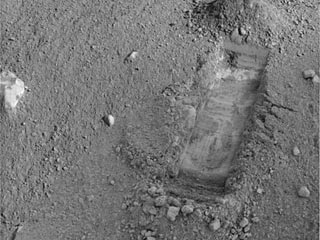
The spacecraft "Phoenix" during the excavations on the surface of Mars, perhaps found pieces of ice. The scientific director of the Phoenix mission Peter Smith said on Thursday that the particles of a brilliant substance that was visible in the pit had soon melted. He said that it was most likely frozen water that evaporated. However, it is possible that the white substance, which the probe manipulator exposed when taking the soil samples, is not ice, but salty deposits.
On Tuesday, the Marsean probe Marsean probe, dug a new trench, which scientists dubbed Snow White, according to the NASA mission . The place where the probe began to work was called the "Country of Wonders". The depth of the trench was two centimeters, and the length was 30 centimeters.
A place for Snow White was chosen in the center of a small tubercle - or a training ground - under the name Cheshire Cat. Scientists hoped that at the landfill towering above the surface of Mars, a larger number of soil layers would be represented.
According to the NASA representative, the photographed white crumbs were the size of cubes for playing the bones. “It must be ice,” Peter Smith said. “The fact that these small blocks have completely disappeared within a few days is an excellent evidence that this is ice,” said NASA representative. At the same time, scientists have the opinion that the imprinted substances could be saline deposits.
- The USA is waiting for help from Russia on Mars
Over the next few days, the probe cameras will take pictures of a dug hole: if it is really a block of water ice, then solar radiation will cause its sublimation, and it will have to decrease in size.
So far, however, in the obtained samples of Martian soil, which the Phoenix took around him, no signs of water ice were found.
In parallel with the digging of the trench, the probe continues to analyze the samples of Martian soil, which he delivered to the furnace on the fourth attempt. The number of incoming data was significantly more than expected, so in the near future the “Phoenix” will not perform other experiments.
The mission of "Phoenix" began on May 26. For 90 days, the device will try to find water on the Red Planet. There is an assumption that in the Arctic deserts of Mars, right under the surface, water ice lies, which tags from time to time, creating a aquatic environment favorable for microorganisms.
“Phoenix” must confirm or refute this hypothesis. The second task is to search for traces of ancient chemical compounds that will help earthlings answer the question of whether there is life on Mars. Along the way, the probe will study the atmosphere and conduct meteorological observations.
The USA is waiting for help from Russia on Mars
The United States does not want to engage in the development of the Moon and Mars alone due to the high cost of these programs, the head of the NASA Michael Gryffin said today, speaking at a meeting of the French National Assembly parliamentary group.
“The study of the moon and, over time, Mars will become a difficult task, and NASA has neither resources nor the desire to engage in it alone. And, as I mentioned earlier, the US policy and the law definitely require participation in international cooperation in achieving our goals,” Griffin said, whose words are quoted by RIA Novosti .
The NASA administrator recalled that earlier in the United States there was a concept for the development of Mars alone, but now the views have changed in favor of international cooperation and cooperation.
"During the development of the American space research policy, it was proposed to go straight to Mars. But when we more carefully approached this issue, we decided that we can neither allow nor ensure the increase in the budget for the risks of this plan to minimize the risks of this plan," Griffin said.