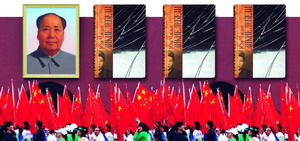
Yong Zhang Book “Wild Swans”: The Chinese model is a matter of taste
Chinese ... too Chinese.
China gets closer to us every day. And not only because the Olympics are taking place in Beijing, and the Chinese presence in the Far East is more tangible. Chinese experience, Chinese economic success, Chinese unwillingness to completely tear up with the communist past forces many to think that we would well strengthen the “Chinese” component. And this is not only a philistine point of view.
Barely living story
Writer Vyacheslav Rybakov, an orientalist, one of the authors hiding under the pseudonym Holm Van Zaychik, in his recently released collection of journalistic performances “directly”, the Chinese tradition and Chinese wisdom praise him in full voice. And Chinese appeal with a recent history including. Here the sign plus is unconditional, and genuine bitterness sounds in the words of the author when he writes about neglect of the Soviet past. Rybakov demonstrates a completely “Chinese” attitude to the Great Soviet Union.
Symptomatic that the newly published book by Vladimir Sorokin “Sugar Kremlin” is replete with Chinese words. It is clear that the position of Sorokin is as far from the position of orientalist Rybakov as the Great Chinese wall from Berlin. It is clear that here is irony, but this irony seems to scare even more than the synological lamentations of the writer Rybakov.
So to the court came a book of Chinese, Jun Zhang, “Wild Swans”, who was happy in England. A large -scale family chronicle, a documentary story about three generations of one family represents a living story of China of the 20th century.
The book of Yoon Zhang is an attempt to look at China (that is, at himself and his past) from Europe, it is an attempt to understand and rethink. It is not surprising that this book is prohibited in China. For us, the author’s European view is the key to objectivity. Or at least an indication of a certain difference in potentials. For some reason, Yoon Zhang would like to believe more than an orientalist in Rybakov.
Grandmother Yong Zhang was the concubine of General Xue Chjihan. She lived with him for a month. And another month in six years. And gave birth to a daughter. After the death of the general, the daughter was supposed to stay in the family of the deceased. But the grandmother fled to her parents. She married the Manchu doctor Xia. His family was against this marriage. The eldest son of Xia in a quarrel with his father shot himself in his stomach and died in the hospital. The family was divided (great grief for the Chinese), the grandmother left with Xia.
Mother Yong Zhang survived the Japanese occupation, the liberation of Manchuria with Soviet troops, the regime of Chan Kayshi and was imbued with communist ideas. She married a convinced communist. Yong Zhang was born "in the elite family of party workers." During the cultural revolution, both the mother and the father were repressed and sent to the camp. In 1978, Yun Zhang left to study in A Nlyia. This is a canvas of the story.
Of course, there are a lot of vicissitudes of various kinds, side plot lines, retreats, and there are many descriptions in the book. But the general feeling after reading is this. This is a detailed story about human suffering - in a traditional archaic Chinese family, during his life under the Japanese, during the reign of Chan Kaisha, during the establishment of a communist regime and in the Mao era. This is death, torture, humiliation, it is a constant and persistent destruction of a person. But if we were talking about ancient traditions and the communist past, we limit ourselves to this.
Traditions, however ...
So, quotes. “The legs of the grandmother were bandaged at the age of two. Her mother, walking on the same legs, first spit her feet with a six -meter piece of white fabric, bending all his fingers except the large, under the sole, then crushed her leg in the rise of a stone to break the bones. Grandmother screamed with terrible pain, begged her mother to stop, and she had to shut her mouth with a gag. Unable to withstand the torment, my grandmother fainted several times. This process lasted several years. Even broken feet should have been kept with bandaged day and night, because without a bandage they immediately began to grow together ... According to legend, the custom of the binto legs was introduced a thousand years ago by one of the imperial concubines. The point was not only that the appearance of a woman lame on tiny legs seemed attractive to men - they also liked to play with bandaged legs, invariably shod in silk embroidered shoes. ” This is a tradition.
“When sincere confessions came to an end, the father said that he would file a statement with a request to allow him to“ talk about love ”(Tan Lyan Ai) with his mother in the hill party, so that they could later get married. So prescribed the rules. Mom thought that this was a little reminiscent of a marriage permit given by the head of the family, and, in essence, was absolutely right: the Communist Party became a new patriarchal power. ” This is the formation of Chinese communism. There was no place for the “personal” place here. You can’t complain about hardships, you can’t cry in pain - others will notice and report. Crying means dissatisfied. Father Yong Zhang, for example, refused to take home a mother, when during a performance, mandatory for all the Communists, she felt ill. Inadmissible whim. As a result, she had a miscarriage and she almost died in the hospital.
Well, this is a combination of tradition and communism. Yong Zhang visits his father in the camp: “At the sight of the father, with whom we were separated for more than a year, my heart ached. Holding, he carried two full baskets of bricks on the rocker ... He noticed me. Shocked, he awkwardly lowered the load to the ground, and I rushed to him. The Chinese tradition does not allow his father to touch his daughter, and only his eyes spoke about how happy he is to see me. ” And then a little further, on the next page: “Father persistently endured all the bullying. Only once he gave free rein. As soon as he appeared in the camp, he was ordered to put on a white bandage with the inscription: "Active counter -revolutionary." He violently threw off his rag and spoke through clenched teeth: “You can score me to death. I will not wear it! " Zaophani retreated. They realized that the father was not joking, and they had no order to kill him. ”
The author does not know what is more in modern China - traditions or communism. And both the present is affected by modernity. But there is no envy of the “Chinese path”, and I do not want to adopt such historical experience. No, tea, Chinese medicine, Confucius (whose books carefully burned Mao), red paper flashlights, a kitchen, even a Chinese consumer goods, which is littered with the whole world, is all wonderful. But here broken female legs, shod in silk shoes, are not. This is perhaps too Chinese.
We will go the other way • New Times • RIMA — Russian Independent Media Archive