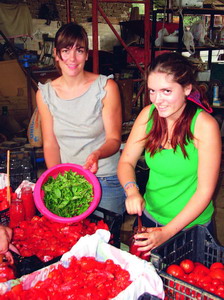
“If you are not ready to get up at 7.30 in the morning, then what the hell did you decide to become a volunteer?” - The Italian farmer Antonello Syraguz hung such an announcement in the room, where students who came here from different parts of the world lived to work out of the world and chat. As a student to spend a good holiday with benefit and inexpensively - by personal experience, the New Times found out
Natalie (Texas, USA): I have been traveling for six months now. She worked as a volunteer on farms in Spain, France, now here, in Italy. After I am going to England, and then home, to the States, to my native Texas.
The New Times: Do you miss the house? Yes, it happens. But in general, I have a dual feeling about returning home: I haven’t been there for so long that I don’t know what I would find there.
And what are you going to do when you return? Work. And then travel again. Work to travel is my life installation.
On a farm in Central Italy, where the author met Natalie from Texas, she adhered to such a life philosophy. People come to this farm in two qualities: some like volunteers, volunteers who help for food and roof over their heads, others like guests, lovers of agrotourism - environmentally friendly rest in rural areas with a tasting of food products there. But all of them are united by one thing: a passion for travel, nature and intercultural communication. Someone comes for a few days to temporarily respond to the affairs that are waiting in the London office, others, almost immediately penetrated by serenity and freedom reigning on the farm, remain for two to three weeks, shaking in a hammock on the terrace with a view of the Apennines.
Farm
A farm is a family business, it is headed by 30-year-old Antonello Syraguz, and Father Giuseppe and mother Maria help him. Antonello studied English and Spanish literature, worked for a year as a waiter in San Francisco, and then returned home and came up with a way to earn money, practically without leaving the house. Free bedrooms in the house and outbuilding in the yard, he converted into guests rooms. Maria prepares wonderful Italian food, mainly paste, and all the products necessary for cooking (vegetables, milk, eggs) are made on a farm. Giuseppe makes olive oil and sweet white wine and is very proud that he does not use any fertilizers when growing grapes: volunteers manually clean every bunch of leaves so that the sun rays can get it from all sides. In general, Giuseppe works according to the rule of one Roman emperor: "Hurry is slow." He loves to repeat the breathless volunteers: “Piano! Con Calma! " (“Quietly! Calm!”) And if one of the girls is not in good shape, he said in a crushed way: “I would have had a coffee machine, I would have made coffee for Signorina.”
Shepherd extreme
The main attraction of the region of Italy where the Antonello farm is located is the Abruzzo National Park, only there there is a Martian brown bear, a special species preserved on this territory isolated mountains. Antonello regularly leads guests to the mountains to meet a bear, and before entering the bear’s habitat, he forces his companions to make a playful rite: to repeat the bear-Orso in Italian three times, and then twist the backwards. But the only wild beast that is found on steep mountain paths is Antonello himself, who, running ahead of the rest of the company, climbs into the trees and growls, imitating the bear. In general, it is difficult to say when Antonello jokes, and when he is serious. Travelers have to think about Antonello’s offer to swim in the ice water of a mountain waterfall-the ultimate goal of visiting the Martian bear, but the most daring still rush into the water to jump out immediately, trembling from the cold.
And the guests are offered an extreme tour - a visit to the local shepherd, and the most extreme in it is that you need to get up at 5 in the morning, when the hot Italian sun is still hiding and the cold makes its way to the bones. But you can see how the shepherd expels the flock of sheep on the pasture, dragging small lambs by the scroll. And then he hangs a huge cauldron with milk over the fire, from where he then caught clods of Pecorino, not yet frozen, sheep cheese. Guests are invited to try a piece of just prepared cheese, laid on bread dipped in olive oil. Western is suitable for use, which remains after preparing the cheese, but this is a drink for an amateur.
Volunteers, if they are freed from work, also take part in these events. But they live in a slightly different schedule, excellent from guests.
They get up at 7.30 in the morning, eat a modest breakfast consisting of a pair of slices of bread with jam, and then gather in the courtyard, where the farmer gives instructions for the upcoming working day. They spend most of the time working in the areas adjacent to the farm, overgrown with forest, which Antonello acquired from the local family who moved to Australia and where he was going to arrange a summer camp for its customers. The task of volunteers is to rake the felled Antonello and his father of trees and lay them in neat piles on the sides of the path formed. Sometimes someone remains on the farm and removes in the house or falls out of weed grass, penetrating with might and main from under the tiles with which the yard is paved. At 12.30, volunteers finish working and sitting down at the table, where an unchanged dish is a paste, and a constant drink is a white homemade wine, which is getting sweeter every day. Then they wash the dishes and are left to their own way. In this period, they have the opportunity to join the farmer and his guests on their campaigns. Dinner on the farm is a special action in which the main idea that prompted Antonello to the occupation of agrotourism is the best as possible.
Intercultural polylogue
Antonello had several reasons to do what he is doing. Firstly, constant contact with nature is very important for him, he could well have a phrase from “Heaven over Berlin-2” about nomads, who at some point became insanely bored, and they built large cities where all their boredom settled. Secondly, of course, it was not without a cherished and long -legged idea. Antonello was very inspired by the novel by Alessandro Barikko “Sea-Ocean”, which describes the time placed in non-time, in Neg dey, located on the small island of the Almeyer tavern, the place of a meeting of random people, each of whom is somehow looking for his fate. The farm Antonello resembles something similar: Europeans, Americans, Australians come here for a couple of days from the bustle of large cities, and all of them meet at dinner, where they come not so much as to talk.
Themes vary in the same way as people who come to the farm. The author had to talk about everything from American politics to the construction of skyscrapers and the features of Indo -European languages. Among the guests was one American and one Englishwoman who listened to a course in Russian politics at the university, and they were interested to know that things in Russia were not quite as they imagined. The Englishwoman, for example, from the words of her optimistic Russian lecturer was convinced that democracy reigns in Russia.
It was curious to see how differently Americans relate to Latin American emigrants. For example, Natalie’s volunteers from Texas, all friends mainly from Latin America, she greatly appreciates this culture, teaches Spanish and reads Marquez. There was one Irishman on the farm, to whom the author told about the boom of Celtic culture in Moscow and about how on St. Patrick's Day, the National Irish holiday, we have a parade almost larger than in Dublin.
Who is the volunteers taken?
Those who invite volunteers, instead of hiring workers, pursue not only mercantile goals (it is difficult to say that it is more profitable: to pay hired workers or endure in their house and feed completely strangers who most often do not have special professional skills). Usually the hosts are experienced, open people called Open-Minded, receiving true pleasure from the situation of intercultural communication and feeling surrounded by their foreign guests and workers as a fish in water. And you must answer them the same, all kinds, feedback, is very encouraged, ideally, you must part mutually enriched from communication.
People looking for volunteers to help exist almost everywhere. The author, as a philosopher studying the Italian language, was naturally recruited by a volunteer in Italy, although a list of countries where volunteering is practiced is generally unlimited. For example, a Celtologist’s friend went to milk cows to Ireland this summer.
There are special sites on the Internet (for example, www.helpx.net), where the owners (Hosts) post offers for volunteers, all visitors to the site can familiarize themselves with these data, but in order to get the contacts of the hosts, you need to pay a certain amount (20 euros). However, you can save by taking the desired e-mail from a friend or friend who already have an account on the volunteer site. Having received the address of the place that was chosen for volunteering, it remains to write that you, so beautiful-distributed, are burning with the desire to join their organization, and wait for an answer. In addition to the account for the account on the volunteer site, as well as the costs of the road and personal needs, volunteering will not cost you anything. The main thing is to be sure that you are ready for this. In the volunteer room, Antonello has an announcement: “If you are not ready to get up at 7.30 in the morning, then what the hell did you decide to become a volunteer?”
A person who wants to try himself as a volunteer must clearly learn that it is better not to meddle with his charter in a foreign monastery, that he needs maximum curiosity and openness, and then all the “difficulties of translation” will disappear, as if by a wave of a magic wand. But first of all, you need a desire. And the will, because it was from this word, only from its Latin analogue (voluntas) that the word "volunteer" came.