The Russian military from space is not to see anything
American space survey did not confirm the thesis about the “destruction” of Tskhinvali. What could our military satellites see for, if they could? The New Times tried to answer this question
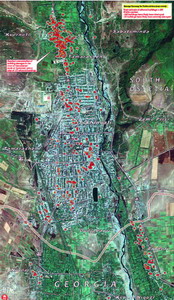
The postulate of “complete destruction” Tskhinvali served as one of the excuses of the Russian military intervention. But television channels stubbornly do not show the new Stalingrad from a bird's eye view, there is no military air photography or satellite images. But Unosat1 publishes the data of the space shooting of Tskhinvali and its environs. The pictures were taken on August 19, 2008 by the American WorldView 1 satellite with a resolution of 50 cm and the Taiwanese device Formosat-2 (2 m resolution). 2 It is noticeable that the greatest destruction is in Georgian villages: Tamarashen, for example, seems to be completely destroyed. But in Tskhinvali, the destruction is clearly less. This can be explained by the fact that in the villages where Georgian positions were, they were lugging sweepingly, the rest was completed by the looters. But it is still surprising that there are fewer destruction in Tskhinvali: it turns out that only low -rise buildings have suffered, and the high -rise buildings survived?! It doesn’t happen in the war. In addition, UNOSAT has Tskhinvali and Tamarashen’s topographic maps imposed on a space picture contradict common sense - roads there pass right through the buildings! This point of view was expressed by experts of the largest Russian media in the field of high technology 3 .
Which, however, does not remove the main question: where is the Russian shooting of the conflict zone - at least from the cosmos?
Film by mail
The cardinal difference between the Russian army and the Georgian is not in the concept of construction, the quantity and quality of soldiers and weapons: Russia has space troops, Georgia does not. Sources in the military department argue that the situation in the Caucasus did not remain without close satellite control and its aggravation allegedly even forced several reconnaissance satellites to the region. It is possible that it was “under Georgia” on July 26, 2008 that the latest spectus of the person’s optical intelligence was launched.
The real state of the domestic “spy” space is deplorable that General Vladimir Popovkin recognized the then commander of the space forces three years ago: “The most difficult situation is taking shape on reconnaissance satellites.” Experts believe that domestic spacecraft is lagging behind American and European to two or three generations 4 . Their problem is low resource and reliability: Russian intelligence satellites do not live in orbit for long. On -board equipment is also far from the requirements presented by the modern war. Satellites of optical reconnaissance (optical-electron, photo intelligence)-our pain point: these are the development of the 70-80s. For example, a satellite of the broadband and detailed photo exploration “Don” (aka “Orlets-1”, product 17F12) was created 20 years ago. All its advantages negate “small” disadvantages, one of them is the brevity of stay in orbit: 120 days 5 . Our military cannot keep in space at once in space.
But more significant is different: the device is equipped with a film camera and a drum for eight lowered capsules with a film. The desired object must be filmed, then drop off the capsule, which will land near Orenburg, they will find it, send it to the manifestation, then the seal of the pictures and their analysis-processing-truly last century! Another scout, “cobalt-m” is almost similar: was developed in the late 70s, the period of active existence is 4 months, the optics is supposedly capable of fixing objects up to 40 cm in size. But its camera is also film, and the film is delivered to the ground in the discharge capsules or the launched apparatus. Further - the same cycle, so the shooting will fall to the analysts of the GRU General Staff at best in a month.
There was also Neman, capable of converting photography into a digital signal transmitted to the ground, but the quality of its pictures was low, this is the level of the 1982 Soviet electronic industry. At the beginning of the Chechen campaign, the Neman was reoriented to the Caucasus, but it could be at Chechnya no more than 20 minutes a day, the last “Neman” was brought from orbit in May 2001. Since then, a crisis has been reigned in the field of optical intelligence, although from June 15, 2006, the military, apparently, could use the materials of the “commercial” apparatus of resourcedk. But the spatial resolution of the latter is 1 meter: you can see only at home and motionless unmarled tanks. We will not talk about other companions of this class: the day before yesterday. Only on July 26, 2008, spacecraft brought into orbit the latest spectator of optical intelligence “Person” (“Cosmos-2441”), but the data on its capabilities are classified.
Eye like an eagle
About a year ago, General Anatoly Perminov, the head of the Federal Space Agency (Roscosmos) and the Excrender of Cosmic Troops, boasted: modern Russian spacecraft have a resolution of about 1.5 meters, and “with this resolution we can distinguish, for example, a machine, determine where it is moving, maybe what kind of brand it is” 6 . But such a resolution will allow at best only to distinguish the tank from the car! To determine its type, the resolution needs to be an order of magnitude higher-15–20 cm, for domestic satellites such a quality is not yet achievable (the American satellite KH-13 allows you to get pictures with a resolution of 4 cm, but each such device costs over $ 1 billion). Along the way, the brave general also said that soon from the cosmos “it will be possible to distinguish between the numbers of cars”, but this is not yet on the shoulder with a resolution of 10-15 cm! Well, at least the general did not promise from the satellites to look at the straps on the uniform, otherwise it would have to be introduced by two -meter epaulets ...
Should it be surprised that the presence of the space component did not affect the quality of the actions of the Russian troops? The 58th Army fought without cosmic intelligence data on the Gruopo state as part of the Russian orbital group-101 spacecraft, of which about 60% were military purposes. The US orbital group has about 500 satellites. 6 Interfax, November 9, 2007. 7 "Russian Newspaper", May 21, 2008. The Zin Army, without satellite guidance of ultra -precision ammunition and almost blindly - without GLONASS. Although two months before the war, the commander of the troops of the North Caucasus District (SKVO) said that “we also get a new navigation equipment that allows you to determine the coordinates using the GLONASS space navigation system” 7. Yes, if the devices would not help: the GLONASS orbital group consists only of 16 satellites instead of the promised 18. And of them, only 12, which are barely able to cover 50% of the territory of Russia.
The “cosmic” diagnosis was made in the fall of last year, when the then First Deputy Prime Minister Sergei Ivanov admitted: the Russian space industry has exhausted the scientific and technical resource and “lost the ability to develop and manufacture most devices and units” 8 .
In the photo: Destruction scheme in the Tskhinvali area, presented by Unosat
As of August 1, 2008, the Russian orbital group was 101 spacecraft, of which about 60% were military purposes. The US orbital group has about 500 satellites.
_______________
1 Un Institute for Training and Research Operational Satellite Applications Programme: UN program to ensure the access of the international community to space pictures.
2 Resolution - the ability of the lens, film or digital image to separately reproduce small details of the object.
3 Portal R&D.CNews, August 25, 2008.
4 "Independent Gazeta", November 21, 2006.
5 American intelligence satellites of a similar purpose of the KH series can be in space for 5-7 years.