
Translated material
Gopniks go
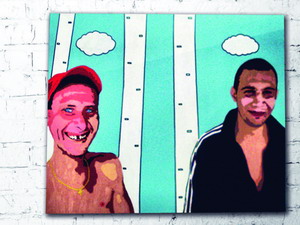
In Moscow, an exhibition was held with the speaking name "Boys", represented by a new movement of young Russian artists GOP-Art. The purpose of the movement is to explore the gopot from the point of view of contemporary art, and modern art to show the eyes of the gopota.
Real boys
Each of us is familiar with gopniks since childhood. Street Shpan, closely connected with the criminal world, borrowed from the last concept of the zone. The “real boys” are distinguished by a unique manner of dressing: their style is built on a combination of sports pants and classic shoes, supplemented with leather accessories - caps, jackets, barriers, and before, for example, a mocher cap. Gopnik is always “responsible for the bazaar”, he is absolutely devoid of pathos and arrogance. Modern highly intellectual theories and concepts are alien to him, his views on the world are deprived of abstruse stamps inherent in intelligentsia and “botanists”. “Real kid” is the personification of common sense and simplicity. “Once at night I heard one after another up to 15 whistles: gopniks, trying to rob, were beaten in the square in front of the Cathedral of a passerby” - this entry from the diary of Pavel Filonov for almost 70 years. Everyone knew about gopniks, but not a single dictionary of the Russian language until the beginning of the 21st century was determined by the word “gopnik”. Its etymology still causes controversy. According to one of the popular versions, the first gopniks appeared in the 20s of the last century in St. Petersburg, where city dormitories of the proletariat (GOP) were opened. From all over the city, street children and local punks, hunting street thefts and small robbery, were led out of all over the city. They were called gopniks.
While philologists were looking for gopniks a place in dictionaries, the Internet made an object of a real cult from them. Runet was full of photographs of "real boys" who "bottle on the hairdryer and are responsible for the bazaar." Over time, entire communities dedicated to gopota appeared on the blogs. In the era of high technology, it became clear: gopniks in Russia, like bad roads and fools, a massive and widespread phenomenon.
Gardener and gardener
However, no one could have a huge mass of people representing modern gopot. Even contemporary art, which, it would seem, is not alien to any topics, bypassed the gopot.
The outcasts and ridiculed, gopniks came to contemporary art themselves. Their guide was the St. Petersburg curator and artist Kirill Shamanov, the creator of the GOP-Art movement, which presented as part of the Biennale of the young art “Stop! Who is coming? " Exhibition "Boys".
“GOP-Art, as I understand it, raises the question not about the role of the intellectual in society or mass, but about the role of gopnik (common sense) among intellectuals,” says artist Anton Kalgaev, participant in the GOP-Art movement. “This is the experience of understanding the intellectual gopnik, it is the vegetable gardener's look at the gardener.”
The idea of creating a movement was born with Kirill Shamanov in 2006. According to the artist, he himself is a native of St. Petersburg gopnik. “The intellectual in Russia, like the intellectual, is thrown into the Ocean of the Niza,” says Kirill Shamanov. - As the dissidents comprehended folk concepts in prisons, today intellectuals and intellectuals comprehend the people through poverty and rejection. Intellectuals for the most part are close to the people, closer than power and business. ”
The young GOP-Art, of course, is far far from the legendary Pop-Art. Most of the participants in the movement are not even thirty years old. GOP-Art is only gaining momentum, but its activists are already sure: they are not only able to change their attitude towards gopniks, they can arouse interest in modern visual arts. Gopnik, according to young artists, is the best social ground for nurturing a new culture. “Enough philosophical suffering about the lost Russian original art! - says Shamanov. - Independent possibilities of formulating simple truths in the environment of urban slums are denied by snobberry intellectual intellectuals, although the example of the Wanderers, who rejected academic institutions and went to the people, as well as the acts of civilians, based on traction to the people and attention to their problems, are not so distant times. However, these are just steps towards, but not a dialogue. ”
At the exhibition "Boys" Shamans and the company are not going to stop. The next city after Moscow is Rostov. There, “GOP artists” are going to continue cultural research and reconcile with the help of GOP-Art Hurst, Warhol, Malevich, Rodchenko and Mayakovsky.
Narodicism is the other way around
GOP-Art activists resemble the movement of populs. The latter appeared during the years of the turning point of Alexander II, the "gopartists" were born and grew up in perestroika. The new circulation to the people, of course, is completely different, because the masses are perceived as a gopot, and the new populist itself, as it turns out, is part of this mass, the “indigenous St. Petersburg gopnik”, albeit graduating from the Philosophy. The new populists grew up among the people, their “walking” is a journey from “real boys” to the intelligentsia, and populism is the other way around. The generation of gopniks-inteligents is ready for dialogue. “But this dialogue can take place only in the event of the desire of society itself to look at himself through the eyes of the city slums,” adds Kirill Shamanov.
The main question is who needs all this. "Real boys"? It seems that they do not care about contemporary art. Maybe GoP-Art really needs a modern elite culture, capable of only highly intellectual reflection? Perhaps it is really time for intellectuals and intellectuals to look at themselves with the eyes of the gopnik, through the eyes of “common sense”? A handful of young artists will have to prove that for the Gopnik Hesse and Baudrillard have the same value as a new mobile phone and tinted “dozen”.
“The relationship, in which art and the viewer are now, are born, perhaps, the only sound thought - the need for negotiations and reconciliation,” says Anton Kalgaev. “Reconciliation is everywhere, and in the artist himself - first of all.” Between the intelligentsia and the Gopota, a recognized society and the despised society, young artists want to reconcile these two extremes, help them find a common language.
A new circulation to the people is primarily their journey into the depths of their own “I”, where the gopnik, philosopher and artist get along.