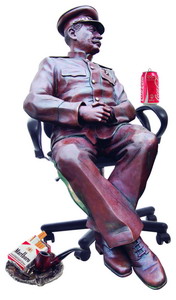
Schools are shining with a new "Brief course of history"
Revanschist historiography. A symbolic event that fits into today's Russian political context was scandalous information about a new history textbook in which Stalin's repressions are proposed to be considered as a rational action aimed at modernizing the country and strengthening the political system before the threat of World War II. The New Times sorted out the nuances of the new "Brief Course"
The note “On the concept of the history of Russia history of 1900–1945”, by the way, openly posted on the Internet (http://www.prosv.ru). The Enlightenment publishing it assures that this is only a draft option, and calls for "expanding the discussion." Meanwhile, the trends of at least the last year clearly demonstrate: while the liberals are trying to emotionally resist the rehabilitation of Stalinism, the “great helmsman” and his “managerial practice” de facto are already justified in the minds of a significant part of the elite and ordinary inhabitants.
Suslov never dreamed
One of the first reactions to the new “brief course” was his comparison with an attempt to rehabilitate the “Stalinist jerk”, undertaken in Brezhnev times. Indeed, the thaw of the 1960s ended, among other things, the return of the positive image of the “leader” to movie screens and school textbooks. However, the concept that is now proposed at that time resembles only externally and only at some points. In fact, we are talking about a much more gloomy and dangerous phenomenon than the Stalinism-Light recent years of the Soviet empire. After all, the events of the 30s of the last century are now placed in a fundamentally different value context. Soviet ideologists, at least in words to the last, remained supporters of progress, implying a movement towards freedom, justice and other basic humanistic values. Therefore, mass repressions were either simply hushed up as not fitting into the logic of the general picture of “the most progressive system in the world”, or were presented as something temporary, exceptional and overcome long before the onset of “developed socialism”.
Now all the conversations about humanism and progress, apparently, are considered a beautifully nonsense. According to the draft new concept, the only value and the main subject of history is the state (in Soviet historiography, which considered the highest value the freedom from exploitation, the “creator of history” was still the masses). The state is already perfect that it is “ours”, that is, Russian. The task of the author of the textbook and the one who should teach him is to prove that the Russian state has always been the right in everything. Since it is very difficult to prove this, relying on facts and based on the norms of ordinary human morality, it is necessary to ignore either facts or moral attitudes. And if the Soviet Hanki was silent about the facts, then the cynics of the era of “sovereign democracy” offer “rationalize” morality. In fact, value relativism is proposed as the method-the excretion of not only the significance of human life, but also of any values, except for “state necessity”.
And if, for example, Soviet propagandists violently denied Katyn, calling the accusations of the prisoners of Polish officers Goebbels propaganda, today's remarks not only recognize, but without blinking the murder of tens of thousands of people: “From Stalin, executions in Katyn were not just a matter of political expediency, but also the answer for the death of many (dozens) thousands of Red Army soldiers in Polish captivity after the 1920 war. ” So with cynical simplicity behind the Russian state, the right to blood revenge is recognized. Under Suslov, for this, it seems, they were sent to agriculture.
Lost discourse
Examples of value relativism in the document are found at every step. What is only the phrase: “The figures of the victims from hunger should be brought here. According to updated data, they reached not 10 million in Ukraine, as Ukrainian historians write about this today, and not more than 1-2 million. ” So one million (in words) or two? Surely, after all, the authors know that, for example, two thousand dollars are twice as much as one! Can they visually imagine a “only one” million ... corpses?! And two million?! Speech, I emphasize, is not so much about the authenticity of “updated numbers” as about the monstrousness of the approach to the problem.
Alas, today the problem is no longer in separate “wrong” authors. With the connivance of the authorities, a whole ideological mainstream was created in the country. Revanchist historiography is the most appropriate definition. Today's followers of the Red Professors, who avoided lustration at the “anti -people Yeltsin regime”, are extremely gesture and rational. Freedom and democracy for them are dilapidated university audiences and a beggarly associate professor. Their views are determined by two serious injuries transferred by the Russian consciousness in the 20th century - the collapse of the Romanov empire and the collapse of the USSR. “Geopolitical tragedies” are explained not so much by internal causes associated with insufficient and disproportionate development of the country, but by external - war and espionage conspiracies. In international affairs, there is a teenage resentment at everyone who “does not love us”, “plays against us” and “uses us”. This constant external threat is justified by any crimes of the authorities within the country. This is the past. The future is also clear - the revival of the empire and the camp for the Fifth Column.
It seems useless to be indignant and complaining. “Fights for History” were lost by liberals a decade ago. While the reform forces in the 1990s were mainly occupied by transformations in the economy, humanitarian problems, and especially the creation of a new concept of the national past, seemed tenth. Even the condemnation of mass terror was not brought to the logical end - the trial of the CPSU ended in nothing, the communist regime was not recognized as criminal by analogy with the Nazi regime. The then power, by the way, was in Boldly hoped that, avoiding sudden movements in ideology, could achieve civil reconciliation. Anyway, why delve into history, all the same, nothing but executions and despotism, you will not find it - it is better to live in the present and think about the future. Until now, the design of Russia in some 2020 in the eyes of “investors in the production of meanings” looks more attractive than creating the concept of the history of the 20th century, adequate to the values of freedom and democracy, which does not very wound up the national feelings of the “soldiers of the empire”. They just did not take into account that the image of the future cannot be built without calculating to the end with the past.
Fragments of the note "On the Concept of the Course of the History of Russia 1900-1945."
“Thus, it is important to show that Stalin acted in a concrete -historical situation, acted (as a manager) quite rationally - as a guardian of the system, as a consistent supporter of the country's transformation into an industrial society, controlled from a single center, as the leader of the country, which in the very near future is threatened by a large war. “Big Terror” ceased immediately, as soon as Stalin became clear that the monolithic model of society was implemented. This happened by the summer of 1938.
But very soon, the “big terror” has already acquired a completely different quality and purpose. With the advent of the NKVD L.P. Beria, albeit not on the previous scale, but terror was put to the service of the tasks of industrial development: the planned arrests of engineers and specialists necessary to solve defense and other problems in the Far East, in Siberia, were provided for the service of the ordering of the NKVD. Terror turned into a pragmatic tool for solving national economic problems. Of course, there are no excuses and explanations for this. However, repressions performed the function of intimidation for those who worked negligently.
The textbook should certainly evaluate the scale of repression during the years of “big terror”. However, for this it should be clearly determined who we mean when speaking of the repressed. It seems that it would be right if the formula appeared here, in which only convicts to the death penalty and executed faces will be included. ”