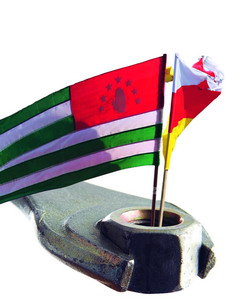
The recognition by Russia of the independence of South Ossetia and Abkhazia inevitably entails the question: what, in fact, to make further with these former unrecognized republics?
You can congratulate South Ossetia and Abkhazia on the acquisition of long -awaited independence. They could not achieve it either under Stalin, or with Khrushchev, or with Brezhnev. And they found - at Saakashvili and Medvedev - Putin. But while in Sukhumi and Tskhinvali they celebrate, dance and shoot in the air with joy, Moscow should be calculated what to do: do the former unrecognized republics with forever independent and recognized Russia, hamas, possibly Belarus and a couple of originals or, after some time, take into the ranks of the constituent entities of the Russian Federation?
Option a: Complete independence
For South Ossetia, it is impossible due to its size, 1 insurmountable economic failure (there is some kind of agriculture, trade and transit through the Rock Tunnel), finally, due to natural gravity to North Ossetia ... In short, Liechtenstein will definitely not come out of it.
For Abkhazia, official independence can purely theoretically result in something more. There, and now there are idealists (modest, silent) who believe that real independence could eventually bring real dividends-something like a free economic zone, attracting tourists and capital from far abroad, in general, something similar to the Bahamas.
Abkhazian and Ossetian independence will clearly not bring anything good to the North Caucasus. This creates a precedent. Chechnya is the first and most obvious. An interesting, long chain from questions is already being built: Kosovo is possible, but Abkhazia is impossible? Abkhazia is possible, but we can’t? In some Caucasian heads, these issues settled very firmly, even if these heads themselves every minute confirm their loyalty to Moscow. By the way, in cities and villages there are other (of course gangster) heads, the carriers of which continue to fight for independence.
The border is broken. So far, one is Georgian. But again, it turns out that if you can change one, then why it is impossible to change others. For example, between Chechnya and Ingushetia (controversial Malgobek district), between Ossetia and Ingushetia (Prigorodny district), problems of district borders in Dagestan, Kabardino-Balkaria, Karachay-Cherkessia. These borders are not state, internal, but, given the specifics of the Caucasus, they are a constant source of large and small explosions. For we repeat the question: why can one change the boundaries as this “one” dictates their understanding of a fair border, and others cannot?
Option B: Entry into the Russian Federation
Not everything is smooth here too. On the one hand, they have already entered de facto. Whose money is South Ossetia restored? With the money of the Russian taxpayer. Whose business has captured Abkhazia? Russian. The main values of Abkhazia are resorts, that is, land, sanatoriums, rest houses, beaches remaining from the time of the USSR - all this is controlled by different Russian interests (in army uniform, including). In other words, both territories joined the Russian Federation both economically and by handing them to citizens of Russian passports. That is, each individual Abkhaz and Ossetians (South) is already a kind of subject of the Russian Federation. But if they come at the same time and all together, what then?
The emergence of two new subjects will at least affect the situation in the North Caucasus. Will affect unpredictably.
For example, the “dispute” format for a suburban area between Ingush and Ossetians will change, because one side of the discussion will no longer be the Republic of North Ossetia, but “Big Ossetia”. At the same time, it is known that people from the south even among the Ossetians have always been known as very fighting guys. It is unlikely that this circumstance will be delighted in Nazran. (True, another option is possible: after the reunification of Ossetia, its territory increases so much that something can be conveyed to the Ingushs. But such a plan is unlikely to like Vladikavkaz.)
If the contradictions are aggravated, then the Ingush in their confrontation with Orthodox Ossetians can be in demand (and rendered) assistance from neighboring Muslim enclaves of Russia. Moreover, support will be both official and informal.
New subjects will clearly not be prosperous, but they will bring their own internal problems. Among which are interethnic and inter -plane contradictions. In the same Abkhazia, on a relatively small patch of land - Abkhazians, Russians, Armenians ... Today in the struggle for independence they are all one. But when there is no common enemy, smoldering disagreements will appear with renewed vigor. These problems are not yet talked about - inconvenient. But sooner or later they will speak. They will speak primarily in the Southern Federal District, where there are enough worries without beginners. And subsequently, the same Abkhazia will quickly learn the difference between the title of “fighter for freedom” and the subject of the federation with all the duties of the ensuing.
By the way, in the general situation in the region and Abkhazia, in particular, the prospect of the loss of the “Olympic dream” may affect: if the IOC refuses Russia in the right to hold the 2014 Winter Olympics (which is quite real), for the Southern Federal District, this will become a real tragedy.
What benefits will Russia get from the acquisition of two new national enclaves? With Southern Ossetia, more or less understandable: a full -fledged military base will be created here, standing guard of our southern borders against NATO. Already announced investments in $ 1 billion for the restoration of the destroyed Tskhinvali will require many other billions from the budget of the Russian Federation. As for Abkhazia, it will probably again become an “all -Union health resort”, unless, of course, inter -plane strife and the struggle for redistribution of property will not make this coast too hot even for Russian tourists.
However, there is an intermediate scenario, at least temporary: the entry of South Ossetia and Abkhazia into the Russian -Belarusian Union. But this is already on the verge of Shapito. It will have to be forgotten about raising gas prices for Belarus, but the world backstage will not be able to blame us for the annexation of these territories.
Option C: Back to Georgia
This scenario cannot be distinguished by the naked eye. And armed? Suppose Georgia will try, with the support of NATO troops, to regain the republic not recognized by her and NATO. This option is rather from the field of science fiction.
So far, the region has been fascinated by the military success of Russia. Her unprecedented adventurous determination. Do not knock the Kremlin with a fist, in the North Caucasus would be treated to him as a “wimp”. We must admit this. But the battles have already died out. A return to Caucasian everyday life begins. And now? However, these everyday life - in Ingushetia, Chechnya, Dagestan - did not stop during the Georgian war.
_______________
1 South Ossetia is many times smaller than the Moscow region, the population is from 70 to 100 thousand - there is no exact statistics, given that the Georgians have gone from there.