
Translated material
The wreckage of the progress cargo ship, together with space garbage, was flooded in the "cemetery" in the Pacific Ocean
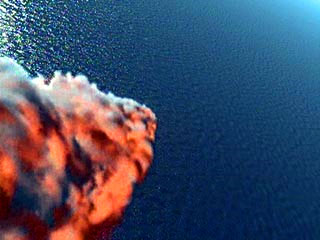
The Russian Progress Cargo ship, turned into the "Orbital Laboratory" for a week, today completed its flight to the "cemetery of spacecraft" in the Pacific Ocean. According to Valery Lyndin, the official representative of the flight management center (TsPU), "at 00:47 Moscow time, at the command of the on-board computer, the engines of the Progress M-64 cargo ship, which was in an autonomous flight for more than a week," ITAR-TASS reports. The engines worked out the impulse for braking, after which the ship began a gathering from the orbit and "at about 01:33 Moscow time" truck fragments with the remains of garbage from the ISS sank at a depth of 4 km in several thousand km east of the New Zealand city of Wellington. " “There is no shipping in the Pacific Ocean,” the expert emphasized.
Progress was plowed from the International Space Station on September 1 and took to a lower orbit. "During the autonomous flight of the ship, an experiment" Plasm -Transgress "was conducted in orbit, the purpose of which was to determine the spatial -temporary dependencies of the density of the plasma environment of the spacecraft, which arises during the operation of liquid missile engines on board," the Central Department Store recalled. Especially for a scientific experiment, according to the expert, a little fuel was left on the ship.
"The adopted practice of destroying space garbage with the help of" trucks "does not harm the ecology of the Earth," the Tsups say. When the atmosphere enters the dense layers of the atmosphere, the waste loaded in the “progress” burns along with the ship, only separate fragments reach the surface of the ocean. The place of "Progress M-64" at the Zarya functional and cargo unit on October 14 will be occupied by the Soyuz TMA-13 manned ship, which will deliver the crew of ISS-18 and the sixth space tourist to the station.
The Central Department Store reminded that the astronauts Sergei Volkov, Oleg Kononenko and Gregory Shamitoff, working in orbit, manually loaded on board the "truck" more than a ton of waste waste and waste equipment. A large -sized garbage, which does not go to the “progress” hatch, as well as the American spacesuits that have worked out the warranty period, take American shuttles to the ground, which resumed regular flights to the ISS.
Another pier of the Russian segment - at the Pierce transition compartment - occupies a “rescue boat” - the piloted “TMA -12”, where at the end of October Volkov and Kononenko will return to the ground, and at the third node - from the module “Zvezda”, from which the first European “truck” of the ATV - “Jules Verne” series, on September 13, was pulled up last Saturday. The next Russian "truck" - "Progress M -65" must moor. His start from the Baikonur cosmodrome is scheduled for today at 23:50. Recall that with the help of the engines of the European Space Truck, Jules Verne managed to dodge the ISS from space garbage.
Cosmic garbage
Note that the problem of space garbage has recently become more and more relevant , since many satellites simply do not live until the end of the service life, but are knocked down or damaged by objects flying in space. According to NASA, at the moment there are about 13,000 artificial objects in orbit. Most of them belong to Russia and the United States and are cosmic garbage.
The situation is so serious that the NASA and the European Space Agency (ECA) urgently form a special program for countering the cosmos clogging. Otherwise, it will simply be nowhere to be safely safe to place new satellites.
Cosmic garbage is the failed satellites, the upper steps and accelerated blocks of launch vehicles, discarded fuel tanks, fragments of destroyed cosmic objects.
The main danger to existing spacecraft is the speed of movement of garbage in orbit. A particle of one centimeter flies at least 20 times faster than a bullet. For a satellite, meeting her is the same as colliding with an average car at a speed of 80 km/h.
According to Eka, during the operation of American shutters, thousands of clashes with particles of 1 millimeter or less are registered. This led to the fact that the sheathing of ships was dotted with potholes to a centimeter depth. 80 times on the shuttle had to change the portholes.
Nowadays, the threat of accidents through the fault of cosmic garbage is high due to the "overpopulation" of some orbit. The desire to place satellites in the most “profitable areas” has led to the fact that today the capacity of the most convenient orbits is almost exhausted. The most acute position was in a stationary orbit, the height of which is 36,000 km.
With cramped in a stationary orbit, a so -called cascading effect is possible in which a collision chain leads to a multiple destruction of satellites and the formation of an even greater amount of cosmic garbage.