
Translated material
The Council of Europe has found the most depressed national minority in Russia
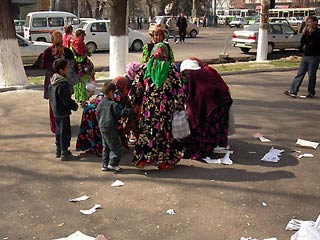
The most depressed national minority in Russia are gypsies. This conclusion was reached by members of the Commission of the Council of Europe to combat racism and intolerance. On Tuesday, they presented in Moscow their report on interethnic relations in our country, reports "News Time" .
"The gypsies, like Caucasians, are 20 times more likely to stop law enforcement officers than people of Slavic appearance, suspecting them of some kind of unlawful activity," said Michael Head vice-chairman, speaking at a round table.
- "The most oppressed" gypsies are still less likely to beat the Caucasians
- In Moscow, a wave of violence against foreigners was shot down, but a new
- Russia has improved laws, but so far it is not applied
The Russian human rights defenders who participated in the meeting, led by Ombudsman Vladimir Lukin, agreed with European colleagues. “Anti -Sigine sentiments are very strong in society,” Galina Kozhevnikova confirmed the deputy director of the Owl information and analytical center.
"The most oppressed" gypsies beat less often than Caucasians
Despite the conclusions of the European Commission, the victims of national ground crimes in Russia are most often not gypsies, but by people from Central Asia and Caucasians - Uzbeks, Kyrgyz, Tajiks and Azerbaijanis, representatives of the Moscow Human Rights Bureau (MBPC) believe.
Galina Kozhevnikova agreed with the conclusions of the MBPC, confirming that the main target of the skinheads, as in previous years, are immigrants from Central Asia. According to her, they make up more than a third of the total number of victims in cases where it was proved that the crime was committed on the basis of national hatred.
“As for statistics, since the beginning of the year there are already 72 killed and about 300 wounded,” the deputy director of the Center for the SOVA brought the data. At the same time, Kozhevnikova noted, statistics can be incomplete, since recently "racists have been masking their crimes for domestic offenses." Sometimes the beating of representatives of the "wrong" nationality is issued for the protection of girls from the "come" hooligans, the deputy head of the Center for "SOVA" added. Moreover, as you intensify the fight against xenophobia, this happens more and more often.
In Moscow, a wave of violence against foreigners was shot down, but a new
Thanks to the activities of law enforcement agencies in Moscow, "a wave of violence is almost halved" in comparison with 2007 data, which cannot be said, for example, about St. Petersburg. However, despite the observed significant improvement, the capital is still leading in the frequency of cases of attacking foreigners, in second place is the Moscow region.
“A new wave is clearly fixed, a new call, especially in Moscow, and precisely because many have already been arrested,” the human rights activist believes. “We think so, because after a rather long break, attacks that are carried out according to the absolutely open schemes described on the Internet.” As an example of one of these "developments", the deputy head of the Center, Owl, brought attacks on migrant workers in trains. "The racists did not kill and did not beat their victims much, but at the same time they defiantly" threw them away "from the wagons of electric trains at the nearest station, simultaneously explaining to the passengers that they were protecting the Russian people," Kozhevnikova explained.
In general, according to representatives of human rights organizations, several tens of thousands of "politically active" skinheads continue to operate in Russia, despite the fact that only a small percentage of these racist young people are activists of any radical-nationalist organizations.
Russia has improved laws, but so far it is not applied
Representatives of the Council of Europe acknowledge that Russia has achieved progress on the fight against xenophobia: the legislation on countering extremism and racism was improved, criminal cases are initiated against active participants in radical organizations in connection with the promotion of hatred. ” However, according to members of the commission, criminal legislation is not always applied to the proper extent.
“So far, Russian legislation is not used systematically as it should, in relation to skinheads and nationalist groups,” relying on the report of the European Commission for Combating Racism, Michael Head said. In his opinion, in Russia there is no thoughtful unified strategy for the fight against xenophobia and national discrimination, and this "causes the extreme concern of" the Council of Europe. The concern of European human rights activists also causes the conditions in which migrants from the CIS countries live and work. "There are problems with resolving the status of refugees and persons who do not have citizenship, as well as with discrimination in the field of education, social services and employment," the report says.