
Translated material
The death of parliament
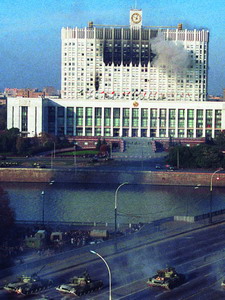
October 1993 forever entered the history of Russia with the phrase "The shooting of the White House." The drama, which began by Decree of President Yeltsin on September 21, 1993, ended with tanks that shot at the representative body of power. They shot and - shot.
What we have today in the building on Okhotnoye, called “State Duma of the Russian Federation”, is a direct consequence of this. “Parliament is not a place for discussions,” said Boris Gryzlov, the current leader of this meeting. Actually, he verbally repeated exactly what tanks made in 1993. The graves of one and a half hundred who died in those October days are the funeral crosses of Russian democracy. Her second fall, although, thank God, in 1996, when the victory over the “dark communist past in the name of the bright capitalist day after tomorrow” was purchased at the cost of containing a box out of a photocopy, completed the 93rd. And it is no coincidence that almost everyone who stood at the helm of young Russian democracy then, today or another, either are active supporters of authoritarian power, or silently extract their dividends from it.
You can argue about what to call the leaders of the parliament of the 93rd year-“legislators”, as says Ruslan Khasbulatov (p. 13), or “rebels”, as others say. Obviously, they are both. Legislators - when they refused to recognize the legitimacy of Decree No. 1400, which was confirmed by the decision of the Constitutional Court of the Russian Federation and what the then head of the presidential administration Sergey Filatov (p. 8) recognizes today, the rebels - when the Moscow City Hall in the Arbits was taken in their hands or fired at the television center in Ostankino. You can argue who was the first to shoot on October 3, from where a shot sounded - from the building of the television center or from the side of the distraught crowd, armed with machine guns and rifles. We can say that the Supreme Council of the RSFSR carried the USSR's tribal marks-by the way, Aristotle once answered: "Democracy means only that we will be controlled exactly as we ourselves are worth it." You can dispute the official data of the dead: Boris Yeltsin in an interview with Eldar Ryazanov in November 1993 (his text first publishes The New Times on page 22) calls the figure of 142 dead, Sergey Filatov says that the president called him on October 5 and said: “Write down - 164 or 165 people”, 1 officially published data - 158 dead, servants. that time: 700-800 people died. And these rumors are still, despite the fact that 15 years have passed, have not been dispelled. And after all, this is also symptomatic: as always, in Russia and in the Soviet Union-a couple of tens, a couple of hundred, a couple of thousands of dead, who believes, a big country, and the women of the new are born. The price of human life is the price is still much less than an oil pipe.
Finally, you can argue what goals Boris Yeltsin himself pursued, issuing that unfortunate decree: saved the country from the civil war or fought to strengthen his own personal power. And then there are many arguments both in favor of one hypothesis and in favor of another. By the way, John Locke claimed that the power that violates the laws adopted by it may be declared a rebel. However, history, as you know, does not tolerate subjunctive mood. There is a fact: after the restructuring of the word “parliament”, “supremacy of the law”, “legislative power”, “constitution” - all these words and concepts that were a parody, a fiction of their essence at least in the time of the USSR, suddenly entered into our lives as conscious, independent meanings. They became fashionable, they were repeated at the meetings of the Democrats and in lines, in clothing markets and on TV. The country was literally fascinated by these new meanings, unknown to it. Suddenly it turned out that neither personalities, nor leaders and Secretary Generals, but a law written on paper, provided with the whole power of the state and society, could become the main ruler of the life of a huge country. In Russia - it was so thought - the civilized rules of the game, the institution of the law, which will become a limiter of the authorities of the personalities - from the clerk in ZhEK to heads of the state, appear. It did not happen. It’s enough to look around - it did not happen! And the point is not that the “good president” replaced the “bad” that the democrat was changed to the Chekist, and now the Chekist to the lawyer. More precisely - not only in this. The fact is that the tanks hitting the building of the parliament, the burning White House became a symbol and visual - much more clearly? - Proof of the authorities of nothing stopped and by no means limited power. The forces standing over the law, the constitution, the court and the elected people, the people, the representatives. This symbol-good, the soil was fertilized for centuries-again fixed in the minds of the rulers-after all, then they won! - As well as in society, in us. So in Russia the very idea of parliamentary democracy was buried: is it by chance that Yeltsin was called the “king”, and Putin’s name is “master”? And how much we will pay on this account of October 1993 - unknown.
The New Times turned to the direct participants, witnesses of that October in order to recreate the picture of this tragedy in all of its polyphony and with all its contradictions. About this is the main theme of the number.
_______________
1 Interview with The New Times, 09.24.2008.