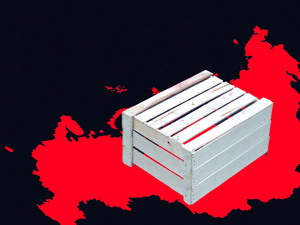
In September of this year, exactly a year was the order of the FSB of the Russian Federation on the rules of the border regime in the border zone. The FSB has more than 550 thousand square kilometers of the territory of Russia, which corresponds to the size of a separate state, say, such as France. The FSB now not only decides who can enter and move around this land, but also controls any economic activity on the territory actually alienated from the country's population
For example, I wanted to go on a trip to Taman to the Krasnodar Territory, where there are a lot of fruits and wine, or to the city of Lagan in the Caspian, where sturgeons, or to Ust-Khayryzovo, where the Kamchatka crab is found. What is needed for this? Previously, only money and free time were needed to fulfill desire. Now our people are so easy not to get into these areas. Now these are border zones. Federal and regional officials and local residents for passports can go there freely, everyone else needs to draw up a pass in the FSB border service. No strangers can enter the border zone without much permission. She is on our castle. Not so long ago, in an expanded to 30 km of the Hall Zone with Finland, forests burned on an area of 6 thousand hectares. Smoke and burning even reached Helsinki. It turned out that the Ministry of Emergency Situations was ready to extinguish fires, but the execution of permission for firefighters to enter the border zone was delayed. When the fighters with fire finally received passes, the forest was already burning out.
The history of the issue
In the 70s of the last century, huge areas were included in the border zone of the USSR: Primorsky Territory and Sevastopol, most of the Tuva and Kamchatka, the mountain-Badakhshansky region of Tajikistan and Norilsk, the Magadan region and Kronstadt. To access these and many other territories, citizens of the USSR had to receive a pass of the place of residence.
In 1990, the Council of Ministers of the USSR adopted a resolution on the abolition of border zones with many socialist states of Eastern Europe. And in 1993, a law on the state border was adopted, according to which the concept of “border zone” was canceled. Instead, the “border strip” was installed along the entire border of the Russian Federation, the width of which should not exceed five kilometers (for comparison: for example, in Finland the border strip cannot be more than 3 km). These border territories were in the joint jurisdiction of federal border structures and local authorities.
In 2004, the State Duma made amendments to this law. The mention of the five -kilometer limit disappeared from it and, in addition, it was the FSB that was endowed with the exceptional right to establish the border of the border zone without coordination with legislators and local authorities. And as a result, the border zone at least increased along the border up to 30 kilometers, and in many places, especially in the eastern and northern borders, the border regions included territories up to two hundred kilometers.
Comment by Tamara Georgievna Morshchakova, judges of the Constitutional Court of the Russian Federation in retired:
“The FSB determines the border zone arbitrarily, this allows the formulation of the law on the state border. This cannot be in the legal state, because the limits of the powers that are vested with one body, in this case, the government, to the body subordinate to it, in this case, the FSB should be determined by the law itself, especially in cases where it comes to restricting rights and freedoms. The current law in Article 16, where it establishes the opportunity to maneuver so freely with the space of borders in which the rules of the border regime apply, in the same article, in its part 2 writes that the establishment of any other rules (except for the restrictions on movement and economic activity) is not allowed and that any restriction of citizens in their rights and freedoms is acceptable only on the basis and in the order provided for by law. From this it follows that all the restrictions that are introduced for citizens due to the fact that the FSB freely determines the spatial limits of the border zone and, therefore, the effect of the border regime, are unacceptable. ”
Managed freedom
A pass in the border zone is issued within a month, or, if special circumstances arise, then two. Moreover, the documents must be submitted not as in Soviet times - at the place of residence, but to the border control at the location of the border zone. For example, the Moscow organization decided to send its employee on a business trip to Taimyr. This is a border zone, but there is no border control there, a pass to Taimyr, who is in the Krasnoyarsk Territory, is discharged for some reason in Novosibirsk. Where is Taimyr, where is Novosibirsk? If the thirsty to visit Taimyr turns out to be a journalist or documentary, then he needs to get another permission “for economic, commercial and other activities, conducting mass socio-political, cultural and other events, maintenance and grazing within the five-kilometer strip along the state border of the Russian Federation”. If the response from the FSB is positive, then the perpetitive paper will be written: “Conducting commercial activity: shooting a documentary.” On Chukotka, for example, the entire territory of which is a continuous border zone, do not require a pass in advance and do not write out permission for “commercial activity” for filming non -game cinema. In the Chukotsk Autonomous Okrug, it is enough to present a travel certificate. In short, each regional border administration interprets the order of the director of the FSB of the Russian Federation on border regime at its discretion. But the sentence must find out about the features of local interpretations in his hometown. However, in the fatherland, no one will tell him about this, you need to call where you are going or flying. And this is the difference in time, as with a plague or kamchatka, at 9 o’clock, money for endless telephone negotiations, and most importantly, there is no certainty that the permission to enter the entrance will ultimately be obtained.
The purpose of expanding the territories of border zones, as the Generals of the FSB explain, is to limit the entry of those whose presence in the border zone is inappropriate. “We are faced with the task not only to ensure national security, but also to create comfortable conditions for law -abiding citizens. Yes, indeed, being in the border zone, citizens, at the request of the border bodies, members of voluntary people's squads, are required to present a pass or passport, which indicates registration, but it is unlikely that this will create any inconvenience, ”said Alexander Lebedev at one of the press conferences in Petropavlovsk-Kamchatka General of the FSB.
Comment T.G. Morshchakova: “An increase in border zone is a matter of expediency, and issues of expediency regarding the restrictions of rights and freedoms should be controlled by the legislator. But what can the legislator control? In this situation, there are two judicial opportunities. The first: if the rights - both citizens of the Russian Federation and foreign citizens - are violated by the orders of the FSB, then this is an occasion to appeal to the Supreme Court. The second: if the rights are violated by the norms of the border, then this is the competence of the Constitutional Court. It is this uncertainty in the law, which allows arbitrarily changing the limits of the border regime and, therefore, arbitrarily introducing restrictions on rights and freedoms in fact not by federal law, as Article 55, part 3 of the Constitution of the Russian Federation requires, and simply by order of the FSB, is a violation of the Constitution of the Russian Federation, or if the legislator implied a different understanding of its prescriptions, a violation of the border law. ”
Visa mode
Checks of documents begin right on the plane to arrive at the settlement. For example, they will not let anyone out from the Chukotka Liner landing to the capital until they check whether the citizen has the right to be here, the same thing is waiting for everyone who will fly to Norilsk airport. But the city of Norilsk is not included in the border zone, then why do everyone without exception check their passports? It turns out that the cities of Norilsk and Dudinka enter the territory within the boundaries of Lake. Half - Kazantsevo - Messoyakha - Maduka - Oz. Dugkupun, which relate to the territories of the Russian Federation with a "regulated visit for foreign citizens." But not that a stranger - not every Russian will find on the geographical map of the country Messoyoi or Lake. Dugkun - in order to understand the area of the border where the entry is prohibited without a special order. Local authorities complained that "control over foreign citizens is difficult." Indeed, it is not so simple to identify strangers, at first glance you will not always understand where yours, where the border guards decided to check the passports from everyone.
In Norilsk, in addition to the all -Russian rule for foreigners, a local resolution is in force “On strengthening control over the entrance and stay of foreign citizens in the territory of Bolshoi Norilsk”. The main emphasis in this document is that only a spouse and one of the parents with citizenship of the Russian Federation can invite relatives and children on a private visit. Those “who invites brothers or sisters will receive the right to issue an invitation based on each specific situation”, that is, to the discretion of officials. In addition, if inviters do not provide the necessary meeting and registration, then they will be deprived of the right to call their family during the year. According to the employees of the Norilsk administration, this will “optimize the process of staying in foreign citizens.”
Comment T.G. Morshchakova: “This act is completely unsuitable, based on a simple requirement: restrictions not provided for by federal law are impossible. If the head of the city introduces restrictions not provided for by federal law, then such an act could cancel any territorial court of general jurisdiction. This is a flagrant violation of the law. ”
True, a foreigner can try to arrange a trip through the travel agency, but not through anyone, but only from the region where he wants to go. The permission will be issued to him for at least three months, and if the “good” is given, then the stranger will be able to enter the territory of, say, the same Chukotka, but he can only move around the Chukotsk Autonomous District, accompanied by a tourist agent, and the foreigner must pay from his pocket the trip of the accompanying person. The whole path of a foreigner must be agreed in advance with local border guards, and they should be notified of any movement, even if it is a trip to the neighboring village, otherwise - deportation.
Such lands actually closed to foreigners are in 19 constituent entities of the Russian Federation. In 1997, the entire Chukotka Autonomous Okrug was included in this list, and in 2006 the Republic of North Ossetia-Alania. For the non -citizens of our country, even part of the Moscow region is closed, for example, the Odintsovo district along the "Uspenskoye - Login - Odintsovo - Barvikha" line. 1
In addition, there is a "list of closed administrative-territorial entities and settlements located on their territory." It is forbidden to enter what citizens of Russia, what are foreigners. Such cities and villages throughout the country 90, starting from the Moscow region and ending with the Far East.
Tourism in Russian
In August, President Medvedev campaigned for stimulating domestic tourism. “Recently, a number of foreign routes have become popular, but we are interested in developing domestic tourism,” the head of state said. The importance of tourism was discussed on Chukotka, where Medvedev was last week. The increase in border zones and the development of tourism are clearly conflicting and in no way compatible. Among the latest innovations are the translation of famous tourist centers - Dombay, Elbrusier, Verkhnyaya Teberda and Arkhyz - to border zones. 2 To enter there, Russian citizens need to buy a tour at the agency, which is expensive. If you want to travel individually, then you need to write a statement to the local border control, certify the tourist’s route book with a clear indication of the entire route by dates, go to the capital of the subject for permission, and then, if the pass is received, you can go to the place of travel. But you need to not forget to register in the units of the FSB border departments of inflatable boats and equipment for scuba diving, if a tourist somewhere in the sea or in the lake wants to have fun in a underwater swimming. If there is no desire to engage in mountaineering or diving, but I want to visit the famous historical places, for example, the Pskov-Pechersky Holy Assumption Monastery of the 15th century in Pechora, or the world-famous Pskov-Pechersky monastery, or a museum with a monastery on the Solovetsky Islands, or Ivangorod with the famous medieval fortress, it is necessary to get a pass to the FSB. Now it is also border zones. As a result, tourists have already become much less here, and some tourist routes simply ceased to exist.
Comment T.G. “ Morshchakova: “ When the state does not explain the reasons, does not establish specific conditions for the use and distribution, in this case, the border regime to any territories and persons, it clearly departs from the requirement of respect for the dignity of the individual - this is such a constitutional principle that suggests that the state does not have the right to handle citizens as an object of its activity, but must consider them as full -fledged relations with the state and equal relations with the state, and This suggests, including that the state must explain its actions. ”
While Europe is united and the European Union citizens are quietly traveling from the country to the country, Russia persistently recreates the Soviet “iron curtain”, including for its citizens. But more recently, there was a hope that "freedom is better than not free."
Many places of the traditional recreation of residents of Primorye, Karelia and the Leningrad Region were found in closed for free access. Large cities, for example, Novotroitsk and ORSK Orenburg Region, as well as territories that are not at all adjacent to the state border, for example, the Terek coast of the White Sea or the island in the Yamal -Nenets Autonomous Okrug, became border. To date, border zones are established in 46 subjects of the country, among them: Ingushetia, Kalmykia, Yakutia, Chukotka, North Ossetia, Chechen Republic, Krasnodar Territory, Belgorod, Volgograd, Voronezh, Kamchatka, Leningrad, Omsk, Samara, Saratov, Chelyabinsk regions. (Orders of the FSB of the Russian Federation issued from April to June 2006 for each of the constituent entities of the Russian Federation.)
_______________
1 “List of territories of the Russian Federation with a regulated visit to foreign citizens”, approved by Decree of the Government of the Russian Federation of July 4, 1992 No. 470, the latest additions to the resolution were made in 2006.
2 Order of the FSB of the Russian Federation dated March 2, 2006 No. 77 “On the limits of the border zone in the Kabardinobalkar Republic”, an order of the FSB of the Russian Federation of March 2, 2006 No. 78 “On the limits of the border zone in the territory of the Karachavorkessian Republic”.