Events of October-1993 in the testimonies of participants and eyewitnesses
Start
September 21, 1993, Tuesday
20.00 - Boris Yeltsin signed Decree No. 1400 “On phased constitutional reform in Russia”. The congress and the Supreme Council must be dissolved, the elections to the new parliament are scheduled for December 12, 1993.
21.00 - About 2 thousand people with flags gathered at the White House, the first barricades are being built.
21.40 - an emergency meeting of the Constitutional Court: the Chairman of the Court Valery Zorkin announced that 9 in votes against 4 court recognized Decree No. 1400 to unconstitutional and giving the grounds for renouncing the president from office.
22.00-Vice-President Alexander Rutskoy declares to assume the powers of the acting President of Russia.
00.00 - in the building of the Supreme Council, government communications and telephones were disabled.
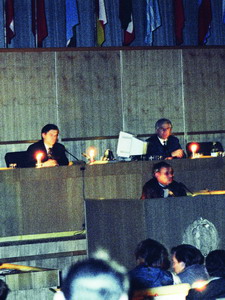
Ruslan Khasbulatov, Chairman of the Supreme Council of the RSFSR in 1991-1993
The Supreme Council was on vacation. As soon as they learned about the decree on September 21, even the supporters of Yeltsin began to fly away, because they were outraged by this decree, they said that this was a betrayal. I added the book "World Economy" in my office in the White House. It was already evening - 7-8 hours. Yuri Mikhailovich Voronin, the first deputy, jumps into the office, and says: "Ruslan Imranovich, Yeltsin carried out a revolution." I say: "Now I will add a conclusion, then we will take up the revolution." I did not have time to finish. I added in prison.
Immediately after the decree, I called Yeltsin, I took the phone Ilyushin. 1 I say: "Where is Boris Nikolaevich?" Ilyushin: "Talking with Grachev." I say: “I'm going to the Kremlin now. Let Grachev linger and delay. ” - "I will report now." He resorts: "Boris Nikolaevich leaves, he has urgent affairs, he will call you." I am typing again: "Yeltsin will call you." I call Chernomyrdin: "He left somewhere, he will call you." And after half an hour, all my channels turn off - all my 20-30 phones.
We immediately held a meeting of the Presidium of the Supreme Council, convened the Supreme Council. The documents were sent to the Constitutional Court. The Constitutional Court made a decision that the president’s actions are too heavy, and they may be the basis to refuse him from office. And at the Supreme Council we rejected Yeltsin from office, the president’s duties were assigned to the vice president of Rutsky. And since September 21, we stayed in the White House for two weeks. My wife came a couple of times, brought me clothes.
They blocked the White House after 4-5 days, began to turn off the light, sewage, water. After all, they were counting on their psychology, on the fact that we would all leave, scatter.
We did everything we could: the regions began to literally rebel against Yeltsin, began to demand normal negotiations, the abolition of a criminal decree. Siberian regions generally threatened: we will block pipelines, gas pipelines, railways. From the Yeltsin side there was an army, Ministry of Internal Affairs, KGB. And they sat very calmly behind the army, the Ministry of Internal Affairs and the KGB. And what can legislators? Even parliamentarians receive wages through the government. Why did Yeltsin go to this matter? They said to him: they were about to overthrow. And they went to accept the decree from fear. And they could not believe that Hasbulatov did not want any overthrow of Yeltsin.
Georgy Satarov, Member of the Presidential Council in 1993
The ability to solve everything peacefully was passed immediately after the referendum, when Khasbulatov and the Rutskoy supporting him in extremely indecent form tried to disavow the results of the referendum. It was said that some drug addicts and drunkards allegedly voted for Yeltsin. And then in May there were powerful opposition demonstrations, one of which ended in the murder of a policeman. In fact, at that time, Yeltsin already carried the draft decree No. 1400 with him. If he then, immediately after the referendum, took advantage of this situation, dissolve the Supreme Council and announced the elections, including the presidential, he would have won on all articles. Contrary to those myths who circulate about Boris Nikolayevich Yeltsin, he was a man prone to compromises. And this often turned him into a situation, which happened in 1993: he proposed a compromise in the form of a constitutional meeting, where he invited everyone, including the opposition. But his opponents did not suit the situation from the situation, because the transition to the new constitution was equivalent to the destruction of the congress, the Supreme Council, etc. The X Congress was being prepared, where Yeltsin had to be refined from office, weapons were brought to the parliamentary center. In August, Yeltsin found out about this, and there was nowhere to retreat.
Ivan Rybkin, in 1993 - Deputy Chairman of the CEC of the Communist Party, was in the White House on the side of the Supreme Council
As the head of one of the factions of the congress of people's deputies and the Supreme Council at the end of August, I turned to Boris Nikolaevich with a proposal to resort to a zero option: so that the president and parliament simultaneously resign. I wrote in my appeal that, most likely, he will be re -elected for a new term, and most of us. But this was not perceived. After the president signed the famous Decree No. 1400 and the next day the Presidium gathered, I turned to the Presidium. But the Presidium did not want to perceive this. Only then, at the not very legitimate X Congress, Oleg Rumyantsev and Viktor Aksyuchits made the same proposal, and the congress voted for it, but it was too late. People at the congress and at the chambers of the chambers elected me a member of the negotiation delegation to the Holy Danilov Monastery. But neither Rutskoy, nor Khasbulatov, nor Voronin took me there. Because they knew my position. I believed that first of all it was necessary to agree, you cannot bring to blood. But, unfortunately, I was in the minority.
Viktor Gerashchenko, Head of the Central Bank in 1992-1994 and 1998-2002
On September 21, they called me and said that there would be a meeting of the Council of Ministers in Old Square. I arrived there - this is the former building of the Central Committee of the CPSU. I’m walking towards the corridor and Stepashin 2 and Ryabov are talking very excitedly, 3 more and closes the repair. 4
I ask the repair: "Sasha, what is it?" He: “Yes, we went to Chernomyrdin and Filatov: Yeltsin issues a decree on the dispersal of the parliament. Well, they say that we cannot do anything .... " I go up to the fourth floor to the meeting room, where the Central Committee’s secretariat used to gather, there the people are already sitting at a long table. Chernomyrdin came running, 5 says: "Come on, let's see the TV." Everyone got into the back room where the assistants are sitting, doing tea, and on TV Yeltsin acts with his speech that I decided to go back and forth ... Like ... it seems to accelerate the parliament. There was the first deputy chairman of the Shayko government, probably was Shokhin, Boris Fedorov, who was the Minister of Finance, Grachev, then this policeman Erin, Nikolai Fedorov - the Ministry of Justice, well, in general, the composition of that council. Chernomyrdin says: "Well, what do you think?" Shoeyko replies: "That's right, we must finish this cavard for a long time." Well, this Grachev: “Of course, back and forth ...” Erin: “Yes, you need order.” Boris Fedorov: "Yes." It came to Nikolai Fedorov-the Ministry of Justice, he was still an active deputy, said: “And I am against it, I think this is wrong. I'm leaving the government. " Glazyev was not, he was on a business trip, he would probably also say “no”, because his father baptized Rutskoy. It is a matter of me, I think what to say, actually a mess, all of you are one gang, one team, how to disperse them? I say: "I would have done wrong." Chernomyrdin: "What do you mean?" “Well, I would not declare on Tuesday, but on Saturday, when there is no one in parliament, there will be confrontation, who needs it?” And Fedorov (Boris) is here: "No, tell me, are you for or against?" Chernomyrdin answers him: "He said that he would have done this, but not so, he was in." Well, they diverged ... The next, it seems, Yeltsin, surrounded by the guard, flew - strongly pressed, by helicopter, the Kremlin did not smash almost the towers ... They told me that there was an almost neutral bomb to abandon. So they told me, I do not answer for this - almost Grachev suggested. But they decided: it is impossible, the American embassy is near ...
A couple of days passed. And then they come to us (to the Central Bank) from the financial department of the Supreme Council, they say: we want to take money from the account ... They also had an account in the Central Bank, in the operational management. My people called me: what to do? I say: “What to do, their money? Their. When did they enter there? " They answer me: "On Monday (September 20, 1993), the Ministry of Finance transferred funds to the account." That is, as expected, he might not know that there would be such a decree. But the money is on the account, the money, well, disperse the parliament, but the deputy should still pay the money. Moreover, we have not received any indication in order to freeze the score. If so, I say, let them take the money-they took, however, more than usual ... And then we were accused that we supported someone there, they gave out money for counter-revolution-yes we simply performed our function.
_______________
1 from May 1992 to August 1996 - the first assistant to the president
2 Sergey Stepashin-in the 93rd-First Deputy Minister of Security.
3 Nikolai Ryabov - then Chairman of the Central Election Commission
4 Alexander Pochinok - at that time the chairman of the budget commission of the Supreme Council of the RSFSR.
5 at that time - the head of the Government of the Russian Federation.
Confrontation
September 23, Thursday
18.00 - Electricity was turned off in the White House.
19.30-In the building of the Constitutional Court, the NFC with the regions was disconnected, the Constitutional Court is deprived of private security.
22.00 - The X Extraordinary Extraordinary Congress of People's Deputies of the RSFSR was opened.
September 24, Friday
The White House is actually surrounded by a ring (7 trucks with the soldiers of the Dzerzhinsky division). The light is disconnected throughout the building.
September 30, Thursday
Patriarch Alexy II proposed himself as an intermediary between the warring parties. In the KS building, chaired by President Kalmykia Kirsan Ilyumzhinov, a meeting of the heads of the constituent entities of the Federation was held, the Council of constituent entities of the Federation was formed, which applied to terminate the blockade until 24.00, cancel decree No. 1400 and the legislative acts adopted by the Armed Forces.
October 1, Friday
10.00-Negotiations began in the Holy Danilov Monastery. At night, Protocol No. 1 was signed on the phased removal of the blockade and the seizure of an “abnormal” weapon. On the part of the Supreme Council, the protocol was signed by deputies of Abdulatipov and Sokolov, from the president - Luzhkov, Soskovets, Filatov. But the collection of the congress denounces the protocol No. 1.
The head of the Moscow Central Internal Affairs Directorate Vladimir Pankratov said that there are about 1,600 machine guns, more than 2000 pistols, 18 machine guns, 10 sniper rifles and 12 grenade launches plus illegally, about 300 machine guns, several grenade launches and a stinger missile. (After taking the White House, 163 machine guns, 5 manual machine guns, 2 sniper rifles, 1 grenade launcher, 420 pistols, 248 gas pistols, 12 minlocks, 1 explosive device, 23 units of other weapons themselves were discovered there; the defenders of the parliament building themselves stated that 74 machine guns and 5 manual machine guns were issued from the warehouse of the department of the Armed Forces.
The Public Opinion Foundation publishes the results of the survey: 50% of respondents support "overclocking by the president of parliament and the congress."
October 2, Saturday
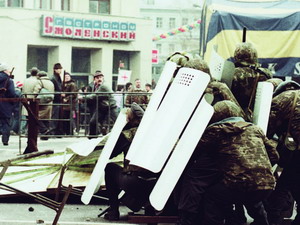
OMON disperses the demonstrators on Smolenskaya Square, there are wounded.
Negotiations in the Holy Danilov Monastery are a screen, it is nonsense. They did not want to negotiate with me, head of parliament. Therefore, all these negotiations are children's games. This is all for public opinion. It was necessary to negotiate with me. If Yeltsin said before the adoption of this decree or by phone: “I am making such a decision, I would say:“ Yes, do everything you want with this supreme advice, just don’t shoot. Here you have my paper on a resignation. ” These cowardly villains did not want to talk to me. And they shifted everything to the army and the police, persuaded them to shoot.
Victor Anpilov, leader of the Labor Russia movement
I was on the street all the time and did not participate in the negotiations of the top. Rutskoy said that there were some attempts to agree in the Holy Danilov Monastery, but they were unsuccessful. There was still the opportunity to agree on the street. I contacted the military, with the Dzerzhinsky division, with soldiers and officers. They all looked for a way out of this terrible impasse. The police could be agreed. The strongest impression is when on October 2, on my birthday, they tried to disconnect us on Smolenskaya Square. My “Labor Russia” was pressed to the Ministry of Foreign Affairs, and the front of national salvation was on the other side of the Garden Ring. Flafifor sites were erected on the spot as if to celebrate the 800th anniversary of Arbat. We used this site as a barricade, but a drunken Sverdlovsk riot police burst there and began to beat the inhabitants. And then I urged people to pick up the remnants of the installation, trimming, some iron corners and defend themselves, and not get strokes. Women seized our proletarian weapons and entered the battle. And we won there. It was an opportunity to turn the course of events with the help of the street. But no one came to our aid: no Supreme Council, nobody at all. They were all afraid of the streets.
Alexey Venediktov, in 1993 - the correspondent of the Radio "Echo of Moscow"
On October 2, the editor -in -chief of Echo of Moscow, Sergei Korzun, said: “Go to the rebels” (we called them the rebels). The White House was already surrounded. I was met by a man from the headquarters of Rutsky, translated through some rubble, and in some reverse I was in the White House. Rutskoy went around the defense units. I was among the people who walked next to Rutsky, and with them entered the White House. The protection of Rutsky knew me in the face. The White House was disconnected from telephone communications, there were no mobile then. And for the entire building there were three satellite phones (boxes weighing eight kilograms) - from foreign journalists. I asked my colleague a phone. He says: "Only two minutes, very expensive." I say to Rutsky: "Alexander Vladimirovich, do you want an interview with" Echo of Moscow "?" He asked: "How will you bear it?" I answer: "And we will go out on the air." He says: "Well, let's try." And that was the same story, the famous story when Rutskaya shouted: “Comrades, raise the planes, fly to bomb the Kremlin!” He said this on our air. It really was then regarded as a call to the rebellion from the radio station. After that, I still interviewed someone, wandered around the White House, from post to post. It was unpleasant: people who arrived from Transnistria looked with suspicion of my non -Aryan appearance. They were already very hot. But since either one of the guards of Rutsky, or one of the guards of the Supreme Council, constantly went with me, I was transferred from hand to hand.
There were a lot of people and weapons. 1 was scary. One could see the following picture: on the stairs lies a man completely insane, and a real automatic machine is lying next to him. As I understand it, there was no single command. Some volunteers from the regions came, there were even teenagers from Transnistria, girls about 15-16 years old, very aggressive. Volunteers stood on the outer circuit, and it was clear that they would be the first to fall under fire. The sensation of something physiologically unpleasant, dirty, common mess did not leave the feeling of something. Even in the reception of Rutskii people did not behave in a military way: they ate where they had to, the bottles of water and alcohol were lying, wrappers from sandwiches and hamburgers, which somehow delivered. There were drunk, bad smell - the sewage system was disabled. The detachments that stood on the outer circuit did not understand anything at all. Rumors were constantly circulating: “Now the Moscow garrison is suitable”, “Everyone is supporting us against Yeltsin” ... They shamaned each other so. They also had no connection. They, unlike the 91st year, did not even listen to the radio, only in the reception room at Rutsky and Khasbulatov. The military, those who commanded, were very tense, they all perfectly understood and knew that they had lost militaryly. I think that they had information that they were not supported by the garrisons, the Kantemirovsky division did not support them, as they expected, the pilots do not support. But they hoped for political negotiations in the Holy Danilov Monastery, thought they would win them. The leaders, the same Rutsky, who promised that the regions would rise, had no illusions on October 2. And Rutsky’s statement on the air is from hopelessness.
At some point, I realized that I had nothing more to do there. I left the 11th entrance, climbed over some kind of fences, and after me they shouted something about my non-Aryan origin. Under control, already from the Yeltsin forces, I was met by a friend from the administration of Filatov and says that the military want to talk to me. They tell me that they heard Rutsky’s calls on the air of “Echo of Moscow”. And then they ask if I have there, inside the White House, a friend. I answer that there is Ivan Petrovich Rybkin, the head of the Communist faction of the Supreme Council. They say: "Alexey, go and tell him that it would be better if they left until tomorrow." And I went back. I found Rybkin and told him: "Ivan Petrovich, the military, who, from the other side, say that you would need to leave." Rybkin told me: “You know, I will tell women to leave. I understood everything, but I won’t leave myself. ” And there were many women there - the entire apparatus of the Communist Party faction. He gathered several people and asked them to go out. These women and I came out together. Meanwhile, a detachment of rebels for capture was sent to the "echo", to Nikolskaya Street.
1 Руцкой позже заявлял, что в Белом доме было порядка 10 тыс. человек.
Blood
3 октября, воскресенье
14.50–15.14 — участники митинга на Октябрьской площади [10–15 тыс. чел.] двинулись к Крымскому мосту, захватывают машины внутренних войск и 4 БТР, преследуют бегущие неорганизованные группы милиционеров, сминают войсковые цепочки.
15.15–14.30 — начинается штурм заграждений возле Белого дома.
16.05 — с балкона Белого дома Руцкой отдает приказ о штурме мэрии и захвате «Останкино».
16.14 — столкновение возле мэрии и гостиницы «Мир», где разместился оперативный штаб МВД;
16.40 — захвачена мэрия,
17.00 — гостиница «Мир».
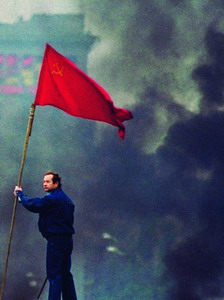
17.30 — вокруг телецентра в Останкино — люди с красными флагами, железными прутьями, «коктейлями Молотова», 3 БТР под красными флагами и группа автоматчиков.
Около 18.00 — Ельцин задним числом (с 16.00) вводит в Москве чрезвычайное положение, указом освобождает Руцкого от исполнения обязанностей вице-президента и увольняет с военной службы.
19.05–22.20 — вооруженные столкновения в «Останкино». Все телеканалы, кроме канала «Россия», прекращают вещание. Есть раненые и убитые.
Руслан Хасбулатов, председатель Верховного совета РСФСР в 1991–1993 годах
Провокаторы… Они все затевали. То взяли мэрию, то пошли в Останкино — это же все администрация, это все игра высшей исполнительной власти. Чем больше проходит времени, тем больше я убеждаюсь, что это провокаторы. Разве я отдал приказ окружить Ельцина танками и колючей проволокой? Это все детские сказки о том, что там были добровольцы, оружие. Никакого оружия прокурор не обнаружил. А куда делись эти добровольцы потом — я их не видел. Было большое количество москвичей.
Я и не хотел никакую армию вовлекать в эти дела. Это должен был обеспечить Руцкой, как исполняющий обязанности президента, министр обороны — генерал Ачалов, глава МВД, которых мы назначили. Мы же назначили в соответствии с Конституцией исполнительную власть. Они ничего не сделали фактически, мешали только работать. Я их собрал и говорю Руцкому: «Александр Владимирович, вы исполняющий обязанности президента?» He says, "Yes." Я говорю: «Тогда, пожалуйста, выезжайте отсюда, вы нам здесь мешаете. Ваша резиденция в Кремле, идите туда, в Кремль. Вы, генерал Ачалов — министр обороны, идите в Министерство обороны. Вы, Дунаев, идите в МВД. Что вы здесь у нас болтаетесь и мешаете только нам». Наши умельцы (в здании Верховного совета) иногда налаживали какую-то связь. Я помню, несколько раз разговаривал с Зорькиным и с некоторыми посольствами.
Если бы у нас была связь, мы бы не потерпели поражения. Информация у нас была, постоянно ходили люди, информировали меня. Если бы вот эти провокаторы не увели бы полмиллиона людей, которые были вокруг Белого дома, к «Останкино», мы бы, конечно, выстояли. Речь шла буквально об одном-двух днях.
Snow
4 октября, понедельник
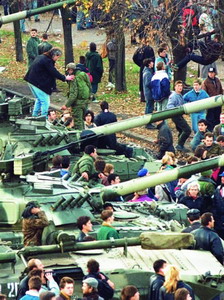
9.00 — по зданию с Новоарбатского моста и с набережной Тараса Шевченко открывают огонь танки Таманской дивизии.
14.30 — возле Белого дома появляются группа «Альфа» и спецподразделение «Вымпел», цокольный этаж уже занят десантниками.
16.30 — «организованный выход» сложивших оружие мятежников
17.00 — войска и спецподразделения вошли в Дом Советов, при штурме погибли 20 военнослужащих и милиционеров.
18.00 — группа «Альфа» арестовывает Руцкого, Хасбулатова и Макашова.
19.30 — арест Ачалова, Баранникова и Дунаева, все арестованные отправлены в Лефортово.
Я был в Японии. Мне звонят из Москвы — в Москве была поздняя ночь с субботы на воскресенье, то есть 3 октября. Звонит мой заместитель Войлуков 1 и говорит: «Виктор Владимирович, на фабрику Гознак (в районе метро «Серпуховская» в Москве) приехал первый замминистра финансов Вавилов Андрей, в кедах, в спортивной форме, но с каким-то генерал-полковником, на «Жигулях», и требует выдать деньги. Ему говорят, что Гознак подчиняется Минфину. Так что мы не можем вам выдать. Вавилов вышел на меня и требует». What to do here? Я говорю своему заму: «Арнольд Васильевич, предположим, вы ему сейчас откажете, ну завтра он привезет расписку, что вот мы просим выдать Минфину внутримесячные кредиты, которые в конце месяца погасят». Так, кстати, было и потом, перед референдумом. Короче, я говорю Войлукову: «Пиши расписку, что в конце месяца погасите…» Выпустили чек Минфина, и Вавилов с этим генерал-полковником взяли деньги — сколько, не помню. Да, конечно, брали наличными, положили в жигуленок — там суммы были не такие огромные, Вавилов получал, генерал его сопровождал. Как я понимаю, за эти деньги и стреляли командиры танков.
Георгий Сатаров, в 1993 году — член Президентского совета
3 октября где-то в 9 вечера я приехал в Кремль. Паники не ощущалось. Работали, готовили президентское обращение. Потом наступила такая пассивная фаза, когда просто наблюдали за происходящим. Больше всего врезалось в память то, что можно было на простой волге въехать в Кремль практически свободно.
Никита Масленников, в 1993 году — советник премьер-министра Черномырдина
Решение о штурме Белого дома принималось ночью, в здании Минобороны на Новом Арбате. До сих пор мне непонятно, был ли этот приказ написан на бумаге. Оттуда все вернулись какие-то дерганые. Хотя премьер-министр был трезв абсолютно и четко рулил своими замами. И Гайдар все время был на связи. У меня было такое ощущение, что ход самой операции был не совсем управляем. В ту ночь я находился на Старой площади. Мы занимались информированием премьера о том, что происходит, давали текущую информацию, еще координировали действия с МЧС, потому что много было всяких разных слухов. Например, приходили сообщения о том, что якобы сейчас начнется митинг на Пушкинской площади и туда выдвигаются около 2 тыс. боевиков. Мы все это оперативно проверяли. Слава богу, не подтвердилось. Также мы готовили разные документы, потому что было понятно, что политическое руководство должно будет рано или поздно выйти в эфир и объяснить всем, что же происходит. It was sick. Вот вляпались, говорили сотрудники, и как теперь из этого всего выходить? Один мой коллега сказал мне: «Черт побери, через многие годы стыдно же будет». Ночь была бессонная. Спали кто как мог. Один из помощников Черномырдина 1,5 часа спал на большом Трудовом кодексе еще времен Советского Союза. Очень удобная книжка оказалась. Некоторых ребят просто укладывали в кабинете и запирали его на ключ, чтоб они никуда не выходили из комнаты отдыха и могли отдохнуть.
Егор Гайдар, в сентябре 1993 года стал первым заместителем председателя Совета министров — Правительства РФ
Ни одного депутата не убили и не ранили (во время штурма Белого дома). Стреляли по этажам, где точно было известно, что людей там нет. Выпустили 12 снарядов. Это решение принималось в ночь с 3-го на 4-е, когда стало абсолютно очевидно, что, если военные не начнут действовать, мы сами раздавим тех, кто начал беспорядки. Атмосфера была напряженной. Предлагался и второй вариант: мы просто раздадим своим сторонникам автоматы. За Ельцина на то время было 85% человек, а против — всего 15%. Так что мы могли бы проиграть, только если бы были абсолютно беспомощны. Просто при втором варианте было бы гораздо больше крови. Когда военные поняли, что в случае чего мы просто возьмемся за оружие, тогда они и начали действовать. Это было примерно в 2 часа ночи.
Я понял, что мы проиграли, как только пролилась первая кровь. Я сразу понял, что это грандиозная провокация, и двухнедельное наше стояние окончилось ничем. Для меня уже не было ничего удивительного. Когда я был в тюрьме, все время настаивали на цифре 156 погибших. Спустя год отставные генералы мне говорили, что в те дни в Москве погибли более полутора тысяч человек, отлавливали людей. Они бы начали стрелять раньше, если бы армия и МВД согласились. Но они сделали эту провокацию у «Останкино», втянули, а потом расстреляли Белый дом. До «Останкино» я был уверен, что мы их переиграем. Главное, чтобы люди не уходили от здания, главное не сбиться, чтобы никто не стрелял. Я очень следил за этим. И люди контролировали. Но когда толпы пошли на машинах в Останкино, когда там начались эти сражения, я понял, что это полный проигрыш.
Анатолий Ермолин, командир резерва спецназа «Вымпел» во время штурма Белого дома
Ельцин вызвал в Кремль начальника «Вымпела » генерала Герасимова, чтобы приказать ему штурм. Президент так выпучивал глаза, произнося слово «штурм», что Герасимов понимал: от него ждут крови, от него ждут, что «Вымпел» в мелкий винегрет покрошит всех защитников Белого дома, которых Ельцин считал мятежниками. — Товарищ президент, сил маловато, — пытался генерал увильнуть от палаческой миссии. Но президент не слушал. Он помавал в воздухе руками и выкрикивал слова: «авиация», «артиллерия», «кольцевой охват»... Герасимов подумал, что если «Вымпел» не будет штурмовать Белый дом, то вызовут десантников, и вот они-то уж точно покрошат всех депутатов Верховного совета в мелкий винегрет. «Вымпел» был поднят по тревоге, и когда бойцы построились в полном боевом снаряжении, генерал Герасимов сказал: «Мужики, есть приказ штурмовать Белый дом. Приказ этот я могу выполнять только добровольцами. Добровольцы, два шага вперед». Никто из офицеров не тронулся с места. «Мужики, кроме нас и «Альфы», никто не может взять Белый дом без крови».
Примерно две трети офицеров сделали два шага вперед. В самом штурме я не участвовал, но рассказов товарищей оказалось достаточно, чтобы считать эту операцию верхом спецназовской виртуозности, а реакцию президента — верхом чиновной неблагодарности.
Они ворвались в вестибюль Белого дома, и депутат Валерий Шуйков крикнул своим разбегавшимся в панике сторонникам: «Не бойтесь, это «Вымпел», крови не будет! » Многих офицеров «Вымпела» Шуйков знал лично: они охраняли его во время поездок в Ингушетию. Они брали этаж за этажом. Один из офицеров распахнул дверь какого-то депутатского кабинета и увидел, что прямо ему в лицо направлен пистолетный ствол. Депутат — хозяин кабинета — то наводил пистолет на спецназовца, то подносил пистолет себе к виску и все не мог решиться на выстрел.
«Мужик, — сказал офицер депутату. — У тебя дети есть? Сдавай мне пистолет по описи и иди к детям».
А полковник Проценко, легендарный полковник Проценко, штурмовавший еще дворец Амина, подошел к дверям в кабинет вице-президента Александра Руцкого и сказал солдатам, охранявшим эти двери: «Я полковник Проценко. Мне надо поговорить с вице-президентом».
И его без слов пропустили. Генерал Руцкой знал полковника Проценко еще по Афганистану. Когда Проценко вошел, генерал сидел за столом, мрачно повесив голову.
«Здорово, полковник!»
— «Здравия желаю, товарищ генерал! У меня приказ арестовать вас. Вы ж понимаете…»
«Понимаю, — Руцкой кивнул. — Ну, давай покурим. Что у тебя?»
— «Прима», — Проценко улыбнулся, доставая из кармана скомканную пачку дешевых сигарет без фильтра.
«Вот мать их! — хмыкнул вице-президент.
— Лучший в мире спецназ курит «Приму». Угощайся». Вице-президент протянул полковнику пачку красного «Мальборо». Они покурили молча, как два старых боевых товарища. И полковник Проценко повел арестованного Руцкого к автобусам, куда собирали и других арестованных депутатов мятежного парламента. Эти автобусы доехали до станции метро «Краснопресненская».
The doors opened. Люди из автобусов вышли, стали к глухой стене метро и приготовились к расстрелу. Кто-то молился, кто-то плакал, кто-то смотрел безучастно на офицеров спецназа, стоявших рядом.
«Чего вы стоите! — крикнул кто-то из офицеров. — Идите в метро! Home! Home!" На следующий день помощник президента доложил Ельцину, что отряд спецназа «Вымпел» отказался от выполнения приказа верховного главнокомандующего, что в штурме участвовали только добровольцы, что не стреляли, что арестованных отпустили. Указом президента отряд «Вымпел» был передан Министерству внутренних дел, переименован в «Вегу» и предназначался теперь для разгона демонстраций. Из девяноста офицеров «Вымпела» восемьдесят тогда уволились. (Из новой книги Валерия Панюшкина «12 несогласных».)
Николай Троицкий, журналист, в 1993 году парламентский корреспондент газеты «Мегаполис-экспресс»
4 октября я находился внутри Белого дома, сидел в пресс-центре. Ждали рассвета. В три часа ночи отозвали корреспондентов РИА «Новости». Им позвонило начальство и сказало: «Уходите». Ну утром-то все и началось.
Мы были на 6-м этаже Белого дома со стороны площади Свободной России — в помещении пресс-центра. Накануне уже дали электричество. В 7 утра я выглянул в окно и увидел вооруженных людей, которые без предупреждения начали стрельбу. Я обратил внимание на то, что они были не совсем по форме одеты: в каких-то джинсах, странных ботинках. Стреляли по тем, кто стрелял из окон. Чуть подальше от меня в другом окне сидел один какой-то товарищ, вот по нему ударили, и не один раз. Из танков стреляли по верхним этажам, но там никого не было — в целях устрашения. И так где-то в течение 2 часов. Потом вдруг понял: лучше уйти внутрь. Прямо передо мной что-то упало с зажигательной смесью. И еще оно летело с такой хитрой траекторией: влетело в одно окно, потом отрикошетило о стену и прямо почти к моим ногам. Стало слишком опасно. Военные нам объяснили, как надо по стенке идти (я потом еще долго дома к окну по стенке подходил). Мы, журналисты, и все другие люди перебежками направились к центру, в залы без окон: в это время простреливались уже все окна. В тех залах сидело много простых сотрудников Белого дома: бухгалтеров, из отдела кадров, секретарей, помощников депутатов. Хотя некоторые депутаты там тоже сидели и прятались. Некоторые люди пробегали с автоматами. Например, Илья Константинов (в 1993 году был сопредседателем Фронта национального спасения. — The New Times) бегал с автоматом. Он, конечно, стрелять не умел. Еще генерал Макашов был весь прямо такой воинственный, как будто он на передовой. Он будто впервые почувствовал себя на войне. Мимо меня постоянно проносили людей на носилках, больше десятка. Стрельба продолжалась с 7 утра и где-то до 5-6 вечера. Без перерыва. Потом наконец зашла группа «Альфа» и начала нас всех выводить. «Альфовцы» шли вокруг нас, чтобы в нас не стреляли. Они нас собой прикрывали. Там ведь был бардак, полная несогласованность действий: одним отдавали приказ идти и выводить нас из здания, другие продолжали стрелять. Кого-то отвели в милицейский участок, но у нас, журналистов, проблем не было, мы просто удостоверения показали, и нас отпустили.
Иван Рыбкин, в 1993 году был заместителем председателя ЦИК КПРФ, находился в Белом доме на стороне Верховного совета
В те утренние часы 4 октября я стоял у окна с видом на Краснопресненскую набережную. Вдруг по окнам стали полосовать крупнокалиберные пулеметы. Полетели брызги от стекол, и от них ничего не осталось. А потом из этих же крупнокалиберных пулеметов стали поливать площадь слева и справа. Я видел, как десятки людей гибли на моих глазах. У меня было ощущение, что это мы людей втащили в эту ситуацию. Мы — люди властные — в президентских структурах, в структурах правительства, в структурах Верховного совета. И уходить оттуда (из Белого дома) честь не позволяла, надо было остаться. Там был просто ад кромешный. Одни потом говорили, что 1500 человек погибли, другие — что 150. Да хоть 150, хоть 1500, все равно это страшное дело. И когда меня спрашивают, кто же в этом виноват, я вспоминаю слова Талейрана, который говорил: «В революции никто не виноват. Виноваты все».
Когда много позже я был избран председателем Государственной думы, мы встретились с Борисом Николаевичем. Я тогда остро ощутил, что он страшно переживал две трагедии: ситуацию с Белым домом и чеченскую войну. Мы тогда с ним договорились, что все сделаем для того, чтобы больше этого не допустить, что будем открыты и честны друг с другом. Договорились, что никогда не сделаем ничего такого, чтобы подвести друг друга. Мы этому следовали до последнего его часа. Не приведи господи пережить это снова. Я вот смотрю сейчас на нынешних ребят в президентских и правительственных структурах, они не пережили того, что пережили мы с Борисом Николаевичем и его командой. Они не имеют той кровавой прививки, они лезут на рожон везде: и во внешней политике, и во внутренней. Я молю Господа Бога, чтобы не рвануло, потому что они ходят по краю...
По официальным данным, с 21 сентября по 5 октября 1993 года погибли 130 гражданских и 28 военнослужащих и сотрудников милиции, ранены — 321 гражданский и 102 военнослужащих, сотрудников милиции и органов госбезопасности.
1 Арнольд Войлуков — в то время первый зампред Центрального банка.