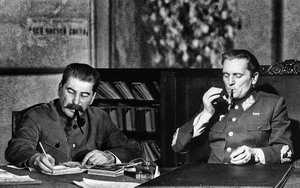
Sixty years ago, a long conflict lasted a decade between two socialist states - the USSR and Yugoslavia - and two once “fraternal” communist parties
Ordinary Soviet people were struck by thunder published in Pravda on June 29, 1948 “Kommunik on a meeting of the information bureau of communist and workers' parties” (Cominform). It contained a sharp criticism of the leadership of the Communist Party of Yugoslavia 1 . More recently, the partisan leader, Secretary General of the KPU Central Committee, the head of the government of Yugoslav, Josip Broz Tito and his associates were for the Soviet leadership and personally for Stalin by faithful and close allies, “Slavic brothers” to combat fascism, comrades in the construction of a new society. And suddenly, the “departure from the Marxism-Leninism”, “counter-revolutionary Trotskyism”, “nationalism”, “sectarian-bureaucratic” party, “compromising the banner of socialist construction in Yugoslavia”. And a year and a half later, in November 1949, the new resolution of the Cominform: "KPU is in the power of killers and spies." The accusations of Trotskyism were replaced by a charges of fascism. The leadership of the KPU was called the "Spy Group", "Fascist-Gestapovsky click." Criticism from the region, although absurd, but still political and ideological controversy, has turned into rough abuse. The Yugoslav side began to answer the same.
*Two Joseph *
Just two years ago, on June 6, 1946, Marshal Josip Broz Tito was full of pride and felt like a triumph. As part of his official visit to Moscow, a heart conversation was held, during which two winners, the “two Josephs” discussed the territorial problems of post -war Europe. After that, Stalin invited Tito, the only of the foreign guests, to the central rostrum of the Lenin Mausoleum 2 , as if deciding to demonstrate to the whole world and his successor and the power of his policy. Then Tito, the cavalier of the Order of Victory, who held the harsh Comintern school in Moscow in the late 1930s, did not suspect that this meeting with Stalin would be the last and that in their relationship “Brotherhood” would be replaced by an irreconcilable enmity and malice.
In the spring of 1948, Stalin and Molotov sent letters to the Yugoslav leader and his associates, which accused them of the most terrible for those years - of Trotskyism. What happened in these two years, what so strikingly changed the relationship? It is impossible to explain this only to Stalin’s suspicion and his intolerance in relation to political rivals, although this, of course, was a psychological background of the conflict.
During the war, Stalin helped Tito and his associates with arms supplies, military and foreign policy support. From the very beginning, help was subordinated to the goals of Soviet foreign policy - the struggle not only for Yugoslavia, but also for the Balkans, for Europe, for influence in the post -war world. The closest associates of Tito Edward Cardel, Milovan Jilas 3 and others who were in the Kremlin, talked about the possibility of joining the socialist Yugoslavia to the USSR. But, as M. Jilas recalled, "hidden friction continued continuously."
And they concerned primarily the economic development of Yugoslavia, which, according to one of the close employees of Tito of those years of Vladimir Velebit, wanted to “have exploration and oil production, as well as develop the chemical and metallurgical industry. And the Russians ... said that we do not need it, because they would supply us with metal and oil ... They sought to get a team position with which they could observe the development of the entire Yugoslav industry ”and through a specially created bank“ keep it under its control. We did not agree to this. ”
Disagreements also concerned foreign policy problems. Tito sought to expand the territory and influence of Yugoslavia by the creation of the so -called Balkan Federation. It was supposed to include Bulgaria and Albania. Then it seemed that if several states are combined into one, then ethno -territorial claims would disappear by themselves, as the “construction of socialism”. However, Stalin is a large, strong and independent state in the Balkans, as well as the Communist Party, which claimed a leading role along with the CPSU (b), was completely not needed.
Stalin’s discontent was also caused by the domestic policy of KPU. Tito and his comrades in the leadership of KPU were accused of supporting the "kulaks." According to contemporaries of the events of those years, communist functionaries reproached the wealthy peasants in 1948: “It is because of you that Comrade Stalin scolds us!” To this, one can add to Stalin’s discontent with intimidation, as it seemed to him, the role of the USSR in victory in the Second World War and the fact that Tito in one of his speeches put the USSR on one board with the United States and Great Britain.
But the immediate cause of the conflict was by no means a certain special, different from the Soviet, the program of the construction of socialism, allegedly proposed by Tito. On the contrary, he was then considered the hardest follower of Stalin. In Belgrade, they were sure that the conflict that arose was a misunderstanding based on “erroneous information”, which was reported to Moscow by members of the KPU leadership and supporters of the maximum rapprochement with the USSR Sreten Zhuyovich and Andriy Hebrag. During the war, Jilas wrote, no one saw in cooperation with the Soviet state and its special services nothing reprehensible: "Contacts with Soviet intelligence were necessary for the party in organizational reasons at the illegal position, and the connection of the party member with Soviet intelligence ... strengthened his prestige." But after the reconstruction of an independent state, the situation fundamentally changed. Yugoslavia had its own interests, its secrets, and now such cooperation was considered a crime. The Kremlin’s attempts to protect their supporters were unsuccessful. In accordance with the Soviet tradition, Zhuyovich and Khambrag were expelled from the party and convicted. Subsequently, hebrang died in conclusion under unknown circumstances.
*Naked Island *
Tito’s policy, which, as the conflict grows, was forced to develop a model of socialism, different from Stalin, caused irritation and hatred in the Kremlin. But Stalin’s position in relation to Tito and the leadership of KPU after the gap of 1948 did not remain unchanged. Initially, in Moscow it was hoped that the “healthy forces” in KPU themselves would be able to remove Tito from power. When the unrealizable of these hopes became obvious, military policy was organized on Yugoslavia around the entire perimeter of its borders. “When an attempt to organize an armed uprising in the country failed, preparations began for armed intervention from the outside,” wrote S. Vukmanovich-Tempo, close in those years close in those years.
Judging by indirect data (including the memoirs of N.S. Khrushchev and the protocols of the plenums of the CPSU Central Committee), preparation for the military action could take place. Probably, at various stages there were different options for this plan. Large -scale operations and “point actions” were possible. They could be carried out by both the Soviet Army and the armed forces of the countries of "folk democracy." There are discrepancies regarding the terms of intervention: some believe that at first the emphasis was placed on saboteurs and terrorists, and only in the winter of 1950-in the spring of 1951-on the possibility of Soviet aggression; Others indicate an earlier time. The “Cominforming” emigrants (Yugoslav in the USSR and other “countries of popular democracy” who supported Stalin) waited for intervention even in 1952, so that after the overthrow of Tito himself, the leading posts themselves.
For the “solution” of the Yugoslav problem in Hungary, Bulgaria and Romania, three international brigades were formed. In Bulgaria and Hungary, special schools were created to train specialists in sabotage and espionage in Yugoslavia. A large number of Yugoslav officers in 1948 studied at Soviet military academies and special educational institutions of intelligence and counterintelligence. Most of them remained (or were left) in the USSR. S. Vukmanovich-Tempo claimed that many former White Guards, as well as former communists, even from the leadership of KPU, command staff, etc., were recruited by the special services of the USSR and the countries of the countries. A wave of “revelations” and trials swept through the country. Often, evidence and methods of their “searches” were not very different from those used in the USSR.
The “ideological and political unity” of the Yugoslav society was achieved not only by propaganda and conviction, but also by repression. In 1948-1949, the State Security Office (UDB) under the gunpoint of a gun proposed a choice for many: "Either you recognize the political line of the Central Committee and fulfill all orders, or you are put to the wall." Camp Goli Otok (Naked Island) in the Adriatic, the most severe place of conclusion and “re -education”, in the minds of the Yugoslavs became a symbol of the system similar to the Gulag. The initial terror against the opposition turned into a terror of the intra -party, aimed at strengthening the power of one person and the closest group of apparatchiks. Simple people suffered, political denunciation became a powerful lever for redistribution of property.
*The failed attempt *
When the West was convinced that the Soviet Yugoslav conflict is a reality, not a provocative staging, Yugoslavia began to receive political, financial, and then military assistance to the United States, Great Britain and other countries. In the fall of 1949, Yugoslavia issued a discussion of the issue of the UN General Assembly, was elected, despite the opposition of Moscow, to the UN Security Council as a non -permanent member, that is, it received international political recognition. In November 1951, the UN Special Political Committee analyzed the complaint of FNRU against "hostile activities" by the USSR, Bulgaria, Hungary, Romania, Albania, Czechoslovakia and Poland. As Military Aid began to act, the intervention became more and more risky for the USSR. The plans for the overthrow of Tito through direct military aggression in any form had to be abandoned.
“When Stalin saw that the internal forces in Yugoslavia, which he hoped to lean on, intending to deal with Tito by any means, was not strong enough,” Khrushchev wrote, “he tried to remove Tito from the road with other means, but this also did not work out. The sending of our agents was not successful. ” The direct participant in the implementation of secret anti -ite operations Pavel Sudoplatov testifies that in the Development of the Kremlin “dossier” the “dossier” on Tito, according to him, was kept, according to him, “the Tito’s idiotic resolutions: to seek ties of Tito with pro -fascist groups and Croatian nationalists”.
It is significant that the planned attempt was supposed to carry out one of the participants in the murder of Trotsky I.R. Grigulevich. In accordance with one of the options for attempts, he had to "carry out a terrorist attack by silently shot from a mechanism disguised as a personal use of a mechanism." The murder plan, which was rather like a belated revenge of the defeated winner, was not implemented and was canceled after the death of Stalin in 1953. (Tito died in 1980)
*Long echo *
Despite the fact that neither Stalin nor Tito has long been alive, and the parties created and headed by them, regimes and state simultaneously collapsed in 1991, the consequences of the events of 1948-1953 are still affecting modern politics. They retained their political and social activity in generation, which those years remember and were brought up on the blood and blood of the Stalin and Titian principles of ideology, politics, propaganda and counter -propaganda.
Knowledge of the causes and essence of the Soviet-Yugoslav conflict, the initial and most acute stage of which came in 1948-1953, helps to understand and evaluate the events in Hungary in 1956, Czechoslovakia of 1968, Poland 1980-1981, as well as the “velvet revolutions”, which put an end to the socialist system and the socialist system.
And in the USSR itself, the experience of Yugoslavia in the 1950s and 1980s played one of the key roles not only in foreign, but also in domestic politics-as a seditious alternative to the “only true” model of socialism, which implicitly nourished the reform forces within the CPSU. More precisely, feeding the illusions that “another” socialism is possible.
_______________
1 since 1952 - the Union of the Communists of Yugoslavia (SKYU).
2 at the funeral of M.I. Kalinin.
3 Subsequently, the opponent of Tito, the author of the famous book “New Class”, in which Jilas claimed that the authorities and property in socialist was seized by party bureaucracy, for which he was sent to prison.
Two Joseph • New Times • RIMA — Russian Independent Media Archive