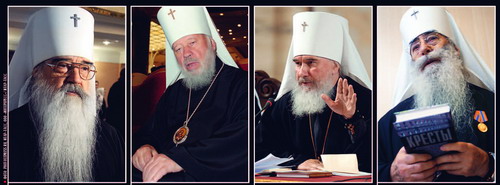
With the blessing of the Kremlin. The Patriarch, the Russian Orthodox Church, behind them, the centuries -old tradition is the most important sources of legitimacy of the Russian authorities. In the Soviet years, the CPSU Central Committee and the KGB authorities carefully monitored what was happening in church circles. The New Times found out how the elections of the future patriarch will take place
After the death of Alexy II, experts and observers began to actively discuss: which of the hierarchs of the Russian Orthodox Church of the Moscow Patriarchate is able to compete for the patriarchal throne. It was said about various fractions, the confrontation of forces within the Russian Orthodox Church.
Candidates
Among the possible candidates, for example, the oldest chirotony 1 Metropolitan of St. Petersburg, Vladimir (Kotlyarov), the same age as the Patriarch, was called the oldest. But he is very weak and is unlikely to be able to seriously compete for victory. The oldest hierarch of the Kiev Metropolitan Vladimir (Sabodan), although slightly younger, is even weaker - moves with extraneous help and is lying to the Ukrainian "self -ist". Metropolitan Krutitsky Juvenal (Poyarkov), who had already lost the Patriarch’s elections once in 1990, most likely refuse this honor - if he will make such an offer. In Juvenal, who in the first days after the death of the Patriarch was called among possible candidates for a temporary post of locomotive, a canonical age is approaching - 75 years, when the metropolitans recover. He complains about health. In addition, he heads the established farm near Moscow - the richest diocese. The young Chisinau Metropolitan Vladimir (Kantaryan) does not even advance, because he categorically does not want to move to Moscow. Metropolitan Minsk Filaret (Vakhromeev), who also lost the election to Alexy II in 1990, is considered the "man Lukashenko." There is also Metropolitan of Smolensk and Kaliningrad Cyril, who became a locomotive with a decision of the Holy Synod: he seems to be a favorite in the struggle for the patriarchal throne. The fact that the decision in church and political circles is made, the unprecedented pace of convocation of the Local Council for the election of the Patriarch is also indicated. Although the charter of the Russian Orthodox Church MP takes half a year to this, the cathedral will be held in January. Moreover, on February 1, the intronization of the new patriarch is appointed!
Out of competition
Prior to the departure of Alexy II, the main competitor of Metropolitan Cyril was considered a relatively young Metropolitan Clement (Kapalin), who holds the position of manager of the Patriarchate. It was even believed that President Vladimir Putin himself made a sign of higher favor, including Clement, and not Cyril in the Public Chamber in 2006. Analysts wrote that the Kremlin does not trust too charismatic Cyril and would prefer a much less bright and laconic climent. Perhaps he himself believed in the "location of the stars" and dared on the morning of December 6, a day after the death of the Patriarch, hold a meeting of the funeral commission. Cyril quickly besieged his former deputy in the department of external church ties - at 16.00 he himself accepted the leadership of the commission, and he appointed Clement by the secretary.
Finally, the most important thing. The 2009 elections will be very different from the 1990 elections, when Alexy II entered the throne. The new charter of the Moscow Patriarchate, adopted in 2000, is not so democratic at all and implies the possibility of non -alternative voting. It is noteworthy that the author of the new charter was Metropolitan Cyril. But there is no doubt that the entire necessary procedure will be followed. At least - for the sake of the procedure itself.
Church Foreign Ministry
The department of external church ties (VPS), which is led by Metropolitan Cyril, is called the Church Foreign Ministry, which occupies an impressive four -story building in the Danilov Monastery. This is the key structure of the Russian Orthodox Church. Cyril headed the Association in 1989, even under the one before Patriarch Pimen. The curators from the Council for Religious Affairs under the Council of Ministers of the USSR completely trusted the young hierarch then - in operational circles he was known under the pseudonym Mikhailov (as employees of the fifth department of the KGB called him in their reports). This detailed detail for the hierarch surfaced in the early 1990s, when the results of the work of the parliamentary commission to investigate the activities of the KGB began to be born. The commission worked with the archives of the fifth department, and the first public result of this work for the church was the publication in the magazine Christian Bulletin over October 1992. It was then that the whole interested audience found out that church hierarchs were completely and in the Soviet years were somehow connected (or dependent?) From the political police-the KGB. Pseudonyms were also called, who gave in their reports the employees of the ideological counterintelligence - “Drozdov,” “Adamant”, “Ostrovsky” ... The representatives of the other faiths, Jews, Catholics, and so on had their pseudonyms.
Metropolitan Cyril made a rapid career in the Soviet years. Already at the age of 22, studying at the Leningrad Theological Academy and the sequence of the secretary of the powerful Metropolitan Nicodemus, Cyril began to regularly travel abroad. He took major posts in the leadership of the World Council of Churches, a conference of European churches, peacekeeping organizations. Already at the age of 28, he is the rector of the Leningrad Academy, and at 30 - Archbishop of Vyborg.
The Commission of the Presidium of the Supreme Council of Russia in early 1992 officially drew the attention of the leadership of the Russian Orthodox Church to the “deep infiltration of special services agents” to the church, which “is a serious danger to society and the state”. In the same year, meeting with students of Moscow State University, Cyril claimed: "The fact of meeting the clergy with representatives of the KGB is morally indifferent." Indeed, this fact soon became “indifferent” because the page called “Mikhailov” in the biography of Cyril replaced the page called “Tobacco”.
Church business
In 1996, the ACCS through its Nick Foundation under the guise of humanitarian aid (without customs duties) brought more than 8 billion cigarettes to Russia, replacing imports from the market for paying duties. The first story was the first to dug up a soon and forgotten small business goal, and then there was a whole shaft of publications in the Moscow Komsomolets and Moscow News.
Actually, the tobacco kings began the first delay campaign, as they believed, an unscrupulous competitor. On Nicotin, then the media and evil languages in the Church itself, Cyril, made up the start -up capital - several hundred million dollars, after which financial scandals poured on it, as out of a cornucopia. He was involved in the duty -free export of oil, the capture of the Kamchatka crab, the extraction of the Ural gems, the institution of banks, the buying of shares and real estate. Specific (with a shade of “pastoral”) communications in the political leadership and business community quickly brought Cyril to the first place in terms of personal assets among the hierarchs of the Russian Orthodox Church MP. In 2004, a researcher at the Center for Studies of the shadow economy at the RSUSU Nikolay Mitrokhin released a monograph on the shadow economic activity of the Russian Orthodox Church. Metropolitan Cyril was estimated at $ 1.5 billion in this work. After 2 years, Moscow News journalists tried to recalculate the assets of the head of the church Foreign Ministry and came to the conclusion that they already have $ 4 billion. Neither the metropolitan nor the leadership of the Russian Orthodox Church commented.
Belonging to the elite requires a certain set of attributes. In 2002, Metropolitan Kirill bought a penthouse in a house on the embankment with a view of the Cathedral of Christ the Savior. This, by the way, is the only apartment in Moscow, registered specifically for the Metropolitan for his worldly surname Gundyaev, which is the corresponding entry in the cadastral statement. In the media, information about the purchase of Metropolitan Villa in Switzerland also appeared. At the same time, the metropolitan engaged in active and largely unprecedented for the church hierarch with educational activities through television: he conducts programs on different television channels, appears daily in news releases, several news agencies and magazines serve it.
Support from all sides
Among the hierarchs who have to choose it in the patriarchs, all this causes not so much envy as respect and loyalty. As the representative of the Russian Orthodox Church, Bishop Ilarion, recognized the representative of the Russian Orthodox Church in Brussels: “The members of the Holy Synod have already decided on their choice ... Metropolitan Cyril is known as a social figure - by television programs, by reports about his visits to different countries, according to his statements on topical political topics.”
Political figures also work on the image of a potential patriarch. State Duma deputy Konstantin Zatulin is trying to convince the Orthodox with such arguments: “No matter how we respect us, dear and pleasant for us, some clergyman who is not known or little known to anyone but ourselves, of course, the priority should be given to the recognized pastor.” Andrei Kuraev, “The Deacon of All Rus'”, seems to persuade him “tolerate a bit”, linking the election of Patriarch Kirill with the crisis, when not an elder-spiritualist, but an “effective manager”: “The elections will become a test of Christian sacrificial behavior ... The church and the country are in a very difficult situation ... Do not succumb to the charm of some conventions.” And immediately - with a direct text about Cyril, especially for the conservative church public: "This is the most stringent and reasoned critic of liberal, consumer ideology."
"Bureaucratic purpose"
Igor Artemov, the leader of the Russian National Union, is influential in the worldly environment of the Legislative Assembly of the Vladimir Region, and the leader of the Russian national union explains the position of opponents of the election of Metropolitan Kirill to the Patriarchal throne: “The Apostolic tradition is gradually being exported, the church is turned into a closed bureaucratic institution. The patriarch is not selected as a result of the canonical procedure, but according to the results of various intrigues and bureaucratic bureaucratic agreements. Cyril is a purely bureaucratic nomenclature purpose. I believe that if any survey was conducted among the Orthodox, Cyril would not be even in the first ten most popular. ”
But is it so important? The main thing from the point of view of the modern administrative-political system of Russia to whom and why he will choose the Patriarch of the Kremlin. The Kremlin needs a patriarch to "sanctify" their power. As he needed, Boris Godunov, Polishki interventionists, and Bolshevik's atheists. They all had their own Moscow patriarchs (but, however, they all suffered a historical fiasco).
Given how significant for the current bureaucratic “vertical” are the Patriarch and the Patriarchate, can they live in it according to democratic (cathedral) norms? If not a single deputy is transparently elected in Russia and even the president is appointed, can the patriarch be freely elected? The Kremlin, apparently, was decided. The president and prime minister arrived at a memorial meal in the Cathedral of Christ the Savior on the evening of December 9, which was not provided in advance by their working schedules. They did this only at the invitation of Metropolitan Cyril and talked only with him. The percentage of Cyril’s presence in Russian television increased many times, and patriots, religious journalists and the best preachers of the patriarchy were thrown to support his candidacy. In the publications of the church media of the last days there are no names of other hierarchs except Cyril. Is the choice made?
_______________
1 chirotony - ordination.
The article makes an error. Nikolai Mitrokhin was not an employee of the Center for the Study of Illegal Economic Activities of the Russian State University: in 2000, he published in this center his work "Economic Activities of the Russian Orthodox Church and its shadow component", which did not contain an assessment of the personal state of Metropolitan Kirill.
Divine voices • New Times • RIMA — Russian Independent Media Archive