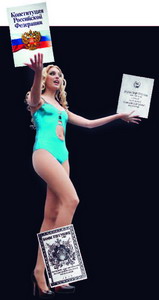
The Constitution of Russia is 15 years old. The history of domestic constitutional construction began shortly after the revolution: in the creation of the Constitution of the RSFSR adopted on July 10, 1918 and containing the “Declaration of the rights of the working and exploited people”, Vladimir Ilyich personally participated. Amendments to the 1993 Constitution, whose anniversary is celebrated these days, are also initiated by the country's leadership. As in the distant 1918, the goal is not the stability of the Constitution, but the authorities
On December 5, 1936, the Constitution of the USSR, the so -called Stalinskaya, was adopted, where the definition of the USSR was enshrined as the “socialist state of workers and peasants” (without intelligentsia). Work on the new Constitution of the USSR, which was supposed to record the post -Stalin changes in the country, began under Nikita Khrushchev, shortly after the adoption of the new program of the CPSU of 1961.
From Stalin to Khrushchev
At the beginning of 1962, a working group was formed to prepare the Basic Law under the leadership of the then chief ideologist Leonid Ilyichev. At first, the ideas of the participants in the working group were very radical: it was proposed, in particular, to form a bicaro -faid Supreme Council, to establish a constitutional court, to expand - compared with the Stalinist constitution - the rights of citizens, to sharply increase the role of representative bodies - Soviets. They say that Khrushchev even somehow threw the phrase in his hearts: “Here, some boys want to move me from the post of Predarmin and appoint the chairman of the Supreme Council of the USSR.” There were also ideological innovations: the “thaw” project contained a provision on the transformation of the state of the dictatorship of the proletariat into a nationwide, and proletarian democracy into the popular. True, in contrast to the 1936 Constitution, which provided for citizens to unite in public organizations, the Khrushchev project contained the norm on the CPSU as “the leading and guiding force of Soviet society” (which is symptomatic, the proposal was made at one of the meetings of the constitutional commission Leonid Brezhnev).
From Khrushchev to Brezhnev
In August 1964, work on the project was completed, but two months later a coup d'etat happened, and they forgot about the Constitution for several years. In 1968, the group under the leadership of Alexander Yakovlev prepared a new version of the constitution project, but returned to the issue only in 1972-Leonid Ilyich was in no hurry.
However, in 1977, it was obvious, the need to record the results of the construction of “stagnation”, which was called “developed socialist society” in the party slang of those years. And the work boiled: at the State Duma in Volyn, Silver Bor and Novo-Ogarev, the best lawyers of the country worked on the text for a year, believing that in this way it was possible to humanize the system. (Alexander Bovin, who strove to throw out an article about the “leading and guide”, even received a bit from the head of the working group Boris Ponomarev: “It will teach us what the Soviet constitution should be?!”))
It is interesting that in the 1977 Constitution of articles regulating the activities of the Supreme Council, there were half as much as in the Khrushchev project, and the section “Narmotics in the USSR” was absent. But then the “leading and guide” crawled from the old project to a new one ...
From Brezhnev to ... Putin
The Russian Constitution of 1993 was born in fundamentally different political circumstances: continuous democracy, many projects, many opinions, a constitutional meeting, finally, a crisis in the relationship of representative and executive branch, which ended in the events of October 1993. And - the adoption of the so -called presidential project of the Constitution on December 12 of the same year.
15 years have passed. What are they talking about today? The fact that the 1st and 2nd chapter of the Constitution-“Fundamentals of the Constitutional system” and “rights and freedoms of a person and citizen”-do not have mechanisms of implementation. That there is an obvious bias towards the presidential power, which is why the principle of separation of powers suffers. That the control powers of representative authorities do not work, and she herself moved away from the voter. All these are mines that were laid down in an unconditionally progressive presidential project. Lawyers also talk about the contradiction of a different kind. The constitution is a normative act of direct action that the courts can apply, and not only constitutional. They don’t use: they are afraid, they don’t know how, they don’t get used to it, there is not enough legal culture. But a direct action is conflicting with some norms that are absolutely declarative in nature. For example, the right to a dwelling formulated abstractly. What does that mean? This means that, referring to the Constitution, any woman Manya, dissatisfied with his housing conditions, may claim the immediate receipt of the apartment. And there are many such norms. Well, few people know that the Constitution is not just a piece of paper, but a basic law that is really applicable in practice.
And here's something else. The stability of constitutional legislation was formulated as an important principle in the Khrushchev project. That is, even the then constitutionalists understood that the Constitution was for a long time. Only 15 years have passed since the adoption of the 1993 Constitution, and it has already undergone a “anniversary” situation. And what is indicative - without any discussion by citizens or even an expert community.
The discussion of the draft Constitution of 1977 was attended by 140 million people. In the discussion of amendments to increase the term of office of the president, no person took part. Except for two leaders. And you know them.
Boris Yeltsin, President of the Russian Federation
“I firmly believe that ... we will not allow ourselves to abandon the letter, and most importantly, from the spirit of the constitution that the country adopted at the popular referendum in 1993.”
September 16, 2004
Vladimir Putin, President of the Russian Federation
“The revision of the fundamental provisions of the Constitution is equal to the revision of the foundations of the state system of the country, and the revision of its norms, dictated by the political conjuncture, is a direct path to the crisis of power and to loosen the authorities, to dangerous state conflicts.”
December 12, 2001
“We must be careful about the Constitution of our country, in no case allow ourselves to change to the taste of those people who are currently in power. And you need to be very careful about it, I repeat, I relate, I categorically against its change, and therefore if it turns something to someone to change something, then this is already without me. ”
June 5, 2003
Boris Gryzlov, the speaker of the State Duma and the leader of the United Russia
“On behalf of our faction, I can claim responsibly: the Constitution will not change.”
December 12, 2005
Valery Zorkin, Chairman of the Constitutional Court of the Russian Federation
“The country's constitution works quite effective, but possible changes are a matter of political will. He wants a people, he wants the legislator, so that the country has such a constitution, which means that it will be just like that. He wants to change her - this is also possible. "
December 12, 2006
Dmitry Medvedev, President of the Russian Federation
“Are any changes in the Constitution in the future possible? In my opinion, you can give an affirmative answer to this question ... None of us know the future ... The Constitution is, of course, not given from above the canon, but still the result of a public agreement. ”