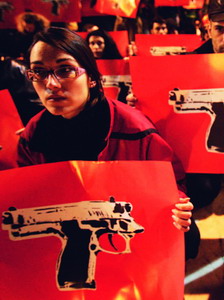
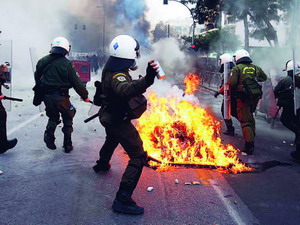
Student unrest took place in Greece. During one of the spontaneous rallies of protest, the police shot 15-year-old Alexander Grigoropoulos. His funeral spilled into a wave of protests and pogroms, which swept throughout the country. 20 police sections, hundreds of stores were defeated. The damage is estimated at € 200 million. People went outside both in Athens and in Thessaloniki - a total of eight cities. How it was - The New Times was told by Anna Kachkaeva, a correspondent of Radio "Freedom", which these days were in Athens at the International Media Development Forum
If you watch a television picture, it seems that in Greece it is something terrible. Indeed, in the area of the Polytechnic University, where student protests began, a black strap of Christmas trees sticks out, a burned -out building stands, a broken ATM, broken windows, burned cars are visible ... However, by morning the smoke is dispersed, and you should move away from the center, as you can see completely different. A large number of tourists, a blue sky, shops and flea markets work, port, restaurants invite tourists, temperature +15 ° C, tangerines on trees, grandfathers frosts in windows and dressed Christmas trees ... In general, life.
A burnt holiday
Then suddenly again the city center becomes a place where young people gather, and clashes instantly occur. The north of the city lives a quiet life, the subway works, and fights in the center. And of course, the sensation is quite strange. When you drive up to the center of the city, washed in the morning, you see young people who seem to sit peacefully on the steps in front of the parliament, and it is very sorry for the burned Christmas tree along with the tent, where, apparently, festive festivities were supposed, and nothing portends what will happen in two to three hours. Somewhere else the glass is lying around, the crumpled display cases are sealed with cardboard, they score those stores that were attacked in the evening ... But after two hours everything changes: somewhere firecrackers explodes, everyone runs, the police enough young people, and the wave of destructive energy covers these areas.
Information that the boy died first of all went on blogs. Actually, blogs, as well as mobile phones and SMS, brought thousands of people to the streets. According to Pavlos Tsimas, a very famous columnist in the Greek newspaper Ta Nea and a commentator on the private television channel Mega-TV, television media were late for a day. The next day was a very curious situation. There was a feeling that if the media was late, then they began to catch up very much, and, perhaps, even stronger than necessary. On the eve of the funeral, when news on all main channels went on the air, either garbage boxes or ATMs flashed in eight cities, in general, different shares began everywhere, the cameras earned at all corners, and this immediately went on the air.
Information tsunami
Polytechnic University is a place where anarchists are especially strong. This is not the first time and not the first year there have been skirmishes with the police. The dislike of the police from the time of “black colonels” is affected, when the junta has tightly dispersed the student uprising. Police in the university quarters are recommended not to bother and not succumb to provocations. You really can’t get to the university, this is an autonomous institution. Now this area is cordoned off.
The lack of information, of course, filed the protesters. But two days after the murder of a teenager, December 8, the channels did not talk about anything else. “Round tables” gathered in the studios, discussions were held, even on music channels against the backdrop of glamorous Christmas trees, the screens endlessly showed what was happening on the streets, reconstructed how the bullet that killed a teenager was drawn (there was already a consensus that it was ricotable), shooting from mobile phones, all possible angles of the same where and how it happened and how it happened and how it happened and how it happened and how it happened and how it happened and how it happened and how it happened and how it happened and how it happened Above, from below, everywhere ... The arrested did not show, although about fifty people detained the police during these days, their faces were blurred on the screens. Experts discussed all this, both left, right, young, old, and people on the streets, and on the phone ...
The spontaneous rallies superimposed a universal strike, scheduled in advance on December 10, and therefore banks did not work in Greece, the acropolis was closed, transported transport, airplanes did not fly ... All this coincided and warmed up the situation. But the manifestation organized by trade unions passed calmly. The strike was declared in advance, and people did not burn anything there, they were with banners, and they had specific requirements. And the anarchists have no clear requirements. Their protest was emotional and destructive.
More than 500 stores were produced throughout the country. The robberies went there, and the journalists actively showed this. They showed different faces of protest. Some information filters stood, says Pavlos Zimas, but not in the sense that they were forbidden to say something, but in the fact that they did not immediately show the entire breadth of the picture and the whole context.
An unfamiliar country
Pavlos Tsimas believes: “We do not really know our own people, our own youth, because the motives for entering the street and the swift reaction in the conditions of new information technologies were completely unexpected. On the one hand, of course, it pleases that the people are so not indifferent, and on the other hand, the motives that they are guided is very different, and we are not always ready to understand what this is connected with. ”
I must say, some private channels oriented to youth obviously sympathized with the protesting. Shots were spinning many times when the police caught the young lady in the “arafat” on the second or third day of the riots, they pressed her face and finally gave a kick. This picture was repeated 12 times, records from mobile phones were shown, a ballistic examination reproduced in 3D graphics, background from anarchist sites. The broadcasts of state channels, of course, were more adjusted.
By the fifth day of the confrontation, a degree of discussion is reduced. The city center is cleaned again, the burned cars are taken, the trees are cut, the airport works ... And it seems that politicians are trying to be as careful as possible so as not to swing the situation further.