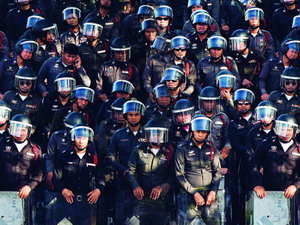
Thailand is in the face of the deepest political crisis that has not been since the Second World War. In one 2008 alone, two prime minister has already been replaced in the country. This week another attempt will be made to form an office, at the head of which a representative of the opposition democratic party can become. In its political attachments, the nation was practically divided in half. Who can unite Thailand and what awaits the country known for its tendency to military coups, ”the New Times found out
The recent capture of supporters of the opposition of the International Airport and the Government House in Bangkok posed the attention of the world community to Thailand. Many people ask about what happened in this country, which recently seemed quite peaceful and where did tourists from all over the world be drawn by pagodas, the blue sea, white sand and upper class hotels?
Revolution: Thai style
Protesters declare that what is happening is a revolution, the motor of which is civil disobedience. With their goal, they set to eradicate corruption, family, favoritism in Thailand, and at the same time the protection of the monarchy. Their slogan, Thailand, needs a “new policy”, no matter what this phrase means. The People’s Union for democracy 1 , under the banners of which various protest groups have united, has been holding its almost non -stop rallies since August and requires the government’s resignation. And quite successfully. Two cabinets have already changed over the year: first the Prime Minister Samak Suntaravet 2 , then - Somyaya Vohhcesata 3 . Both were removed from the authorities on the decision of the Constitutional Court. But despite the resignations, the political situation remains very shame: the opposition democratic party and the PHEU Thai party (reincarnation of the party of the Thai people) are beating for the right to form the following coalition government. This week, the prime minister’s post can receive a ham absive-the 45-year-old leader of the Democratic Party and a graduate of the University of Oxford, who is considered an expressor of the interests of the Bangkok middle class. At the time of signing the number to print, Vetchachiv managed to enlist the support of most members of the parliament. But the situation may change a day before voting.
Apple of discord
The origins of the current political crisis lie in the events of 2006, when the then Prime Minister Taxin Chinavat 4, as a result of a military coup, lost power. Taxin was expelled from Thailand and later sentenced in absentia to two years in prison for abuse of official position when concluding a land transaction 5 . The opposition believes that both of the government’s resignation of the government, in fact, represented the interests of Taxin this year and the overthrown prime minister would do everything possible to return to the political arena. And this opposition categorically does not want to allow. At the same time, the disgraced prime minister is a considerable folk support. “14 million Thais support Protaxin, about 12 million against him. The country has practically split, ”says Dr. Pravez Vazi, a famous Thai public figure.
North against the south
Taxin opponents, that is, those 12 million that voted against him at one time, are mainly residents of the south of the country, where the most adherents of the opposition democratic party, plus the metropolitan middle class and city residents. And 14 million of its supporters live mainly in rural areas in the north and northeast of Thailand.
Taxin was very successful, following the principle of “divide and conquer” while being in the post of prime minister. And he remains a very influential figure of the Thai political scene: he retained the levers of influence and management, even being outside Thailand.
Taxin opponents say that his policy is based on the ability to manipulate a crowd. In the Thai political dictionary there is the term "Thai politics that we know it." Translated - a corrupt policy based on the fact that during the voting elections voters are simply bought, and the “merchants” are then included in the government, which is used to distribute wealth with each other and the immediate environment, while only gnawed bones remain the people. Having come on the shoulders of the crowds to power, politicians become absolutely inappropriate to the people from the moment they occupy their offices.
The tyranny of the crowd
“Democracy is in Toyski” is an endless vicious circle, which consists of elections, corruption, military coup, then adopting a new constitution and then all in a new one. And so since 1932. The basis of this policy is an appeal to an uneducated and easily purchased crowd, in political science this is called the "tyranny of the majority."
The rural residents of the north and north-east of the country, the main base of Taxin support, probably sincerely believe that the expelled prime minister and its people were apologists of democracy. And indeed: the majority voted for his party. And besides, Taxin introduced public healthcare and a system of cheap loans. Rural residents believe that all governments are corrupted, and the taxi government is no exception. But at least, they believe, voters received at least some help from the Taxin government, while others simply ignore their distress: in the traditions of Thai politicians-to focus primarily on those who live in Bangkok, as if the rest of the country is not.
It is funny that this favorite of the poor is the richest person in Thailand, his fortune is estimated at almost $ 2 billion, which are now stored in banks: after the military coup, his account was frozen. In other words, the overthrown prime minister Taxin knows very well how to use the political system that exists in Thailand.
A view from the side
For those who observe what is happening from the side, for example for a foreign press, everything looks like the military, the elite, the establishment and the Bangkok middle class are anti -democrats who are trying by all means to overthrow the democratically elected government of the national authorities to protect their “interests and privileges”. Taxin and its rural voters are people who are truly "in love with democracy." And the opposition democratic party is most often depicted as a bunch of non -able to play losers.
And then there are t -shirts: the opposition wears yellow (the color of the king), and the supporters of Taxin - red, which only adds confusion and provokes the question: on which side the king is?
Monarchy between two lights
Thai monarchy traditionally stands out of politics. The interests of the monarchy are political stability and compliance with the law. If there is political stability, then the institution of the monarchy only benefits from this. If the situation is unstable, riots in the country, then the royal dynasty also suffers.
The king cannot openly favor the kind of political party, because in this case he loses his impartiality. In 2006, he was already asked to appoint the Prime Minister, which is a violation of the Constitution. But even now, all aspects of the conflict turn to the king.
Recently, a number of articles appeared in the foreign press, which claims that Korold secretly supports the opposition in her attempts to overthrow the government. This is wrong.
His Majesty honors traditions and the Constitution. Several times he called on the Thais to the unification, called to show wisdom and prevent disaster. The king repeated the word “disaster” several times, but it seems that few people heard it.
The choice of generals
The most influential person today in Thailand is General Anupong Paochand: 6 in his hands weapons and tanks. Recently, the general has been seeking to lead a “soft game”. He insists that he will not allow the new military coup: after all, the military coup of 2006, which declared its goal to establish new rules in politics, by and large has failed and did not achieve the declared goal. In 2006 there were clashes between the "yellow" and "red", and now everything was repeated again. The rules of the game remained the same. And therefore, the military, as they say, will not openly intervene in politics, unless the civil war begins in the country.
Of course, today General Anupong has significant power: when politicians are weak, the role of the military grows in proportion to their weaknesses. That is how traditionally the balance of power in Thai politics is built. But we must pay tribute to the general: he in every possible way holds back his people, hoping that politicians will figure it out and reach a compromise.
When will the situation in Thailand finally calm down? It is unlikely that soon. Troubles and discord will continue until Thailand can find a way to cope with the influence of the expelled prime minister of Taxin. But the main problem is that the political system is extremely corrupt and there is no leader in the country who can unite people, give them a perspective and really change the principles of Thai policy - what we have known for the last 76 years.
The Nation is one of the two daily newspapers in Thailand in English (the other is Bangkok Post). Founded in 1971, belongs to the national multimedia group. It is believed that English -language newspapers in Thailand are more free from state control than those that come out in Thai. Nevertheless, not a single media in Thailand allows himself to criticize the king, since he equates to the semi -divided person.
Thailand is a constitutional monarchy with a parliamentary form of government. The population is 65.5 million people. The main religion is Buddhism, it is professed by 95% of Thais. In 1932, the constitutional replaced the absolute monarchy. However, the political system is characterized by extreme instability: since 1932, 19 state coups have occurred in the country and 17 constitutions and charters have been adopted. The last military revolution occurred on September 19, 2006. The king of Thailand Pumpion Adulyadet ascended the throne in 1946, belongs to the Chakri dynasty, is also known as Rama IX. The king is considered a symbol of the country's unity and the supreme commander in chief. The Prime Minister De Jure is appointed king, but the majority leader in parliament becomes defectator. The birthday of the king and queen are national holidays.
_______________
1 Conservative Monarchical Party, symbol - yellow color, the color of the king. Leader - Media Magnate Sondhi Limthongkul.
2 Prime Minister of Thailand from January 29 to September 9, 2008, leader of the party of the Thai people.
Since September 2, 2008, he acted as Prime Minister Thailand, on September 18, 2008 he was appointed prime minister, left the post of December 2, 2008, deputy leader of the party of the Thai people.
4 Prime Minister of Thailand from February 2001 to September 2006.
On February 5 on February, 2008, Taksin Chinavat returned to Thailand, where he was charged with corruption and abuse of power. He was released on bail. Recently, his visa was canceled by Great Britain.