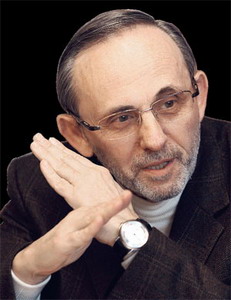
Light at the end of June. Since July 1, I have ceased to exist one of the largest energy holdings in the world of RAO UES of Russia. How will the country's energy system work further? Will the population encounter mass accidents in networks, fan shutdings and uncontrolled growth in electricity prices? This is in an interview with The New Times is told by the first deputy chairman of the RAO EES Yakov Urinson
Event of the year according to The New Times
Yakov Moiseevich, now, when there are only a few days left before the existence of RAO UES, do you think that the goals that were set when discussing the energy reform are achieved?
The glass, as you know, depending on the point of view, is either half empty or half full. Nevertheless, in 10 years, almost all the most important transformations have been carried out in the industry. We actually managed from the Ministry of Energy, which RAO was before making a normally working joint -stock company with corporate governance and transparent economy. It was possible to solve the problem of non -payments: 10 years ago, payments were only 15–20% of the released electricity. And when we began to demand 100 percent payment, protests rolled around the country, the scarecrow of Chubais burned ... Locating in the company, we carried out the reform so necessary for the industry, making the energy market in a vast-competitive market.
Death for life
Why did you need to liquidate the company with Chubais?
Other natural monopolies - Gazprom, Russian Railways - feel great ... At the recent St. Petersburg Economic Forum, the head of one of the world's largest energy companies asked me exactly this: “The management of all natural monopolies fights for its preservation. And you have been struggling with the state for 5 years to be destroyed. For what?" The fact is that without the elimination of RAO UES in the market, real competition is impossible. After all, all companies, all AO-Energo were daughters of RAO UES. And inside each AO-Energo-networks, and generation, and sales, and repairs .... Yes, at heart, we were terribly sorry: after we all debugged, we promoted when everything was already starting to work like a clock, now we need to eliminate all this energy “vertical”. But we must clearly and clearly understand that otherwise Russian energy would simply die.
So directly and died?
Judge for yourself: in the 90s, investments in the industry practically did not go. It is clear that no sensible investor will go to the company, in which it is not clear how, where and why money is spent. And even if the investor invested the money, he is unlikely to be able to “recapture” it, because the state set the prices of electricity. Moreover, it also said from whom to receive money for the released electricity, and from whom to wait: from the government of Moscow or from the Government of Chechnya, from the aluminum factory or from some seedy factory ... And the equipment wear coefficient reached 80%. Due to some state investments, the problems could not be solved, even if the entire stabund was spent on it. Gradually, the degradation of the electric power system would reach the limit.
Will the industry remonopolization happen, since Gazprom bought energy assets and other large state or close to power company ...
I am sure that no remonopolization will happen. We have now created 20 territorial and wholesale generating companies on the market. And they are simply doomed to compete with each other. Of course, a reconfiguration will still take place on the market: sales, associations, exchanges of assets. But look: today each structure that owns the energy company is either consumers or manufacturers of raw materials. They compete with each other. And as the recent experience of the failed alliance between Gazprom and Suek shows, to those who compete in one market, it is almost impossible to agree on the other. So today the situation is almost ideal: the largest share in the market at Gazprom, but at the same time it is only 20%.
Investments are the main thing
But will not the disappearance of the “vertical of power” in the energy sector to increase the number of accidents?
The essence of the reform is that we demonopolized the production and sale of electricity. And they retained the monopoly where it was necessary - in national and distribution networks. Next: the dispatch administration remains 100% state. Now a company has been created, which is called the “system operator”, and everything is subordinate to its manager: the central dispatch department in Moscow, regional dispatch governments and even local government (“shields” - as power sections call them). So the vertical, which, unlike politics, is necessary here, it is not only preserved, but also strengthened. As for accidents, it must be understood that energy is a complex system, not only the manufacturer, but also the consumer affects its safety. Therefore, in the electric power industry, reliability is a special category. And it directly depends on investment. Now the numbers: thanks to the reform of the industry, € 21.6 billion was involved in it according to our estimates, € 119 billion will come to the industry until 2012, of which there are only € 5.2 billion.
They said that competition will lead to a decrease in electricity price. But now it’s more often heard completely different: we have an electricity underestimated, and we must pay for it a lot more ...
As soon as the electricity market earned, for three years (2004-2006) the tariff growth index for it was below the inflation index. That is, really electricity is cheaper. But our tariffs have still set the state - once a year and for each region. In real life, the demand for electricity rises somewhere, somewhere it falls, somewhere cold winter, somewhere warm, somewhere new production was introduced, somewhere the old was stopped ... and the tariff has already been set. As a result, neither the manufacturer nor the consumer is interested in saving electricity. And now 35% of electricity is already sold in the market, and by 2011 all 100% will be. As a result, we have something that the USSR could not achieve by any methods - neither kagabash, nor party, nor state planning - optimal loading of power plants. And the price during the day really reacts to the ratio of demand and supply. So, there are real chances of reducing tariffs.
Why do they grow, and faster than inflation?
Precisely because nothing has been invested in electricity for many years. If there were no market, tariffs would grow even faster.