
Translated material
Gorbachev begins the fight against the crisis and criticizes the authorities for riot police in Primorye
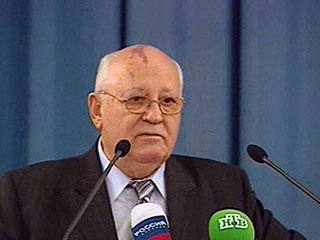
In Russia, on the initiative of the ex-president of the USSR Mikhail Gorbachev, a group of economists and public figures creates public anti-crisis initiative (OAI), the purpose of which will be the struggle with the consequences of the financial crisis in Russia. To achieve this OAI will be by combining the efforts of professional economists and representatives of various public forces of civil society in the analysis of the situation and the search for the necessary decisions necessary for the economy and the whole society.
Representing the Memorandum of the OAI, Gorbachev also criticized measures taken by the authorities regarding the motorists of Primorye, who protested against raising duties on imported foreign cars: "The questions there are business, vital, and we did not come up with anything better how to send rockers ."
According to Interfax , while the memorandum was signed by 15 people, among them - the president of the National Investment Council, Alexander Lebedev, former leader of the republican party, professor of the Higher School of Economics, Vladimir Ryzhkov, director of the Center for Ethno -Policy and Regional Research, Emil Payne, chief researcher at IMMO RAS Victor Sheinis, head of the strategic consulting group, Sergei Aleksashenko.
Assessing the current situation in Russia, the authors of the Memorandum said that it was a mistake to make statements that the country would survive the crisis as a "quiet harbor." The document is also criticized by the fact that "the most important decisions of recent years were actually made without public participation." According to the authors of the Memorandum of the OAI, anti -crisis measures are also taken today, and, apparently, the authorities simply do not have a strategy for overcoming the crisis.
The document also states that, according to the participants of the OAI, $ 50 billion aimed at paying off the external debts of corporations belonging to the richest citizens of the country, could be invested in Russia and get an economic and social effect.
The authors of the Memorandum propose to make the first real anti -crisis measure a comprehensive analysis of the internal causes of the crisis, an open discussion on an alternative democratic basis for the project of a national general criticism program.
Among the specific measures that are proposed in the document is the development of a set of emergency measures to support socially vulnerable segments of the population, changes in the policy of external borrowing; freezing tariffs of natural monopolies; Strengthening export support and import destruction.
Gorbachev and his supporters propose to raise the issue of holding an anti -crisis meeting, with the participation of civil society, representatives of regions and local self -government, trade unions, unions of employers, government and parliament. At this meeting, a wide public consent should be achieved about the principles of anti -crisis policy, its main specific measures.
Recall that on Monday, Gorbachev published an article dedicated to the crisis in the Rossiyskaya Gazeta . In it, he stated that the authorities sounding at the beginning the authorities regarding the consequences of the crisis were irresponsible.
The task of overcoming the crisis - colossal complexity, states Gorbachev. “It is solved only in the conditions of equal dialogue, democratization of international relations, overcoming militaristic trends in politics and thinking. This is essentially a new agenda for world politics,” the ex -president of the USSR wrote.