North Korea: Step forward, two back. The global media outlets circled the sensation: Kim Jong Il finally made a historical decision on the question of the throne of the throne-the successor of the all-conquering commander, as they say, will be Kim Jung Un, his third son. What is actually happening in this reserve of Stalinism - learned The New Times
The question immediately arises: where did the information come from? No messages from Pyongyang were received, and ordinary North Koreans do not at all seek to share gossip with foreign journalists. In Pyongyang-2009, such conversations inevitably end in the camp (this is lucky), and all residents of the north know this perfectly.
Heirs
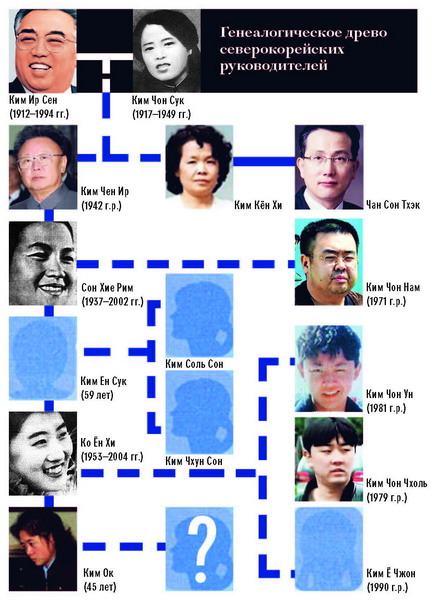
The source of the next sensation was the messages of the South Korean media that refer to the anonymous. However, those who carefully monitor affairs in Pyongyang remember well that only a couple of months ago the South Korean and Japanese media, citing anonymous sources, reported that the successor of the great leader (the main of the fifty of the titles Kim Jong Ira) will be his sister Chan Song Taek. A few months earlier-and again with reference to anonymous sources-it was said that the commander finally made his choice and decided to appoint a second son, Kim Chon Chol. All these messages were not confirmed, as, most likely, the current “sensation” is not confirmed.
Behind the iron curtain
Such uncertainty is understandable: the North Korean state is arranged in such a way as to remain impenetrable for external eyes. Almost all statistics, including the most harmless, are classified. A few foreigners are under constant supervision, can travel only along pre -approved routes and do not have the right to meet with Koreans in a neo -icial situation. Thus, the analysis of the North Korean policy mainly comes down to attempts to read between the lines in the articles of the main party newspaper Nodon Sinmoon (it is curious that the Kyllochi party magazine, the direct analogue of the communist magazine, is prohibited for exporting abroad and cannot be transferred to foreigners).
However, this does not mean in any way that North Korea remains a kind of untouched reserve of Stalinism, a monument to the day before yesterday. In the 90s, great changes occurred in the country.
Perestroika a la chuchhe
Until the beginning of the 90s, the whole economy was socialized, and even in the village of personal plots could not exceed 100 m 2 . For a short -term departure, even beyond the borders of their county, preliminary permission of the police was required. Trade was practically absent - all products and almost all of the first necessity were distributed by cards. Extraordinary measures were taken to isolate the country's population from the outside world: all the receivers in the country have a fixed setting on the wave of official Pyongyan broadcasting, all foreign literature enters the special security.
For decades, the country remained afloat thanks to the external, mainly Soviet, help, the very fact of which was fiercely denied official propaganda (it came to the removal of signs from Soviet machines). The cessation of this assistance in 1990-1992 was a serious blow to the North Korean economy. It was impossible to purchase goods abroad on a commercial basis: the North Korean economy could not produce goods that would be in demand in the world market.
The most difficult crisis was affected by agriculture. By 1996, food difficulties have grown into a full -scale hunger, which took from half a million to a million lives. By this time, most North Korean enterprises had not worked, and the issuance of goods on cards ceased, so the explosive growth, as we say, was the natural consequence of such a turn of events. In the markets, not only traded: small snack, various workshops began to appear there, and enterprising aunts established the delivery of the rooms to wandering merchants. The authorities sometimes tried to prevent the rapid growth of market capitalism, but more often looked at what was happening through their fingers, because it was clear that in this way the population somehow feeds itself. However, in many cases, the reluctance of officials to punish violators of socialist legality was not entirely disinterested: corruption in the country became universal. In a poorly guarded Korean-Chinese border, smuggled trade began to flourish, and North Korean refugees and illegal workers reached out in China.
In fact, a market economy was revived in the DPRK, however, unlike China, this revival spontaneously occurred as a spontaneous reaction of society to a crisis situation. The largest that the authorities were ready for was to officially recognize the current situation and legalize the markets, which they did in the summer of 2002. These decisions in the foreign press were declared almost the beginning of the North Korean perestroika. In fact, the changes meant only a partial recognition of those realities that had already developed in society by that time.
Fears of vertical
At first glance, North Korean problems have a simple solution - radical market reforms of the Chinese or Vietnamese model. However, the implementation of such reforms in North Korea is too dangerous for the current regime. Problems creates the existence of a prosperous South Korea. The gap in the level of income between the north and the south is evaluated in different ways: the optimists talk about a 17-fold break, pessimists-about 50 times. There are no two other neighboring countries on the planet, between which there would be the same difference in living standards. In recent years, the noticeable part of the residents of the DPRK began to guess that the south is not a starving American colony, namely, this is still the official propaganda. However, outside the ruling elite, few in the DPRK suspect how large the gap between the two Korean states.
If the government begins reform, information about South Korean prosperity will actively penetrate the country. The result of this, as they are reasonably feared in Pyongyang, will be political destabilization: although the reforms will certainly lead to an improvement in the situation, the regime will be responsible for the grand lag behind the south. In addition, the North Koreans will have the feeling that all their problems can be easily and simply solved by uniting with a fabulously rich south. The result may be a crisis that will end with a merger with the south according to the German model.
For the current Pyongyang elite, this option is absolutely unacceptable: after all, with such a turn of events, she has no chance of maintaining privileges and power. In the case of unification to the north, firms of the South will come, with which North Korean structures will not be able to compete and there will be no place in which former functionaries will not find (who will need former officials in the conditions of collapse of North Korean statehood and the absorption of the country by the South).
From the point of view of the North Korean elite, Chinese reforms are political suicide, and the most rational survival strategy is to preserve the existing system into inviolability. The current “teninization from below” causes considerable concern among Pyongyang rulers: markets serve as intermediaries in the spread of unauthorized information, and people engaged in private business usually cannot be controlled by the state with the efficiency that it is used to.
Back to the cards
On the other hand, in recent years, hunger managed to overcome, and the economic situation has stabilized (mainly due to foreign assistance, the receipt of which was established as a result of complex diplomatic maneuvers). In these conditions, the North Korean leadership decided to go on a counterattack. In October 2005, the restoration of the card system was announced. In 2006, the markets were forbidden to trade working -off men, and since December 2007 this ban has been extended to women younger than fifty years. Finally, in November 2008, circulars were sent, who reported that from January 2009 the markets would only work three days a month-the 1st, 11th and 21st. In addition, private trade in industrial products and grain was prohibited.
However, the plan of actual closure of the markets met mass resistance from the bureaucracy. Part of the grassroots nomenclature feeds from the markets, and some understand how important the markets are for the normal existence of the majority of the population. As a result, the decision was withdrawn at the very last moment.
So, the markets in the DPRK are still working. And perhaps, in the long run, the consequences of this fact are much more important than all the palace intrigues and all decisions on the issue of the throne about the throne of the throne. Moreover, most of these sensations are most likely a provocation of special services.