What will the return to the "gold standard" will lead
The Russian authorities are seriously concerned about how to stop the collapse of the ruble (the rate fell from 24 to 33 rubles per dollar), which is observed over the past four months. One of the recipes seriously discussed in government offices is the introduction of the Golden Standard in Russia. How workable is this idea - The New Times found out
The Golden Standard began to be used everywhere at the turn of the XIX - XX centuries, when there was a need to organize international calculations in the world economy, which began, in modern language, to globalize. In practice, the introduction of this standard meant that the courses of the main international currencies were recorded at a certain level in relation to gold and, thus, became commensurate with each other. At the same time, all countries that have chosen the Golden Standard for themselves took an obligation to exchange their currency for gold without restrictions. This design forced the central banks (government) to accumulate reserves in gold and limited their ability to print money.
Golden stimulus
The Golden Standard once contributed to the rapid development of international trade. But this standard also had very significant drawbacks of both macroeconomic and technical nature. From the point of view of macroeconomics, it is obvious that economic activity in any country demanded an increase in the amount of money in circulation, but such demand could not be satisfied if the country could not increase its gold reserves. From a technical point of view, there was a need for regular transportation of large volumes of gold between countries (after all, it was often useless to present your money in a foreign country - they had no value there), which was expensive and troublesome. However, the Golden Standard, with all its shortcomings, existed before the Second World War, during which the international financial system based on this standard turned out to be completely destroyed: the warring countries were not up to maintaining their reserves in conditions when enormous arms costs were required. At the same time, 70% of world gold reserves were concentrated by the end of the war in the United States. All this led in 1944 to the creation of the Brettonwood system, or the dollar standard - the system of international settlements based on the use of the American currency. At the same time, the binding of the dollar to gold was recorded (1 Troika ounce = $ 32), and the courses of all other currencies were recorded in relation to the dollar. In turn, the United States pledged without restrictions to exchange dollars for gold to the central banks of other countries. This system did not last relatively long - until the spring of 1973, when the world moved to the system of floating exchange rates, abandoning attempts to build a global monetary system. Countries abandoned the use of the gold (or other metal) standard mainly because it interfered with the flexibility of monetary policy: with an increase in the economy, the country could not provide the corresponding issue of its currency, since it was not able to automatically increase gold reserves.
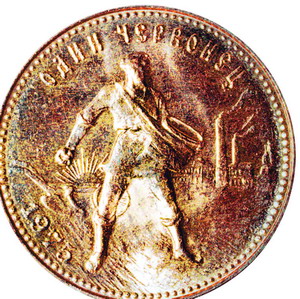
In Russia, after 1917, the Golden Standard was de facto abolished by the Soviet government, but for a short period of the NEP (1922-1928), the state had to return to ensure the ruble to Dragmetal. So “Golden Chervonets” appeared: paper money with a face value 1, 3, 5, 10 and 25 chervonets, which the government fully provided with its gold and foreign currency, foreign currency, goods and bills. The Golden Chervonets played an important role in the country's exit from a state of hyperinflation and post -war devastation. In the future, the “gold standard” was not used within the USSR, although there was nowhere to go in the international trade in the Soviet Union. Perhaps that is why today it seems to individual experts that a return to this system will magically solve all the problems of the Russian economy. The proposals on the use of the “gold standard” regularly appeared in the highly inflationary 90s, later this idea was pushed into the shadow of the era of the mass tributary of the Nefedollars, but the crisis came-and the “old songs” sounded again.
Pros
Of course, theoretically, the Golden Standard may well be introduced in Russia. To do this, the Central Bank of the Russian Federation must announce that from such a time he takes the obligation to exchange commercial banks (and possibly international organizations such as the IMF) rubles for gold (in other words, sell gold) at a fixed price: say, 900 rubles per gram. 1 The same principle should work in the opposite direction: at any time, banks should be able to sell gold to the Central Bank at the same rate.
At the same time, a technical problem immediately arises: since today's gold reserves of the Bank of Russia are a little exceeding 500 tons a little, and the number of rubles issued by it (wide monetary base) is a little more than 5,500 billion rubles, it is easy to count that to ensure the stability of the ruble of the ruble, the bank of about 3,000 tons of gold should be bought on the international market-then 50 percent provision of the ruble of the ruble of gold will be reached. However, we can imagine what will happen at this moment with world prices for gold if the reserves of all central banks in the world are about 30,000 tons! The plus of this venture is obvious: the ruble measured in gold becomes stable and does not change daily. But, in fact, all the pluses end there. But there are much more minuses ...
Cons
Since 1973, the whole world has switched to a floating price for gold, which is traditionally fixed in dollars. This means that at least in order to recalculate the companies and banks of foreign currency assets into rubles (for drawing up a balance or for taxes), it will still be necessary to fix the ruble exchange rate to the main international currencies. Let us leave aside the fact that by and large, none of the central banks in the world does this work: all economic entities and tax authorities have enough quotations from Bloomberg/Reiters. But due to the fact that the price of gold is changing daily, the Bank of Russia will be forced to continue to issue official orders on the establishment of the ruble exchange rate for foreign currencies daily. Moreover, if the dollar exchange rate is determined by a simple way of direct multiplication, then the courses of all other currencies will be determined using the cross-courses of these currencies in relation to the dollar. Property It is possible, today the same thing happens, and in this sense the “gold standard”, used in one, separately taken, our country, will not change the situation in the currency sphere for the better.
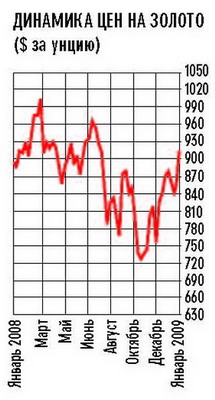
Further: the volatility of prices for gold is quite large (see the schedule on page 31). If we calculate the dollar and euros in 2008, based on the actual price of gold in the world market and the “gold standard” reflects for the purposes of the “gold standard” for the purposes of 900 rubles per gram (28 thousand rubles for a triple ounce), then the dollar with our hypotheses “walked” from 28 to 38 rubles during the year, and the euro - from 43 to 52 rubles. In other words, it would not be possible to get any sore stability.
But it would be possible to create an excellent design for enriching those elected banks that would be allowed to “golden” transactions with the Bank of Russia: they would not fail to use the moment and buy gold from the Central Bank at the fixed rate when it is expensive on the world market (to sell it there), and, accordingly, sell Gold of the Central Bank in those moments when it is cheap in the world market (having bought it there). It seems that several such waves of purchases and sale of gold are enough banks to create a couple of dozens of dollar billionaires in Russia, the number of which, according to the crisis, has been slightly reduced. Or maybe for this, the idea of a “golden standard” has long deceased in the Bose of the Golden Standard?
Will the introduction of the “gold standard” help the Russian economy?
Igor Nikolaev, Director of the Department of Strategic Analysis of the FBK company
I understand why such proposals are now appearing: at the time of the crisis, I want to find a simple recipe that will immediately solve all problems. But while the economy is in such a deplorable state as ours, simple recipes will not help. It is no accident that the world has long abandoned the “gold standard”, and one should not think that its restoration in a single country will lead to strengthening the national currency of this country. In the modern economy, the power of the national currency is not ensured by the magnitude of the gold reserve, but by the power of the whole economy of this country. Say, the fortress of the dollar is determined not by the stocks of Fortoks, but by the fact that the American economy is a quarter of the world. And since Russia has a raw material economy, the course of our currency is determined primarily by the price of oil. And this dependence of the ruble on the price of oil will not go anywhere, even if we introduce the “gold standard”: the shadow currency market will simply appear, as it was in Soviet times when the ruble exchange rate towards the dollar was determined artificially.
Natalia Orlova, chief economist of Alfa Bank
First of all, it should be understood why the Golden Standard should be introduced for. Obviously, in order to stop the fall of the ruble in relation to the dollar. But we have this fall, in essence, is funded by the government, which constantly pumps rubles into the economy. Obviously, the government believes that it thereby stimulates economic growth, but in practice this does not happen. Accordingly, in order to strengthen the ruble, it is necessary not to introduce the “gold standard”, but to stop destabilizing the economy by pumping it with “anti -crisis” money.
Alexander Khandruev, First Vice-President of the Association of Regional Banks
In the case of the introduction of the “gold standard”, the volume of money will be limited by gold mining in the country. This is a very inflexible design: such a system works only when you can exchange your banknotes for gold bits at any time at a fixed rate. This means that it is necessary to sharply reduce the volume of money -know, which are in circulation in order to bring them into line with the number of gold in the reserves of the state. I simply cannot imagine such actions in the modern world based on credit money. It’s like announcing from tomorrow a return to the Victorian era - with carriages, camisols and other delights of past centuries. Beautiful, but utopian! In fact, the ruble should not strengthen the ruble as artificial solutions such as the introduction of the “gold standard”, but by a rigid financial discipline: the Central Bank should impose restrictions on the issue, and the government should not allow a budget deficit.
_______________
1 Account price of the Central Bank for January 22 - 903.09 rubles. per gram.
Does the chervonets protect the ruble? • New Times • RIMA — Russian Independent Media Archive