According to sociologists, the peak of the people's trust in power has passed
Historians will study 2008 as a turning point, say the sociologists of the Levada Center. The viewer society abruptly loses confidence in the future
In the spring, it seemed that the post -Soviet political regime was quite developed, was accepted by the overwhelming majority of the population and there were no special changes in the near future - and then these same changes came. In fact, on the March of the past year, there is a peak of the popularity of our Duumvirate, the peak of trust in him and the high cohesion of the people around the leaders in the “minute of testing” by the last Caucasian war: the usual mobilization script worked. Then, for the first time in the post -Soviet history, the Russians declared the current political and economic regime the best, better even Soviet, not to mention the democracy of the Western type.
The regime ended the opposition, practically replaced it from the field of public attention, and at the same time finished with public opinion as such. Levadacenter Director Lev Gudkov, who has been studying public opinion for twenty years, believes that today it is paralyzed in Russia: this important institution of modern society is reduced to a direct reaction to television programs, a television presentation of events, usually a non -alternative and extremely tendentious, interspersed with entertainment.
Society of viewers
Almost half of the viewers, as before, states that it is not inclined to trust the interpretation of events in the media, primarily by TV, but Russians have practically no other sources of information. And not so much because the opposition publications are pursued in more or less, but because they are less addressed to them. From the daily life of the Russians, thick magazines almost disappeared, which once played a huge role in crystallization of public opinion, which to a certain extent set its structure. Then central newspapers were pushed to the periphery of public interest. Today, among print media, thin magazines are leading with stories from the life of stars, recipes for losing weight and always with a television program. Yuri Levada called the new society "the company of viewers." That is what the study of Lev Gudkov and Boris Dubin was called, in which the sharply increased “television dependence” of the average Russian was not only stated, but also a analysis of the type of society created by her - amorphous, passive, relaxed, devoid of internal structure and space for public action.
The perception of the last Caucasian war was very significant in this sense. Boris Dubin compared the reaction of the viewers and those who mainly drew information from the Internet and shared their comments there. Such an impression, says a sociologist that we are talking about different wars. 75–80% of our fellow citizens, of course, supported the actions of the Russian authorities, although half of them admitted that she did not understand the essence of events. The majority saw this war not as an attempt (albeit completely unusual, even criminal methods) of the Georgian government to “restore the constitutional order on its territory” (which would make us recall the Chechen wars), and as a “hot episode” in the eternal confrontation of Russia and the United States.
Constant visitors to the Internet saw this war completely differently. They had a variety of information, ardently discussed it, argued a lot and, as a result, developed a certain voluminous idea of the conflict. It was completely different than the permanent viewers, the manner of handling information, its other perception. But there were no more than 7-8% of the respondents.
“Television dependence” also dictates a certain set of the main events of the outgoing year, in which the death of the Patriarch is in the first place, in the second - the war in the Caucasus and the election of the new president, in the third - the financial crisis, on the fourth - the death of the artists of A. Abdulov, N. Mordyukova, M. Magomayeva.
The beginning of the fracture
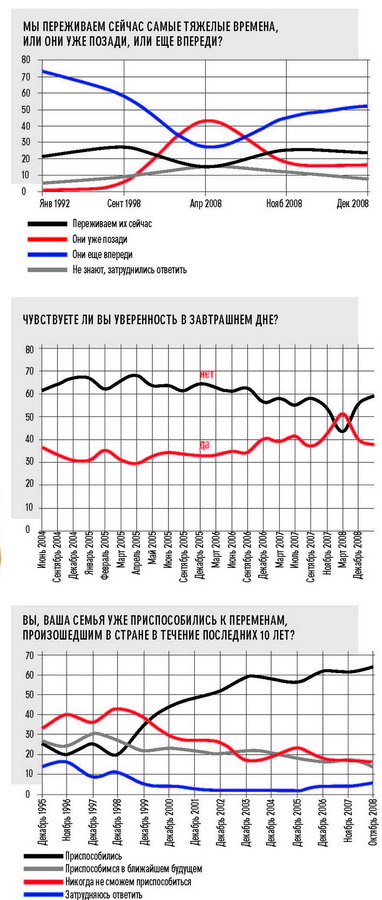
Over the past years, a kind of public treaty of the authorities and society has developed: the authorities contribute to the fact that Russians live in increasingly more abundance, and citizens adopt its domestic and foreign policy. 57% of Russians were confident in the predestination of choice Medvedev by the president (that is, thereby recognized the absence of a real choice), but they treated this quite calmly. A layer of people, earlier significant, who believed that they could not adapt to the post -Soviet reality never became very small. The anxiety characteristic of our citizens at the beginning and in the late 90s (after the default) was constantly reduced to a minimum in 2007-2008.
This went on about about September 2008. And here sociologists fix the beginning of the fracture.
Confidence in the president (now the president and prime minister) and before was not so much the result of assessing their specific policy, but the focus of hopes that the foreseeable future would not get worse. Therefore, it is paradoxical, but constantly accompanied by very low confidence in all institutions that should serve as instruments in the implementation of these hopes: for officials, ships, and police. After September 2008, confidence in the first persons of the country began to decline.
Almost half of the sociologists answered questions in December said that 2008 was “more difficult for Russia than the previous one” (46%) - there have been no such numbers since 1999. A sense of confidence in the future, reaching a maximum in March 2008, sharply decline. Back in April, the opinion prevailed that difficult times for the country behind; In the summer it began to gain strength and in November the opposite opinion prevailed - that the difficulties ahead. There are fewer people who are confident that the country is moving in the right direction - there are already less than half of them.
Fragile vertical
Nevertheless, the anxiety that spilled in the atmosphere is still quite virtual: it is not embodied in concrete fears for its own position and position of its family. As always, the situation in the country is evaluated worse than at home; Most are still not afraid of poverty and unemployment personally, and even less than in recent years, they fear public humiliations (although 46% of our fellow citizens are constantly waiting for them or from time to time), the arbitrariness of the authorities, lawlessness (but more than half of the country's population is afraid of them-56%).
However, the farther to the crisis, the more often doubts will arise and strengthen the effectiveness of the social contract between the authorities and the company.
Having trampled all sorts of sprouts of political independence and almost destroying economic amateur performances, the center concentrated all responsibility for what is happening on itself. As before, the “man of the year” is V. Putin for 40%, for 27%-D. Medvedev, then the usual failure: other famous persons gain a few interest. The vertical of power in this version is warned by sociologists, the construction is fragile. Trying to strengthen it further by power methods, new restrictions, it only makes it even more fragile.
But not only the authorities, but also the citizens on the eve of serious tests found themselves in any expanded, strange world in which it is difficult to make the right decisions. The country seemed to return to the era of the Cold War (which, according to many speaking at the newly annual conference of the Levada Center, 1 may well turn into a “hot” war). According to recent surveys, Russia is in the ring of enemies. Her main enemies (in descending order): Georgia, USA, Ukraine, Lithuania, Poland; Friends - Belarusian, Germany, China, France. But relations with European countries are evaluated as all less friendly. Most have no doubt in the political background of a clash with Ukraine regarding the transportation of gas, but understands this background as a completely reasonable desire of the Russian authorities to “punish” the former fraternal republic for the “orange revolution”, for pro -Western orientation, for the desire to withdraw from the field of dependence of Russia.
For many Russians, as for the Russian government, the world is again divided into the zones of influence of the superpowers, one of which remains (or became again when “rising from the knees”) Russia; The Russian zone must be protected around the entire perimeter with no means of zero than the well -being of your own citizens (“you would like to live in a huge country that is respected and afraid, or in a small, cozy, harmless country?” - the ratio in answers 75:19). They are ready to reproduce the model worked out in the last Caucasian war again and again: two or three days of military operations-and the victory that must be proud of, but with which it is completely incomprehensible what to do. The main thing is that everyone in the “your” zone understands: “You will breathe when I allow (otherwise I will take the tanks to the road to Tbilisi or the overlap of the gas valve).” Whether such a view of the world will remain in the coming months, when the crisis is gaining momentum - we will see.
_______________
1 "Public opinion: events and trends of 2008." Moscow, January 2009