How the Internet began - I found out The New Times
The Russian Internet was born on August 28, 1990. In a country that is no longer there. Most of its creators came out of the "mailbox", better known to work on the creation of the first Soviet atomic bomb - from the Institute of Atomic Energy. Kurchatov (kiae).
Next to the bomb
The KGB is believed by the "founding fathers" of the Internet in the USSR, the birth of the Soviet segment of the world network simply did not notice. There was a late “scoop” in the yard, citizens were concerned about one line after another, and in the machine rooms of large scientific institutions tied to the “defense”, a technical revolution was prepared under the rustle of punch and a whistle of magnetic tape. She was brought as possible as young men with abundant and inaccurate hair, with glasses with thick lenses and stretched sweaters. Mathematics and programmers. But in 1984, a miracle was what young scientists planned: to remake UNIX to the Soviet computers, on the basis of which the Internet in the USA and Europe was built in the 80s. It was possible to enter the world only like this: to join the European Association of UNIX users. “What was meant then by the Internet? -Asks one of the developers, Sergei Ryzhkov, who formed in the late 80s an employee of Kurchatovka, now-the general director of the provider Rinet. “The ability to exchange e -mail and hold conferences.” But this was almost a miracle: the usual letter went to the United States up to several weeks, the transfer of fax abroad took two days. On the network, the letter reached in 1 hour!
The KGB, according to The New Times, showed up under the curtain of history when the Demos system (programmers jokingly called it UNAS, as a counterbalance of Unix, that is, “unih”) was ready and acted. “In 1990, our“ curator ”at the Institute. Kurchatov, it seems, with the rank of captain, asked: "What needs to be done to put control on the network?" -recalls one of the “founding fathers”, laureate of the USSR Council of Ministers Valery Bardin. - And he received a mockery in response: “To ban scientific exchange from the territory of the Kurchatov Institute!” “Times are not the same,” the captain answered, with drooping. “Then create a system similar to a telephone wiretapping.” - "Who will give money for this?" “These approaches ended with walls about the“ untimely ”of the appearance of the All -Union Computer Network, which was clearly heard:“ Well, why did this happen here, and not at the neighbor? ” - says Bardin.
Virtual flea
Where did the American Unix program come from in the USSR, behind the iron curtain? According to Valery Bardin, software was brought in units in the USSR on magnetic tapes, starting in 1983, specialists who were internships at Western universities. In particular, something “took” right from the University of Maryland, something else from the Berkeley University. “What was done according to the special rooms (that is, through the scientific and technical intelligence line of the KGB of the USSR or GRU), the vulture was automatically received and was forever lost in the safes of the first departments,” Bardin says. “The channels through which the source came, that is, the parts of the operating system, apparently, were somehow connected with the special services,” Ryzhkov admits. “On the other hand, I personally saw that the software line at the Berkeley University was open, it was not even necessary to steal anything.” Bardin recalled that part of the Unix “pumped” from some European computer on the Radau Date channel between the Ministry of Communications of the USSR and Austria programmer Nikolai Saukh.
“The KGB of the USSR could not miss the emergence of communication networks in the United States and Europe, especially since they suspended the control and communication channels of various defense systems,” retired General Vladimir Rubanov, General of the KGB General of KGB. However, the issue of the origin of the “sources” of the Western operating systems in the USSR Rubanov bypasses in silence. Maybe they really brought the interns? From the book of the English researcher, Andrew, written in co -authorship with the Soviet defector Oleg Gordievsky, 1 however, it is known that the KGB recruited hackers to Germany, who successfully pumped data from the Pentagon and the emerging networks of the United States.
Violating prohibitions
The half -bore maneuvers of Soviet scientists for the extraction of Western samples for the construction of the domestic operating system were caused by the ban on the export of equipment and software to the countries of the Warsaw Treaty. For this, back in 1949, the US Coordination Committee on Export Control (COM) was created in the United States. The committee until March 1994 was one of the western levers in the Cold War, professing the principle of “controlled technological lag”. However, everything is in vain: already at the Olympics-80 KGB of the USSR, he possessed the latest Japanese computer technology set by Toshiba. When the fact of this cooperation was revealed, an international scandal erupted. Later, the Westerners realized that Soviet intelligence successfully went around all the “Cocomes”, creating a network of one-day firms in different countries of the world that purchased programs and computers, which later-sometimes through the entire “ball”-ended up in the USSR. So, in the Union, for example, a com appeared Pucchers are an exact copy of those created in the American IBM.
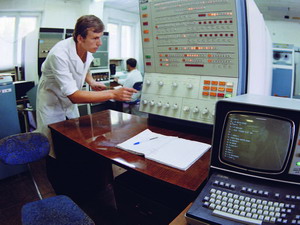
There was a large computing center at the Kurchatov Institute, where the system workers worked, and the author of the idea, according to Bardin, was senior engineer Mikhail Paremsky. “In 1983–1984, the first meeting of programmers in Protvino took place, where they gathered together different fragments of UNIX and presented a more or less integral version,” says Bardin. “From there, the party took up, who did all this.” Programmers of the Kurchatov Institute and the Department of Applied Mathematics IPC Minavtoprom, headed by Mikhail Davydov (as well as specialists from other organizations, for example, the High Energy Institute of Physics in Protvino, JSI in Dubna), adapted the “Operation” from the United States to the computers available in the USSR. “Then it was called initiative development,” recalls Sergey Ryzhkov. The rest of the “veterans” confirm: the order of the authorities, there were no ministries for these developments-everything was done on the enthusiasm of young scientists. The programmers of these two groups turned UNIX into a demos - a system for computers of the BESM series, Elbrus 1k2, Electronics 225, EU computer, etc. Demos developers - 25 people - were awarded the Prize of the Council of Ministers of the USSR for 1988. “It turned out about 450 rubles somewhere. per person, ”recalls Bardin. There were victims: for example, the programmer Vadim Antonov was excluded at once from the Komsomol and from the faculty of the ICS of Moscow State University for refusing to go “to potatoes”. The efforts of the Komsomol Central Committee were required to restore the laureate at the university and the "advanced detachment of the party."
Foreth "Unlimited"
“The description of the history of the Internet often begins as“ one morning Gagarin decided to fly into space, ”Bardin laughs. - We all understood what we were doing, and went to this for more than one day. The same Unix has explicitly expected from the late 70s. A large scientific network was created in the USSR - and all this before connecting to the Internet. ” The Web in the USSR had other "godparents". By the birth of the Internet, academician Yevgeny Velikhov, director of the Kurchatov Institute, now secretary of the Russian Chamber of Russia. “With his support, modems were acquired,” Kurchatovites recall. - For international communications, Velikhov gave one direct telephone number (in the territory of KIAE there was his own substation). By the end of 1990, about 30 organizations were connected to the network, including centers of Russian science in Serpukhov, St. Petersburg, Novosibirsk, Dubna. ”
Alla, is this a KGB?
Davydov, Bardin and others know for sure when the Internet was born in the USSR - August 28, 1990. On that day, the programmer Dmitry Volodin phoned (with the filing of Estonian Leo Tomberg) to the computer user Petri Oyal at the University of Helsinki. The focus was that not the Department of IPC Minavtoprom, but a whole network from the USSR, joined the computer in Helsinki! “First, a network of several scientific centers and their employees in several cities of the USSR formed and only then did it reach the west. They paid only for intercity in Finland. At first, a stream of mail went from amazement - they discussed there: "Is this a joke or not?" And "Is it a KGB or not?" - recalls Bardin. “There was such a feeling of breaking through the Berlin Wall, especially on the periphery of our network, a sort of attached state.”
Zone .Su
However, the .Su domain did not appear immediately: the letters came from the USSR, but in the opposite direction - to the Finland server marked. SU. The Finns sent letters to the desired address. Vigilant Russian emigrants immediately realized that it was a KGB. Dmitry Wulis, one of the participants in the USENET conference, even “irrefutably” proved this in lengthy work (“CPSU could not”, “the army is not up to it”, it is clear that the KGB is “there is no other power in the USSR”). “In order to take suspicions, I had to connect his acquaintance of a mathematician from Moscow,” says Bardin, after which Wulis believed in the “scientific” origin of the aliens because of the iron curtain. The domain was registered a little later - September 19, 1990. “A semi-drunk, enthusiastic-dinked state was preserved,” says Valery Bardin. “We sent a request to register the domain, we thought that we had to wait two weeks, and connected that evening.” The Moscow node of the Internet, through which the network went further west, originally worked on one IBM RS-286! The canvas in the closet of Pope Carlo was broken, the "dog" of e -mail went on flight.
Coherent revolution
In 1989, Mikhail Davydov decided to create a cooperative who would distribute the Demos system (“Dialogue Unified Mobile Operating System”), other software and “iron” for money. Programmers who did not have the concept of doing business successfully traded - at that time there were mainly state -owned enterprises. Runet developed Runet on earned money, which was not yet called that then. There was an extensive network “Academy”, a demos and “relay” were built by their network - they exist now, although they are little known. The cooperative “Interface” (predecessor of the demos) was created with the personal participation of Yuri Luzhkov and Oleg Tolkachev, later recalled Davydov. Luzhkov at that time was a boss at the Moscow City Executive Committee, registered cooperatives. Hearing that the cooperative will “write programs”, the future mayor said the firm “no”: “Cooperatives are created to serve the population, and you will suck out money for your programs from state -owned enterprises.” Having wandered the night, the signature documents were reduced, saying that the cooperative would write programs for car owners - for “testing their personal cars”. “Then our first television advertising appeared: the Bulgakov cat turned his head to the seller for not wanting to sell imported equipment for rubles,” Davydov recalled (most of the sales of computers was then committed for currency). And Tolkachev helped Demos to rent a building on the Ovchinnikovskaya embankment. “Then it was a homeless person, but the Kremlin was visible from the windows of the 2nd floor,” the “founders” of the Internet recall.
The "star hour" of the Soviet Internet came in August 1991. “With the start of the coup, all traditional channels of information transfer were cut off,” recalls Sergey Ryzhkov. “And from the demos to the whole world there were reports about the situation in Moscow, about the movements of tanks, demonstrations of the defenders of the White House.” Valery Bardin says that in those days they personally connected information agencies to the Internet: RIA Novosti, Interfax and the Moscow City Hall. “We put reports of news agencies in our news feed tape,” he says. “And the local authorities in the country with a delay for only an hour received reports from the providers, as a result of which they quickly realized that, in addition to the movements of the technology, the State Emergency Committee had nothing behind the soul.” Davydov wrote in network memoirs as the director of the library of the US Congress tried to “get out” from programmers a copy of that August correspondence, about 50 thousand messages by e -mail, but did not succeed. “Oddly enough, the 8th KGB Directorate (it was engaged in communication systems and ciphers-now enters FAPSI.-The New Times) did not block the Relkom network,” Davydov was surprised. “The participants in the events recall that they called from the“ eight ”, they wanted something, but they never took hard measures.” The scheme was again repeated during the events of 1993.
Zone .ru
The country - the USSR - disappeared, but the domain remained. When domains of higher levels were established in the United States, the .ua and .bu zones were fixed after Ukraine and Belarus, and the .ru, in addition to K.SU, for Russia. Then, at the first stage, the “relay” and the demos possessed the most mass network in Russia. However, from 1990 to 1994, when the .ru zone appeared on the world network, there were others: VNINIPAS, “Owls Teleport”, “Sprint”, “Glaznet”, Rosniyro, Relarn, Freeenet, Fidonet. They were helped by investors from European and American organizations (for example, the western part of the Demos network “Relkom” paid for the representative office of the Carnegie Foundation), as well as the government agencies of Russia (the same Ministry of Communications), and most importantly, they had their own communication channels with the world. The most common circuit of the global web space was ground channels through Northern Europe to American servers. RosNIIRO - RELARN (free network of "Relkomovtsy"), for example, grew out of the understanding that universities working on the Relkom network should not pay for communication. Fidonet, created in the United States in 1984, came to Russia in 1990 and was the most popular and inexpensive network (only payment of telephone conversations).
In 1992, Ryzhkov recalls, Relkom established the first online channel (similar to modern) to Tallinn, and from there there was already a digital channel in Helsinki-so the Russian Internet with Europe was connected. “I remember that the first time for using the channel it was necessary to pay 20 thousand rubles a year - they were paid by organizations initially connected to the network,” he says. Zhiguli then cost 45 thousand rubles. The demos was also engaged in the first connection of private users: they had to purchase an IBM PC, personally get the login and password on the Ovchinnikovskaya embankment, and then install MS-DOS, after which it was possible to send and receive e-mail, which was then paid by users “wandering”. Already on April 7, 1994, the upper level of the upper level .ru was officially registered in Internet. And the world www “saw” Russia.
_______________
1 Cristopher Andrew, Oleg Gordievsky, KGB: The Inside Story, 1990.
From the Nativity of Runet • New Times • RIMA — Russian Independent Media Archive