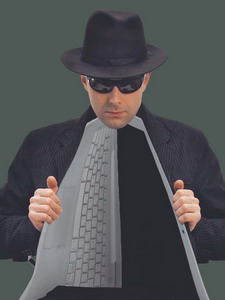
Today, the Internet is the only uncontrolled free platform uniting people from Moscow to Kamchatka, from Ingushetia to Murmansk and Yakutsk. This country lives a life that you will not see on the screens of central television. She informs, she discusses, she creates communities - that very civilian society (read on page 18), on which only the lazy did not complain in Russia. Actually, the people in the conditions of strict control over the media. Son-.ru performed this role almost from its very birth in the late 80s (about the history of Runet-on page 52). Then, as now, the political police, the KGB, was burdened with the question: how to establish control over the network? While the intellectuals in uniform thought, went through, the country collapsed. And a new one appeared. Over the years, the space of freedom in the country of real was compressed as shagren skin. But the virtual country grew up, protecting in the network space what they lost in real: today in Russia there are already more than 33 million Internet users, business defense-hundreds of million dollars (p. 7). But the big brother does not sleep, endlessly inventing the laws and methods of monitoring the network, arranging demonstration processes over bloggers or forming the teams of cyberkillers (p. 14). However, so far without great success. Bye. The economic crisis, the growing unemployment, the fear of social protest, the ghost of the “Orange Revolution” a la RUS, finally, information asphyxia forces people in the power, including the famous blogger-President Dmitry Medvedev, to peer carefully at the computer’s screen: what does this country unknown to them live? What to expect from her? What to be afraid?
The presidential administration has a problem: it is difficult to control the network, but it is impossible to leave it unattended in a crisis. The task has been set: to ensure the dominance of pro -Kremlin views on the Internet. This happened after demonstrations of motorists in Vladivostok, when thousands of citizens took to the streets, protesting against raising duties on the import of foreign cars. Until now, the authorities belonged to the World Wide Web. In the late 90s-early 2000s, as one of the founding fathers of Runet Anton Nosik says, in the Kremlin there was a project to introduce control over the Internet space, but from him-for the ambiguity of how to do this, they decided to refuse. During the parliamentary and presidential campaigns of the 2000s, the Internet did not play a significant role. Both times, the deceased union of right -wing forces tried to enlist the support of its inhabitants. But - without visible success. The TV once after time was more powerful and effective. As confirmed by the events of August last year-a five-day Georgian-Ossetian war (see The New Times No. 34 of August 25, 2008). But performances in Vladivostok and, most importantly, the reaction to them in other cities forced the Kremlin to think.
Anti -mode web
As before, television did not report the dispersal of demonstrations in the Far East. The news agencies, newspapers and even Internet media were silent, there was no information. The Blogosphere played a decisive role. It was thanks to the live magazine about the performances of motorists that became known in Moscow, from the blogs the information also got into traditional media. Photos of the protesters holding the Putler - Kaput and Vovochka, out of the class, flew around the entire Internet. “The leadership (countries) really did not like how uncontrolled information from Vladivostok was large -scale on online platforms,” the interlocutor in the presidential administration told The New Times.
From this moment on, the presidential administration began to prepare the meeting of the main Russian ideologist, and part -time the first deputy head of the AP Vladislav Surkov with bloggers. According to The New Times, this meeting is planned in mid -March, and about 20 people will be invited to it. In the short list, famous bloggers as Samson Shutemi (more than 3 thousand people read his blog), Daria Mitina, a former State Duma deputy, and now one of the leaders of the Russian Communist Youth Union (about 1.5 thousand readers), Maxim Abrakhimov-the Voronezh Commissioner of our movement “Our” and also a blogger (2.5 thousand “Frends”). Most likely, the list will also include the leaders of the “Young Guard” Maria Sergeeva, who became famous after the rally of the Party of power on January 31, at which she suggested that the opposition teach Vladimir Putin how to make “Lada” Lexus. It is claimed that there will be another commissar of “ours” Maria Drokova, sadly famous for her complaints against Immanuel Kant (she complained, of course, to Vladislav Surkov), whom she was “hard to read”. In May 2008, she received the medal of the Order “For Merit to the Fatherland” of the II degree - for active activity in the field of youth policy. Finally, political technologists specializing in working with the blogosphere will take part in this important meeting.
The purpose of the meeting is to develop a strategy for information campaigns on the Internet. This is formulated like this: “There should be an answer for each call, and better two answers at once,” explained a source familiar with the process of preparing this meeting. -If the opposition launches an online publication, the Kremlin must respond with the launch of two projects. If a user tells about protests in Vladivostok in a living magazine, 10 Kremlin political technologists must come to the blog who will convince the audience that everything written is a lie. ”
New front
Vladislav Surkov is already not indifferent to the blogosphere. According to The New Times, he periodically holds meetings with Zamremlin political technologists: how they should cover certain important events on the Internet. For example, one of the closed meetings took place in September 2008, immediately after the completion of the battles in South Ossetia. Then Surkov instructed how to fight with Georgians not only on the battlefield, but also in the media field. Following the results of those consultations and the actions of them in the European Publishing House 1, the book “Chronicles of the Information War”, written by political technologists, Maxim Zarov and Timofei Shevyakov, was published. In the annotation to this work, the following introductory is given: “Network wars have always remained an internal feature of the Internet - and in real life they were not interested in anyone. A five -day war showed that the network is the same front as traditional media, and the front is much larger and operational. August 2008 became the point of forming virtual reality of conflicts and the moment of awareness of the need to wage war, including on the information field. ”
Hello from the 90s
The Fund for the effective policy of Gleb Pavlovsky was the first, back in the late 90s, began to guess what role the Internet could play in the future. Then the oldest online publication “Russian Journal” was founded, now being in an enduring crisis. Then, with the participation of FEP, such successful Internet projects as Gazeta.ru, Lenta.ru, Inosmi.ru were born. But over time, the Kremlin began to appear new favorites. By the beginning of the 2007 election campaign, Konstantin Rykova, the NewMedia Stars Publishing House, went to the main favorites of AP (in December 2007, Rykov was elected to the State Duma according to the United Russia lists from Nizhny Novgorod). The efforts of the Internet entrepreneur and deputy Runet were replenished with such publications as “Days.ru”, “Glaz.ru” and the video portal “Russia.ru” launched in front of the Duma elections. Now in the favorites the publishing house of Vadim Gorshenin, which includes the online publications Pravda.ru, Yoki.ru, electorate.info and the Politonline.ru created a few months ago. The well -being of Gorshenin’s publications is ensured by the former chief PRP of United Russia Konstantin Kostin, who in June 2008 replaced Alexei Chesnakov as deputy head of the domestic policy of the presidential administration.
The presidential cut
The destruction of competition leads, as you know, to the fall of the quality of the product issued by the monopolists. The authorities were faced with this problem in November 2008, when on the day of the Pompous Congress of United Russia in the Gostiny Dvor it was announced to create a “new social network for those who are not indifferent to the future of Russia”. The social network of United Russia “Berloga.ru” was really launched, but this project was made so crookedly and caused so much ridicule among ordinary users of the Internet that it had to be closed immediately and in a hurry to redo it.
The money after this failure, however, did not cease to allocate money. “Both in the Kremlin and in the Zamrevelee structures, there are a lot of people who know about Dmitry Medvedev’s love for the Internet and want to play more money on this,” said the NewMedia Stars in an interview with The New Times. -Therefore, it is the Kremlin political technologists that are the first to protest against the introduction of some restrictive measures or the construction of the Russian version of the “Great Chinese Firevol”. As long as the president who is fond of the Internet is fond of the Internet, budgets for Internet projects will be generously allocated. ”
The end of the freebie?
However, the crisis will force the presidential administration to revise its financial policy. Now you will have to fight for the minds of the Internet audience of Kremlin political technologists in a monetary deficit. According to the New Times, a source in the Kremlin administration, at the March meeting, Vladislav Surkov will announce the cutting of budgets on Internet projects. For example, they say, budgets for the development of Internet television "Russia.ru" will be reduced. Partly, this information was already confirmed by Surkov himself. Speaking on February 9 at the Strategy-2020 forum, the first deputy head of AP said: “It is very important to get used to the idea that there will be less and less money.” “All politicians in the country are used to the fact that politics is when you have achieved an increase in some line in the budget,” complained Vladislav Surkov. “However, now the idea of politics must be greatly changed: the method should not be“ problem - money ”, but“ the problem is the solution to the problem ”, serious work should be carried out to resolve issues.” Do you solve?
_______________
1 created by the Effective Policy Fund of Gleb Pavlovsky.
Country Point ru • New Times • RIMA — Russian Independent Media Archive