
Translated material
Bilateral reservations
In August 1830, the newly arrived American messenger John Randolf, introducing himself to Nicholas I, slipped on the parquet of the Winter Palace and fell to the feet of Empress Alexandra Fedorovna. Having risen, he at ease turned to the king on Tu: "How are you, emperor? How Madame?" Nikolai decided that he was crazy in front of him, and Alexandra Fedorovna - that the envoy demonstrates "eccentric republican etiquette."
In fact, Randolf simply spoke French very poorly. He did not manage to do anything at his post and left St. Petersburg for an unknown reason three weeks after the description described, and not having time to hand it to credentials. Following, he really suffered from a mental disorder.
This is far from the only episode of the history of American -Russian relations related to language, and if you like, by a civilizational barrier. Here is the case, a witness and partly the participant of which I myself was. In July 1999, during his brief premiere, Sergey Stepashin came to Washington. Speaking in the national press club, he told a joke about the owner of the Zaporozhets, who answers the offensive remarks of the American with an irresistible argument: "And you have blacks!" The hall met a laid -back joke with grave silence. But when the television people turned on the Sofites, and Stepashin, having grown up, complained that he was not used to this location of lighting devices - you can’t see faces, a lonely but hysterical laughter came from the gallery for the press. The prime minister was bewildered in the eyes, and the American colleagues glanced at me like a psycho. Well, I could not explain to them in any way that the former boss of Lubyanka was used to the lamp shining in the face of the interlocutor!
In recent years, translators of both countries have especially tormented with all these “torture in the toilers” and “werewolves in uniform” (ITAR -TASS, I remember, translated the Gryzlovsky Perl as Wolves in Sheep Clothing - “Wolves in Sheep's Black”, and the New York Times - as Werewolves in Epaulets - "Werewolfs in the epaulettes"). And on Friday last week, translators of the US State Department distinguished themselves.
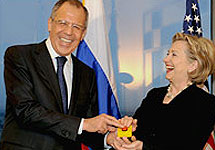
About how Hillary Clinton was promised, giving Sergey Lavrov in Geneva a box tied to a bow, only the lazy did not write. In the box was a symbolic button with the inscription by the Cyrillic "overload" and in English Reset. “We tried our best to find the right word,” Hillary fled. “You found the wrong one,” Lavrov said sternly. And he explained that it was necessary to write a "reboot".
Over the translators of the State Department, both in the Russian and American press were pleased. The story is really amazing. Even a vague guess of the reservation on Freud comes to mind - after all, the governments have a subconscious. At a briefing, at the end of negotiations, Lavrov once again returned to the topic of the button: “We have already managed to achieve one specific practical result. We have reached the consent of how“ rebooting ”should sound in English and in Russian. Now there are no discrepancies. And I am sure that this is a contribution to the interaction between our people in Russia and the Russian language in the United States in the United States in the United States America ".
But let me, Mr. Minister! "Reloading" is also wrong! "Reloading" in English - Reloading, Restart or Reboot. When performing this operation, the processor rebuilt all the data from the hard drive exactly in the form in the form in which they were before reloading. And reset in Russian is a discharge of data, return to the starting position, restarting the system in order to get rid of network garbage or freezing; In order to prevent random restart, on modern computers, the Reset button is drowned into the case. When it comes to a meter or an hourly mechanism, Reset is an installation on zero.
The difference, as we see, is fundamental. This is exactly what the Vice President Joe Biden, the author of the reprise about the need to press the Reset button in the American-Russian relations, and then understood him in Russia correctly: "Start from the clean sheet." No, it’s too early to talk about the minister’s contribution to the questions of linguistics.
And we must also find out what kind of state of bilateral relations Biden considers a clean sheet.