
Translated material
World fireworks
North Korean missile is not as terrible as dangerous
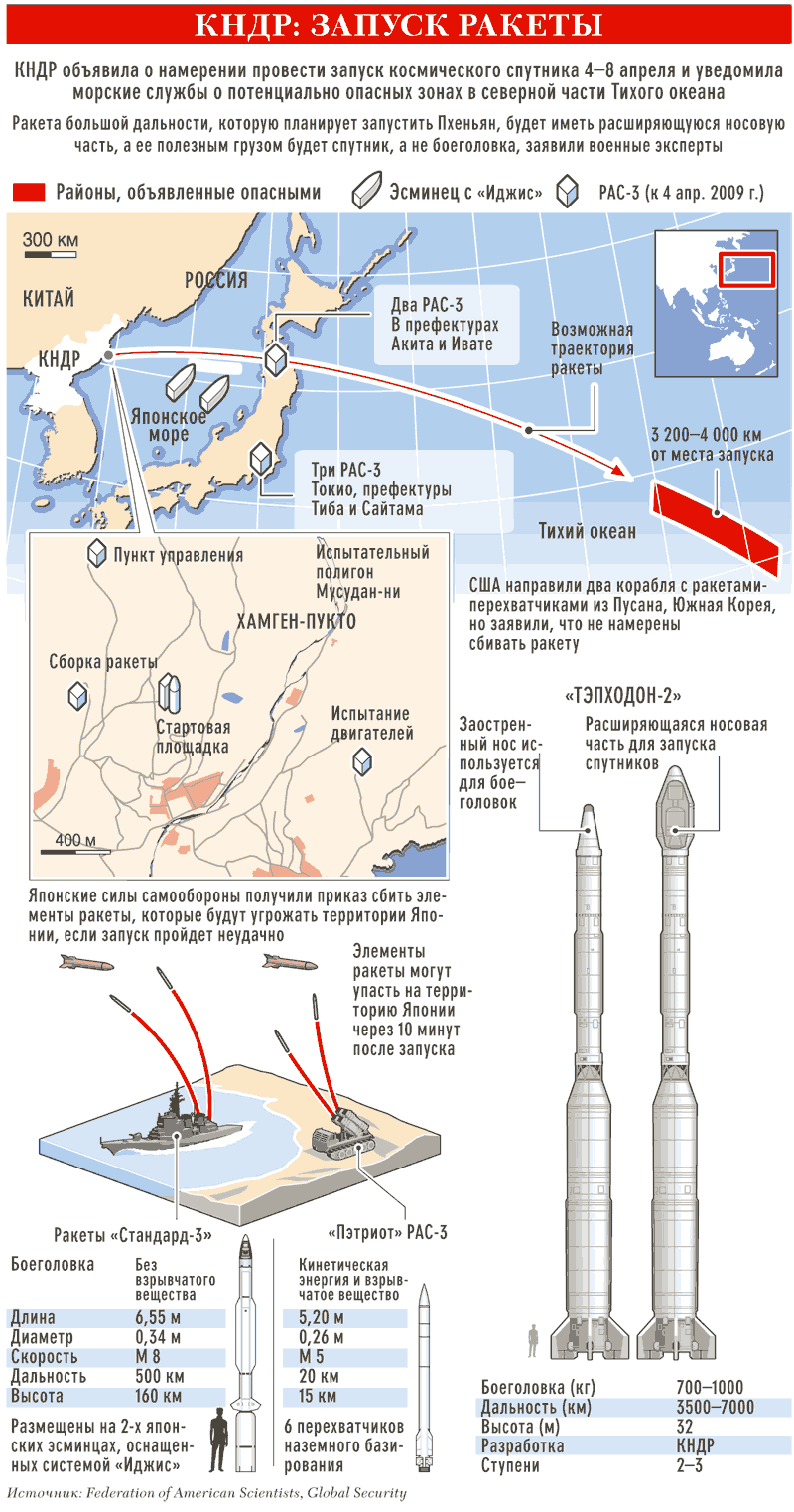
Dangerous show. At the landfill on the coast of the Sea of Japan, preparations for the launch of the North Korean rocket are ending. The DPRK does not take a secret from the launch - it is officially announced that it will happen in April. The New Times recognized the size of the North Korean military threat
In Pyongyang, this event is described as preparations for the launch of an artificial Earth satellite, part of the program of “peaceful development of space”. Pyongyang even sent all the necessary applications to international organizations engaged in the launch of satellites. Nodon Sinmun, the main North Korean newspaper, recently made an invectors to the evil imperialists and their accomplices, who, they say, only dream of how to take away their old dreams from Korean children ... to become astronauts.
The launch expected in the coming days is most likely to be carried out along the satellite trajectory, which will allow North Korea with anger to reject all the accusations against it. In his course, many will be worked out, but not all elements of real combat launch. The goals of this launch (as well as the entire North Korean missile and nuclear program) are not so much military as political, diplomatic and advertising and commercial.
Where does the thrush come from? However, the question arises: why is the DPRK, a country that, in basic macroeconomic indicators, is noticeably inferior to mosambic and recently survived catastrophic hunger, is engaged in non -cheeky missile technologies? And how did you manage to get these technologies? I must say that, despite understandable secrecy, quite a lot is now known about the North Korean missile program. A significant role here was played by its semi -commercial character: many of the missiles were sold to the third countries, which contributed to the leaks of information. Several thorough work of American and South Korean specialists - Daniel Pinkston, Joseph Bermudes, Charles Vika is devoted to this program.
The history of the North Korean missile program dates back to the 60s, when in Pyongyang they were seriously preparing for the second round of the intra-Korean conflict. The North Korean military needed missiles that could strike at American bases in South Korea and Japan.
At first glance, they could simply be bought from the USSR or China. However, everything is not so simple. Despite public assurances in "eternal and indestructible friendship", Pyongyang and Moscow were not friends in any way. In Moscow, they did not want to be unnecessary to arm Pyongyang, because they understood that the DPRK would use the weapons received, at all regarding Soviet interests, and the new Korean war was by no means part of the Moscow plans. Therefore, the Soviet Union refrained from sending modern offensive weapons to the DPRK and delivered only short -range missiles there.
Kim Il San could only hope for his own engineers, as well as scouts and diplomats, before whom they set the task to get a prototype for copying. How this problem was solved is still not entirely clear. At one time there were rumors that the missiles got into the DPRK through Syria, but now all foreign experts agree that the prototypes were bought in Egypt. In any case, through Egypt in the late 70s, several Soviet R-17 missiles, known in the West as Scud-B, with a range of 300 km, got into the North Korea. These missiles were first simply copied by North Korean engineers (“Khusason-5”), and then somewhat modernized (“Shzason-6”).
By the end of the 80s, our people in Pyongyang turned into one of the few countries of the world, which, on the one hand, had missile technologies, and on the other, they could not reckon with shouts from Moscow and Washington and were ready to sell missiles to everyone who could pay well. Among buyers, Iranians played a significant role, which widely used North Korean missiles during the war with Iraq (about 80 military launches were held in Iraqi cities).
By 1990, North Korea began the development and high-range missiles, which was important, including because of the intensification of nuclear weapons. In a sense, the North Korean leaders were lucky: due to the collapse of the USSR and the subsequent economic crisis without work and income, many talented engineers in Russia and Ukraine turned out to be. North Korean intelligence was able to contact many of them. However, the North Koreans began to steal missile secrets earlier, even in those days when formally Moscow and Pyongyang were allies: the expulsion of excessively inquisitive Korean cadets and graduate students from the USSR took place back in the 80s.
Of course, Moscow was not glad of the prospect of the appearance of rocket and nuclear North Korea on the borders of the Russian Federation, and the Russian authorities tried to prevent these contacts. At the end of 1992, a large group of military engineers sent to Pyongyang was removed from the aircraft ready to fly out. However, it was completely unable to block the channel: too seductive proposals were then made by engineers in Miass and other places. According to Charles Vika, a well -known expert on missile weapons, engineers from the former USSR, depending on their qualifications, offered salaries from $ 1,500 to $ 4000 per month - an impressive amount in 1992-1993. So, some of the ex-Soviet experts were in the DPRK and played a significant role in the deployment of the North Korean missile program.
The hymns from heaven did not stop, despite the most severe economic crisis and mass hunger. In the 90s, Pectusan-1 missiles were created in the DPRK (more known as Tepkhodon-1, 2500 km) and Pectusan-2 (Tepkhodon-2, 7000 km).
Pectusan-1 acted as the basis for the first Korean space rocket, which was launched on August 31, 1998 from the training ground on the coast of the Sea of Japan. The North Korean media claimed that the satellite launched then went into orbit and began to fulfill his task - the broadcast of revolutionary songs about the beloved leader Kim Jong Ira. True, in reality, the launch was unsuccessful, and the satellite fell into the Pacific Ocean.
This failure once again recalled that the North Korean missile program is carried out by a poor and technically backward country, and already because of this is not accurately. Experts note, in particular, not the highest reliability of missiles, which often explode on launch sites or at the initial stage of the flight. The most powerful of the North Korean missiles Pectusan-1 and Pectusan-2 were launched only twice, and one of the launches ended with an explosion of a rocket at the 40th second of the flight, and the other (the launch of the satellite in 1998) was only a partial success due to failures with the third step, that is, the satellite itself. Achilles fifth of all North Korean missiles remains a guidance system. In July 2006, when the DPRK conducted a simultaneous test of several missiles, two of them deviated from the course and fell into the sea 60 km from the find.
Theoretically, missiles with such low accuracy in combat conditions can only be effective when equipping them with nuclear warheads, but more or less all Western experts agree that there are no such warheads at the disposal of the DPRK and their development is a rather distant future. Finally, David Wright from the Massachusetts Institute of Technology generally believes that the Pectusan-2 carrier, which served as the basis for the current rocket, cannot be used to strike at the United States. According to his estimates, this rocket can bring a relatively light satellite into orbit. But with a much more severe warhead, its range will be insufficient to defeat goals in the United States.
Thus, the North Korean missile program in its current form does not increase the chances of Pyongyang to win the war. However, its main role is not military, but political and commercial, and now the program is fully coping with it. Firstly, it brings some money to the meager North Korean treasury, and secondly, it serves as a quite effective tool for pressure on the world community. In addition, the North Korean missiles continue their work, and many of the current problems, most likely, will be able to overcome over time.
The message of the enemies launch of the rocket is partly designed to attract the attention of foreign buyers to the North Korean missile technology, and partly with a propaganda gesture addressed to their own population. However, first of all, the April missile show pursues diplomatic goals.
Firstly, the launch of the rocket is a kind of message to Washington, who is now not up to North Korea: the economic crisis and the situation in the Middle East are more and more distracted. If the United States ceases to consider Pyongyang a serious threat, then the DPRK will become much more difficult to receive economic assistance from the United States, as well as use Washington in its diplomatic combinations.
Another political goal of launch is, of course, South Korea, the government of Lee Men Buck. It tried to link the provision of economic assistance to the North with the fulfillment of political requirements, which for the most part for the North are unacceptable. In response, Pyongyang began to escalate tension in relations with Seoul. In Pyongyang, they want the South Korean authorities to have no doubt: interaction with the DPRK is possible only in the North Korean conditions. Not so unequivocal and in relation to Tokyo. In recent years, the relations of Japan and North Korea, which used to be cool, but not hostile, suddenly aggravated. The Japanese government now needs an external threat, the existence of which allows us to motivate partial remilitarization, without indicating without a special need for a real object of Japanese concern (this is China). In other words, a convenient enemy in the person of North Korea allows Japan to prepare without an unnecessary hype to be repulsed by the replacement of the Western neighbor.
The launch seems to be practically predetermined: after it was announced publicly about it, North Korea cannot refuse him without losing his face. In the same way, there is no doubt that in the North Korean press the launch will be declared successful, even if in reality it ends in complete Fiasco.
Professor University Kukmin
Seoul