
Translated material
The percentage of survival
The fate of the "golden billion" in the hands of a billion Chinese
Walking patient. The eyes of the economic world today are addressed to China. If the PRC manages to preserve the 8 percent growth of its economy, then this heavy truck can pull out the developed countries of the world out of the crisis pit. If growth falls to 5-6%, then this will affect the world market, and China may be on the verge of a social explosion. What is happening in the Middle Kingdom - The New Times found out in the capital of the manufacturing industry of the PRC 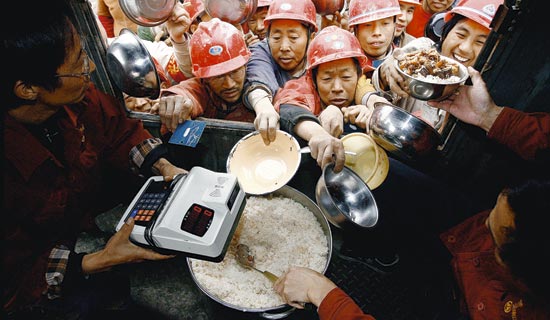
The city of Dunguan of the province of Guangdun is the capital of the manufacturing industry of China. More recently, a giant stream of goods from here spread around the world. And by no means one shirpotreb. For example, the microcircuits produced in Dunguan are used in the American air defense system, which became known about the general public last year, when the defective Chinese chip caused the tenderness of the tests of the new system.
In the pre -crisis period, only officially registered companies in the city were more than 30 thousand, underground - many more, and how many God knows. The 500 largest world companies opened their plants in Dunguan.
The bird in the cage of the clouds began to thicken at the beginning of last year, and in August there was a uniform collapse. Only according to official figures, almost 5 thousand enterprises closed. Juan Yuyusao, an engineer who worked in a construction company, recently received a dismissal notice. She honestly paid the three salaries plus bonus specified in the contract. With this money, you can live a year comfortably, besides, Huang Yuyuso’s husband works at the Ministry of Defense, receives a good salary and is unlikely to be reduced. But the colleague Juan Yuyusao, who cannot afford to sit at home, sent out more
800 resumes, more than 10 interviews passed, but never found work.
The true scale of the disaster can be judged by preliminary figures made in the Association of enterprises with foreign participation of the city of Dunguan: in the IV quarter of last year, compared with the same period of 2007, the volume of foreign orders was reduced by 15–20%. Professor Zhongsan, Professor Zhongshan, who is not yet accurate, believes in the production of the Dean of the Faculty of Finance and Taxes of the Institute of Finance and Taxes of the Institute of Finance and Taxes. Without much optimism, those who are directly related to production look into the future. The director of the spinning factory Van Shenglin is convinced that a wave of mass closes in Dunguan will not fall in any case until the end of this year and will absorb two -thirds of the medium and small enterprises: “Now no orders are received. This applies not only to the spinning industry, but also of all sectors of the Dunguan economy. And here is the strengthening of the yuan - for us it is just a disaster. If the buyer paid $ 5 for goods, then for $ 5.5 he will not take it. ”1
Less than others, the closure of enterprises is concerned about the leadership of the province of Guangdun. The secretary of the local Committee of the Communist Party Van Jana has a popular slogan "to release a bird from the cage." In his opinion, the crisis will free the economy from labor -cost, non -ecological, unsuccessful industries, which, albeit not immediately, will serve the further flourishing of the province.
But while the grass grows up, the horse will die of hunger. Guangdun is one of the largest labor markets in China, and the closure of production here will inevitably entail a surge in unemployment in the country, which does not suit the central authorities. During the recent inspection trip to Guangdun, the Prime Minister of the State Council of Wen Jiabao, in almost every speech, repeated that the province should share difficulties with the whole country and do everything possible in order to save jobs. After such statements, local officials, of course, beware of openly repeat the formula “release a bird from the cage” in their speeches, but continue to act exactly in her spirit. Moreover, there is no complete unity at the top: unlike the prime minister, the General Secretary of the Communist Party of Hu Jintao, judging by his last statements, understands that the crisis is a unique chance to reform the economy. This again makes the transformations invented at the dawn of the era in the same Guangdun and a very popular recipe for the province of the province: “It is calm to go to the green light, quickly on yellow and bypassing red.”
Growth hormone if in most countries the growth rate fell to almost zero, or even to negative values, then China plans to get 8 percent GDP growth in 2009. This, of course, is lower than 11%below, but still higher than anyone in the world. Experts of the International Bank for Reconstruction and Development (ICBR) give a more moderate forecast - 6.7%, which is also an instinct. And within China, many economists consider the government’s plans not too realistic. After all, the country's GDP is almost 70% formed due to foreign trade, which only over the past year has fallen by 17.5%. The government responds to skeptics - the growth will provide 4 trillion yuan (this is about $ 586 billion), which will be poured into the economy for two years .2 only 1.18 trillion of them will allocate the center, the rest - regional governments, enterprises and private investors. Funds will go to the development of infrastructure, including the construction of airports, railways, metro in large cities, nuclear power plants, etc., as well as healthcare, education, housing subsidies, social benefits, in particular, unemployment benefits. By the way, the government has long planned to engage in a completely neglected social sphere, since it clearly slowed down the development of the economy, and this would inevitably require a decrease in growth rate - so there would be no happiness, and misfortune helped.
According to many Chinese experts, the main drawback of the 4-Trillion Plan is too much share (45%), directed to the development of infrastructure. In 1997, when the Asian crisis erupted, the government sharply increased the volume of investment in infrastructure projects. “Today,” says one of the specialists of the Institute of Economics of the Academy of Sciences of the PRC, “this volume is already quite large, and investments are made insignificant, and not the fact that they contribute to the growth of employment.” The authorities heeded the arguments of experts and infrastructure investments significantly cut, focusing on the development of internal demand.
Consumption for salvation 
In China today, the point of view won that the main lever, with the help of which you can raise internal demand, is urbanization, and above all the construction of urban housing. Most of the funds from the planned 4 trillion should be directed to this. Thus, it will be possible to occupy those who lost their jobs due to the crisis, and attract significant masses from the village to the cities, which suffers from excess of working hands. Other measures are also provided, such as the increase in the minimum purchase prices for grain, an increase in state allocations for the acquisition of equipment and inventory, increase the subsistence level, and increase pensions to former employees of state -owned enterprises and other social benefits. In addition, on December 1, 2008, the campaign for the distribution of household electronics in the village, the purchase of which is 13% subsidized by a state budget. The authorities of a number of cities and provinces also went direct distribution of consumer vouchers to the population (for example, for purchases for the Chinese New Year, for tourist trips, etc.).
But if the global crisis is delayed, all these measures may not work, many experts say. “Then,” the prime minister of the State Council, Wen Jiabao, said at a recent press conference, “will have to use a full set of ammunition.” The director of the Research Center at the Ministry of Finance of the PRC Jia Kan, explaining the government plans, said that if until May-June this year, GDP growth could not be kept at 8%, the center would have to increase funding for anti-crisis measures. “At the key point, you need to use budget funds without regret for these purposes.”
China already had such an experience. After the 1997 crisis, the government released long -term bonds by 50 billion yuan in order to send the proceeds to the construction industry. There was no noticeable revitalization in the economy for this, and then in several receptions bonds were issued by another 210 billion. In the early 2000s, it worked, however, with a much more favorable external conjuncture.
Delighting real estate, most peasants who came to the city work in construction, and it suffered from the crisis to the greatest extent. 70% of the enterprises of this sphere threatens the closure, 20 million recent peasants have already lost their jobs and returned home, although many experts believe that the last figure should be multiplied by 5. As a result, the village lost the money that the workers used to sent families, received an army of units not secured by the land, to trust all the troubles due to the crisis, the world prices for agricultural products were reduced, many countries entered it. Fasting duties. In general, the situation is astholy.
Advisor to the State Council of the PRC Zhen Yulin made a proposal in addition to the already planned measures to sharply increase the volume of investments in agricultural construction in order to occupy people and give them earnings. But the trouble is that the so -called Sannun problem in China - the problem of the village - was so old and acute that it can not be quickly solved. Meanwhile, the situation worsens every day, and in such conditions, it will be very difficult to ensure social calm to the government.
In any case, despite the significant assistance that the village receives, it will not be able to cope with its problems if the urban construction and the real estate market, which are in full decline, do not come to life. Until recently, a realtor Lee Jinjen from Shanzhen Province Guangdun was a rich man. In early 2003, he, a mechanic by training, bought two apartments for the accumulated 400 thousand yuan: one for himself, the other for leasing. It went - he rented, resold the apartments and by 2006 he already owned real estate for 1 billion yuan. The big turnover demanded large loans, and when the crisis struck, Lee Jincun, to pay off on them, was forced to sell all his real estate at rude prices. “The former Jintun died,” says the recent billionaire, “now I’m just a worker living in an apartment for peasants who came to work ...”
The city itself, if the construction industry does not revive, also not rise. At one time, it was the construction boom that launched an economic growth engine. Of the 50 richest Chinese who fell on the List of Forbes, more than 40 made their own states on real estate.
And local budgets are entirely dependent on the well-being of the builders-in most regions they are formed by 90% due to transactions for the sale of land, and this market is directly related to construction.
However, the company is wary of the government plans to support real estate for the simple reason that it is one of the most corruption. Therefore, the phrase “Real Estate industry” is not directly used in the 4-thrillion plan, although fixed assets are directed to it. On other grounds, but some economists are apprehension belonging to unrestrained pumping of funds in construction. They are afraid of the emergence of exactly the same credit bubble that recently brought down the financial system of the United States and the whole world.
Be that as it may, according to the latest information, government measures took the action - in March, real estate prices began to rise. In Beijing, the cost per square meter increased by almost a thousand yuan. However, the Fan Shiya, the real estate trader, the famous real estate trader, said that this is most likely a fluctuation and truly the market will not come to life very soon.
Nevertheless, both Chinese and Western experts greatly appreciate China's chances the first and without significant upheavals to get out of the crisis. Firstly, the country has accumulated huge reserves in foreign currency, the same “full ammunition”. Secondly, the Chinese financial system is under state control and therefore the crisis did not affect it too much. Thirdly, China is characterized by an extremely low level of social guarantees, so the government can direct a much larger share of GDP compared to other countries. At the recent Congress of the All -China Council of People's Representatives, delegates said with confidence: "China will become the world's first country to overcome the financial crisis."
1 since July 2007, when a strict binding to the dollar of a Chinese monetary unit was canceled, it has been significantly strengthened - from 8.3 yuan for $ 1 to 6.8.
2 China foreign exchange reserves are approaching $ 2 trillion, of which more than $ 600 billion are stored in the US Treasury bonds.
3, 20% of the richest citizens of China accounts for 66.4% of the country's financial resources, and 20% of the poorest are only 1.3%.