
Translated material
The traditions of Passha
The symbolism of Peshah studied The New Times
Pesakh - Jewish Easter - begins in this, 5769 from the creation of the world, on the 15th of the spring month of Nisan and is celebrated within a week. The ritual and all the details of the meal on the festive Easter night are called to recall the salvation of the people from slavery and the endless path to freedom, which has no end for ordinary mortals. This is a holiday-recall about how easily people became slaves and how difficult it is to become free. This is a story about what was and what is - about the past and present and that the slaves have no future. The symbolism of Peshah studied The New Times 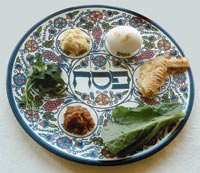
Seder's goal of the Easter meal is to force the participant to realize the outcome of Jews from Egypt not as a long -lasting event, but as his own experience of transition from slavery to freedom. This goal is the reading and discussion during the Seder of Easter Agada - a story about the history of Egyptian slavery, the outcome of Jews and the commandments of the holiday. Seder is a feast that provokes the participants to ask questions that they are unlikely to pretend on other days. After all, everything does not happen like on weekdays: they don’t eat bread, but Matsu, they drink wine without sitting, but leaning on pillows, modeling food in salty water, biting with bitter herbs. And Agada is not quite a book, but rather a score or script. Her heroes are those who are sitting at the table, since the seder is fundamentally interactive.
Four sons 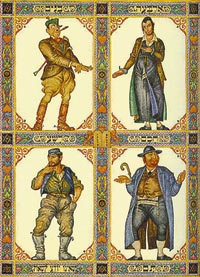
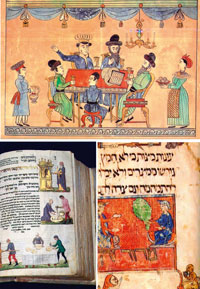
Type and era , since the task of Agada was to interest the “four sons”, that is, different in age and level of education of a group of people, visibility was required from it. Agada is one of the most richly illustrated books in Judaism. Most often, four sons are portrayed in their medallion as four psychological and social types: “wise” - in traditional clothing, “villain” - in the image of a warrior or hunter, “simple” - in the form of a layman or even in a clown cap, but “does not know how to ask” - like an articious child. For centuries, the essence of these types remains unchanged, but it is interesting how, in accordance with the style of the era, the appearance of the sons changes. For example, in the famous agad of the American artist Arthur Shik (1894–1951), behind which Hitler, furious by his anti -fascist caricatures, promised a reward, four sons are depicted as contemporaries of readers. "The villain" here is an aristocrat, a hunter, a modern version of the biblical Isava; “Not knowing how to ask” is a proletarian in work clothes; "Prostak" - a well -fed businessman; “Sage” is in traditional Hasida clothing. In the Jewish popular picture of the 19th century, sons turn into a family gathered at the parental table. On the right hand of the father of the father, the wise son, next to the “villain” in the uniform, followed by a “simpleton” and, finally, the youngest, “does not know how to ask.” A close to the popular consciousness, Lubok depicts everything intelligibly and as visibly as possible: the artist here forces all four sons to meet at the same table and start a conversation.
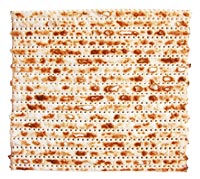
Matsu in Judaism in order to realize and comprehend a certain idea, you need to taste it: a meal with its symbolism is the core of any Jewish holiday. Pesakh is no exception: the vicissitudes of history, the concept of freedom and slavery, memory and modernity - all this is present on the Easter table in the form of signs. The main character of the Easter Sedera is, of course, Matsa, or, as it is also called, "poverty bread." Matsu recalls the meager diet of slaves in Egypt. It is no coincidence that during a feast there is a moment when Matsu is broken and hide most of it - this is exactly what a hungry slave does not confident in tomorrow. But at the same time, Matsu also symbolizes the opposite idea, because it is baked extremely quickly, no more than eighteen minutes, preventing the test from starting. This is the memory of a rapid transition from slavery to freedom: the Jews left Egypt in such a hurry that only the herbs managed to prepare. As the central hero of the Easter meal, Matsa became the main accused. As you know, the Jews were accused of "making fun of Christian blood for ritual purposes" in Matsu. The absurdity of this slander lies in the fact that according to Jewish dietary laws, any blood in food is strictly prohibited. Moreover, these accusations become ridiculous when meeting with a recipe for the manufacture of Matsa, which does not allow the slightest additives: only flour and water. However, in the traditional red wine, which they drink at the Easter table, stupefied with anti -Semitism, people also saw ritual blood. However, the same Europeans attributed special healing properties. In rural areas of Eastern Europe and Germany, the peasants believed that with the help of Matsa you can extinguish any fire, it could protect from hail and lightning, heal paralysis and even protect clothes from moths. Therefore, the peasants gave her to each other as a sign of respect as a valuable amulet.
Sweetness and bitterness in the collection of the Museum of Jewish ritual art. Wolfson in Jerusalem among traditional Easter attributes is a funny and curious exhibit. This is a metal vessel in the form of a miniature construction car dating from the 19th century. And only the purpose of the vessel explains its strange appearance. It is intended for a special Easter dish - a hareoset, a thick mixture of grated fruits, nuts and red wine. Haroset, like all other components of the meal, simultaneously reminds both bitterness of slavery and the sweetness of freedom. The name of the dish is consonant with the word "sherry" - in the Hebrew "clay". From clay, Jews in Egypt made bricks. A straw was kneaded into a clay solution, so one of the recipes of the Haroset includes ginger: the threads of this spice should hint at the interspersed of the straw. Now the shape of an unusual museum exhibit is becoming clear: this is a car for transporting building materials, stones and clay. In European Jews, Haroset consists of apples, pears and walnuts, while other ingredients are added to the oriental communities - grenades, figs, dates, almonds. The choice of all these fruits is not accidental: it is with them that the Jewish people are compared in songs of songs. The Haroset has a special function during the feast, bitter herbs - Maror are dipping into it. Usually under Maror they mean a mixture of horseradish and salad leaves. Maror is called upon to arouse the memories of the bitterness of Egyptian slavery. However, so that this memory is not too painful, the bitter Maror plunges into sweet Haroset.
The text, image and even taste merge at the Easter table into a single semantic whole. The book, illustration and food direct the thought of the Sedera participant, helping to realize the past, understand the present and look into the future.
Haroset in Macressan 150 g of washed and dried raisins, 150 g of dates without bones, 100 g of pistachios dried in the oven, 100 g of walnuts, 100 g of almonds, 1 apple, 1 pear, 1 banana, 3/4 glasses of pomegranate juice, 1/2–1 tsp. nutmeg (to taste). Silence everything in a blender, served in a deep salad bowl, you can on a salad sheet.
Haroset in Ashkenazi (Eastern Europe) 1 cup of walnuts (can be replaced with another species), 2-3 glasses of sugar, 2 or 3 large apples, peeled from peel and bones, 1 tsp. Cinnamon, 2-4 tbsp. Sweet red wine.
Skip the nuts and sugar once through a meat grinder or ground in a combine. Transfer the resulting lumpy mass to clean dishes. Grate the apples on a coarse grater and combine with walnut mass. Add cinnamon. Gradually add wine, forming a dense mass. If desired, you can add more sugar. Serve with Matsu.
Haroset serves as a kind of seasoning or sauce into which Maror is dipped before eating. Bitter plants are used as Marora: fresh horseradish, Italian salad and chicory.
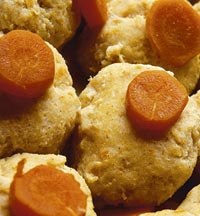
Gfilt Fish is the first festive dish. The traditional Gephilt Fish is the balls made of fish minced fish cooked in fish sauce. For minced meat, fish (several varieties can) are passed with onions through a meat grinder and mixed with an egg, ground mats and spices. The sauce is prepared on the basis of fish broth, in which onions are placed, whole or chopped carrots, salt, pepper, and also (if desired) cut potatoes, sugar and paprika.
Long Gephilt Fish 1 3/4 kg of a sig and cod, 1 onion, 3/4 cups of ground Matz, 1 tbsp. a spoonful of oil, 1 teaspoon of salt, 1 teaspoon of black pepper, 1 potato. The bottom of the pots is covered with vegetables, as for the preparation of the main fish sauce, and chopped potatoes. Add seasonings. Fish mince is well mixed and the shape of the loaves are given. Carefully put them on vegetables. Slowly water is poured so that it is closed, brought to a boil and boiled over medium heat for an hour.
This mixture is also suitable for a standard gephilt of fisha in the form of balls. First, the sauce is brought to a boil, then fish balls are added there.
Gephilt Fish is often served with horseradish or slices of carrots from sauce. You can serve on salad leaves, with slices of tomato, cucumber.