
Translated material
Ten "horror stories" of antitrast
The need and legitimacy of economy regulation has been increasingly questioning. Despite this, the antimonopoly legislation, which declares unrealistic a number of methods of doing business, continues to enjoy general support, as well as the idea that antimonopoly laws protect the interests of consumers and are an instrument of public good. “Polit.ru” publishes an article by Claid Wayne Kryus Jr. , in which the author analyzes the features of business regulation in detail, and also criticizes antimonopoly legislation as contradicting property rights and the nature of the market. The material is provided by the Russian project of the Cato Institute.
Brief content
Antimonopoly legislation is one of the forms of regulation of the economy. And, as it always happens with such regulation, it ensures the redistribution of wealth - often in accordance with the requirements of groups of interests. Including as a result of recognition of such shortcomings in many sectors of the economy, for example, in transport and in the field of telecommunications, partial deregulation was carried out. However, antimonopoly measures are still successful. Even in the context of the “new economy”, these laws of a hundred years ago - the era of “smoking factories” - are used to justify the restrictions imposed on the activities of companies such as Microsoft or Aol Time Warner. Almost everyone believes that antimonopoly legislation serves the interests of society and is necessary for “supervision” behind market mechanisms.
However, when it comes to “antimonopoly” trials, it should be noted that their outcome is of direct financial - and not ethical - interest for competitors of those companies that are persecuted by the court. The allegations that antimonopoly laws serve as a public good, do not completely cancel the fact that private motives of competitors always loom here in the background - and even ambitious officials. The idea that antimonopoly legislation helps consumers and retains expediency in the conditions of the “new economy” requires attentive analysis.
In the framework of antitrust legislation, a number of business methods “falls under suspicion”, and some other procedures are completely declared outlawed. However, transactions in business, in fact, are voluntary transactions, without any coercion-in contrast to the "antimonopoly" intervention in the economy. If you look at them under these uncomplicated stereotypes with an angle, it turns out that even the most “unworthy” methods used in business - such as conspiracy and megasia - can contribute to the competition and interests of consumers. To the extent that antimonopoly regulation eliminates methods, the effectiveness of which is quite justified, but is ignored or incorrectly perceived, it reduces the level of material well -being of individual individuals and society as a whole without need.
The list of business methods subjected to rephids is very large - but this should not be. For consumers, it would be much more useful to have a list of “unwinded” antimonopoly methods.
Introduction
Given the long history of antimonopoly legislation and its neglect of genuine market competition, the most effective of steps to protect consumers would be the recognition of federal antimonopoly laws by practice, to determine the limiting commercial activity. Thomas W. Hazlet. [1]
It seems that even in our digital information era, almost everyone believes that antimonopoly legislation protects consumers and is designed to play an important role in supervision of high -tech markets. But is this generally accepted point of view fair?
Partly the driving force of two decades of deregulation in sectors such as transport, communications, banking and electric power, the country's leadership began to reconsider the thesis that the regulation of economic activity is beneficial for consumers. The authorities recognize that the regulation of the economy is associated with the redistribution of material wealth, which means that in a political whirlpool that accompanies the development and practical embodiment of economic policy, “entrepreneurs from politics” inevitably pop up, striving to get “head start” in competition in the form of access to the market or price regulation. And as a result, consumers suffer. The same healthy skepticism also contributed to the “self -restraint” of the authorities in terms of regulating the high -tech sector. Since the antimonopoly legislation is one of the forms of regulation of the economy, it is just as vulnerable to the manipulation of firms hoping to weaken competitors, as well as to state and private legal infrastructure, successfully “cutting coupons” with an entire “industry” that arose in the process of implementing antimonopoly laws.
Thus, the skeptical interpretation of the history of antimonopoly legislation, up to recent campaigns against Microsoft, the merger of AOL with Time Warner and measures to prevent the merger of WorldCom and Sprint, is that this regulation contributes to the welfare of “entrepreneurs from politics”, and by no means consumers. Antimonopoly legislation, like any forms of regulation of the economy, often contributes to the growth of prices and reduction of production by eliminating incorrectly understood or ignored efficiency tools. Similar results are directly opposite to those that regulatory authorities officially strive for. Nevertheless, although the legitimacy of regulation of the economy is often questioned, antitrust legislation enjoys almost universal support.
Its supporters compare the real market with the theoretical model, as economists express, “ideal competition”, in which there are a large number of buyers and sellers for each type of product. In accordance with this script, if the seller raises prices, consumers simply begin to purchase products of his competitors. In conditions of ideal competition, strategic rivalry, scale and will to win-characteristic features of real competition-can, if supporters of regulation will wish to qualify as illegal methods, since each company has some kind of impact on the market.
Successfully current companies cannot know whether their methods of doing business will fall under the blow, and if so, at what point. R.U. Grant in the book “Tom Smith and its incredible bakery machine” formulates everything extremely simply: if the prices at which the company sells products is higher than that of everyone else, it has a monopoly influence; If everyone has the same prices, you can suspect that we are talking about conspiracy; “Too low” prices may mean that the company is engaged in dumping to strangle competitors [2] . So, too high, too low prices, or the same as the others - in each of these options, antimonopoly organs have the right to intervene. In such conditions, the art of "not catching the eye" is important.
Critics of antimonopoly regulation usually indicate its inefficiency or unforeseen consequences. A more fundamental, although not so “digestible” in politically, the remark is due to the fact that the antimonopoly legislation in determination contradicts property rights. Supporters of antimonopoly regulation, in fact, deny the very concept of capitalism, based on property rights and the creation of wealth, considering the economic “pie” as something constant in size and imagining that some one company can grab a too large “piece” of social production. Contradicting the fundamental principles of property rights, antimonopoly regulation interprets the conditions under which products belonging to the company, for example, Microsoft browsers or Intel processors, are sold or distributed as the use of violence in relation to competitors and consumers.
Thus, antimonopoly legislation is based on a misunderstanding of the nature of the market itself, the fact that its foundation is private property and private control. Firms reaching the prevalence in the market due to internal growth and energetic competitive struggle do not threaten the consumer. Moreover, the crowding out of competitors is the essence of business, and such a “restriction of commercial activity” is extremely important from the point of view of consumer interests. No matter how great a separate company is, capital markets and the entire economy acting against it are not comparablely larger, and is able to properly “discipline” it. Moreover, the situation in the market, in principle, is impossible to “freeze”, because the market is an arena where seemingly unshakable standards (for example, large computers and vinyl records) are constantly overthrown from the pedestal).
Economists who established on the basis of facts that for many decades the antimonopoly legislation and business regulation did not bring any benefits to consumers, note that a number of methods, usually considered “suspicious” within the framework of antimonopoly regulation, carry an element of encouraging competition. But if these methods are actually effective, then regulation gives rise to inefficiency and, accordingly, does harm. It seems that politicians are not able to turn the antimonopoly model of industrial policy to the benefits of consumers, and this indicates the insolvency of the generally accepted view of antimonopoly legislation as an instrument of social good.
Although supporters of this regulation agree with Adam Smith that personal interests reign on the market in relation to government officials who are entrusted with “defense of competition”, they clearly adhere to the opposite view of human nature. They believe that selfish behavior is excluded for civil servants, although it is characteristic of the private sector by definition. Skeptics, however, do not share this point of view. They are wondering: whose well -being increases the antitrust legislation, and they conclude that there is definitely no question of the interests of consumers.
Of course, forced monopoly influence really exists. It is based on a state protectionist policy - a restriction of access to the market and a ban on competition [3] . At one time, the state protected from the competition of AT&T, and today does the same in relation to some services provided by electricity companies and the US postal service. If we talk about a truly antitrust regulation, then this name would deserve the dismantling of monopoly privileges provided by the state - i.e. The abolition of exclusive franchises, tariffs, quotas and excessive licensing restrictions.
Although some methods of doing business are traditionally considered as anti -competitive and harmful to consumers, many of them can actually be considered, on the contrary, corresponding to their interests. Alternative interpretations of several such “unworthy” methods presented below allow us to conclude that their suppression is only the redistribution of wealth from one manufacturers to others, or even from consumers to manufacturers. In this sense, antitrust legislation may be one of the least obvious modern forms of promotion of group interests. Moreover, even the impeccable honesty of officials who know the use of antimonopoly legislation will not help the case: the problem is due to the fact that it is based on its own private property rights and contract rights and proceeds from the wrong idea of the functioning of the market and the interaction of people.
In a word, antitrust legislation, in fact, is anti -consumer.
1. Limiting trade and monopolization
The declared purpose of antitrust laws is the struggle with the restriction of commercial activity and monopolization. The Sherman’s law, adopted in 1890, puts under the ban “Any contracts, combinations or conspiracies that limit trade” [4] and announces: “Each person engaged in monopolization tries to carry out monopolization or enters into a conspiracy to monopolize, commits a criminal offense” [5] . The Law of Cleiton from 1914 includes a list of procedures that, under certain conditions, can entail a restriction of competition, including forced agreements, exclusive transactions, mergers and intersecting compositions of directors [6] .
However, the very assertion that the market mechanism is characterized by a limitation of commercial activity is dubious. The market is a social embodiment of voluntary commercial activity. Take as an example of the “golden age” of antimonopoly regulation in the industrial era. As Isabelle Paterson notes in the book “God from the Machine”, “Standard Oil was not engaged in limiting commercial activities: she created the market without a bow. Is it possible to say about the company that it “limits commercial activity” if this activity itself simply did not exist before it began to produce and sell its products? ” . Nevertheless, similar accusations today are put forward against Microsoft, working in the personal computers industry, which mainly thanks to this company have gained popularity against the AOL Time Warner Instant Messenger (it really prevails in this area, but is the creator of the service itself), and against the providers of broadband Internet, which supposedly limiting access to this A high -speed system that appeared thanks to these providers themselves.
Within the framework of the model of ideal competition created by economists, the world is inhabited by exactly the same sellers selling their goods at exactly the same prices. However, almost all sellers have some kind of control over their own goods and their volume of production, just as consumers have the right to decide whether to buy them or not to buy these goods.
Since the monopoly is determined from the point of view of damage caused to consumers due to the reduction in production or increasing prices, these features should have been at least characteristic of the very trusts, whose existence led to the adoption of the Law of Sherman. However, this was not. “During the 10 years preceding the adoption of Sherman’s law, production [in the sectors where monopolies prevailed] grew faster than the total volume of GDP,” said economist Thomas Di Lorenzo [7] . The only exception was the production of matches and castor oil. As output of products rises, prices in the most important industries were sharply reduced. If the presence of monopolies really contributed to an increase, and not a decrease in prices, this would give an occasion to their competitors to increase prices, which means that they would not have incentives for complaints, which, in fact, turned into the adoption of antimonopoly laws. However, claims against competitors, or appeal to Congress in a situation where rivals are reduced, and the volume of sales is growing, allows us to talk about a completely different nature of antimonopoly legislation: it helps not able to reduce production costs to competitors to put sticks in the wheels with their more effective rivals.
Thus, even in the Golden Age of Antitrast, we do not find real evidence of damage caused to consumers. “Damage” to competitors, of course, was caused all the time, but this brought to consumers unprecedented material benefits due to a constant reduction in prices. If we take the most dramatic of today's examples, then Microsoft is accused of trying to establish a monopoly by linking the Internet browser to their Windows operating system installed on most personal computers [8] . However, this accusation of monopolism is doubtful not only because the “crusors of monopolies” are too suspicious of aggressive methods of doing business and neglect property rights. In this case, they used a too narrow and arbitrary market determination, limiting it to the Intel processors intended for one user, as a result of which the main competitors of Microsoft-Apple, Sun and laptop manufacturers remained behind the brackets [9] .
Despite all the accusations of monopolism and limiting commercial activities, the market and during the conflict around Microsoft remained open for competition, since most American families have no computers at all. Even today, less than 45% of Americans have Internet access at home [10] , so competitors have a giant field for activity. Microsoft can always “take revenge” by consumers, manufacturers of computers and processors - they all affect the market, and they have more than enough. In addition, it is obvious that in the future the possibilities in the computer industry and the field of Internet services will only expand, since many of the devices with which you can go to the network tomorrow-phones, TVs and compact computers are very different from desktops.
Nevertheless, extreme measures, including a Microsoft disaggregation order, and proposals in some states to do the same with the local Bells [11] departments, show only how far some are ready to enter “from above” to compete with a high -tech sector. Such “courage”, manifested by centralized planning adherents, portends tomorrow's anmonopoly adventures, the victims of which will be other “monopolies”, today joyfully observing what is happening from the outside. High -tech companies should beware of the erroneous idea that “restriction of commercial activity” is a wealthy concept with respect to the disposal of their own property. Of course, an increase in the volume of sales of own products (if we assume that the volume of the Konstanten market) can lead to “limiting the commercial activity” of competitors - but this is precisely the purpose of competitive free entrepreneurship. Antimonopoly regulation, however, proceeds from the unnatural principle that “no company is a full owner of its property, if this property can be used to expand production,” and “business in principle does not have the right to dispose of property at its discretion; His freedom is limited by the degree that it contributes to the implementation of a certain social utilitarian function ” [12] . Based on this prerequisite, regulatory authorities can invent “monopolism” in any field of business where they will like to.
2. Horizontal mergers
Criteria of competition is by no means the number of rivals in a particular industry or the concentration of production. When firms merge, the number of competitors in this business area is really reduced, at least for a while. However, firms that join efforts to increase the market share, sometimes increase production efficiency by reducing costs, and this outweighs any reduction in output. Moreover, such a merger may be necessary to establish the production of new types of products, or to develop new areas of activity. As the late economist Murray Rotbard noted, the conversations that the merger leads to a “significant reduction in competition” is meaningless: competition is a process, not volume [13] . Now the current attitudes in relation to mergers take into account dynamic effects in terms of efficiency, especially in cases where it is impossible to achieve in a different way of these effects [14] . Nevertheless, counteraction to mergers or attempts to furnish them are still common. Aggressive supervision and mergers in the high -tech sector causes special concern, since this industry is characterized by easier access to the market than that of industrial enterprises.
Economist Oliver Williamson showed that the merger leading to increased influence on the market consists of two components: the often mentioned restrictions on products leading to social “losses due to dead cargo”, and saving costs occurring due to efficiency that can outweigh these losses [15] . Consider Figure 1: On it, consumers pay 1 dollar for Q1 products.
Figure 1.
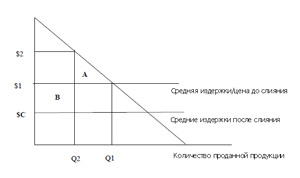
Suppose that the costs of all competing firms also amount to $ 1, so the profit in the entire industry is zero. If, as a result of the merger, the price increases to $ 2, and the number of products sold is reduced to Q2, consumers will be ready to pay extra the amount represented by the triangle A - it will be lower than the demand curve, but it will turn out to be between the old and the new price - at the lost volume of production. However, if at the same time the costs are reduced to $ C, and this newfound savings, represented by a quadrangle in, exceeds the cost of lost A, then the merger increases the well -being of society. In addition, with a decrease in costs, new companies may have an incentive in the form of potential profits to penetrate this market.
Although attitudes regarding mergers take into account their possible benefits for society, a clearly negative attitude is met by a phenomenon, which is called the “merger to the level of monopoly” in the supervisory authorities. But even if the merger does not benefit society, a reasonable question arises: whose production is limited as a result of a merger? In a market economy, manufacturers have the right to a free association, and no one forces them to part with their products on disadvantageous conditions. These fundamental rights of property - even though they diverge from the “antimonopoly philosophy” - not only do not conflict with the welfare of society, but are also his most important prerequisite. For the benefits of consumers, a dynamics is needed, provided by both rivalry and strategic associations.
As already noted in connection with the Microsoft case, the “crusors of monopolies” are able to be guided by the narrowed definition of the market in order to exaggerate the negative consequences of the merger. So, in the 1980s of the confluence of Coca Cola with Dr. Pepper and Pepsico with Seven UP were attacked in accordance with an arbitrarily formulated thesis about the need - to establish whether there is a monopoly as a result of - to make a difference between “carbonated non -alcoholic drinks” and simply “non -alcoholic drinks” [16] . And in 1997, on the basis of a static idea that prices may increase, and the entering the market will not occur instantly was the merger of Staples and Office Depot, as a result of which the economy and consumers did not see a competitive reaction from such giants of retailers as Walmart, and “unraviable” settlements did not appear “supramegravi”. The occurrence would be possible thanks to the profits obtained at the expense of the merger [17] .
Since antimonopoly regulation is able to impede competition, political leadership should be suspected of objection to mergers if they come from direct competitors of the respective firms. Such protests may not indicate the anti -competitive nature of such mergers, but, on the contrary, about their positive impact in terms of effectiveness. If competitors suggest that the merger will lead to an increase in consumer prices for a particular product - which, in fact, is considered the result of a monopoly - this means that it is beneficial to these competitors, because they can increase sales at existing or even slightly increased prices, simultaneously undermining the positions of a newly -naked monopolist.
Of course, not all merger is effective, and not everyone makes sense. So, in 2000, more than 4900 applications for the merger [18] were submitted, and most likely in many cases nothing will come of it. The wave of creation of conglomerates, which swept through the country in the late 1960s, ended with the fact that many united companies later “fled”; The American Express made in the 1980s attempt to penetrate several new business areas undertaken in the 1980s [19] . Regardless of such risks, market experiments with various schemes and business management structures, carried out by trial and error, are one of the most important processes in its functioning. The Chairman of the Federal Reserve Alan Grinspen warned of the dangers associated with adventurism when regulating mergers in high -tech markets, noting in a speech to the Senate Committee on Legal Affairs: “I would have felt extremely uncomfortable if we prevented various types of mergers and acquisitions based on some formulated assumptions on how to develop how to develop There are many cases in the market ... In history, such assumptions subsequently turned out to be extremely inaccurate. ” “We must more modestly evaluate” his capabilities, he added [20] .
Of course, without preventing the mergers, the state should not artificially stimulate them. For example, if, as a result of ill -conceived measures to prevent the “conspiracy”, it is prohibited to exchange information between firms, antitrust regulation can unintentively contribute to mergers in cases where, under normal conditions, it would be quite possible to do close cooperation in the field of R&D.
Despite the warnings of Greenpan regarding the stereotypical attitude to the market, Joel Klein, the former Deputy Minister of Justice, who headed the antimonopoly administration of the Ministry of Justice, said: “We categorically reject the idea that the market should“ be self -building ”, and we should simply sit down and observe it” [21] . Although the vast majority of mergers are still being brought to the end today, the antimonopoly authorities are increasingly trying to get concessions from unifying companies, often try to prevent the most “resonant” mergers and consider the activities of firms for a long time after the unification has become an accomplished fact [22] . So, during the merger of AOL and Time Warner, the company was not only forced to share access to the Instant Messenger service and its cable lines, which will result in a decrease in the costs for competing companies, which otherwise had to negotiate such access or develop ways to create their own similar infrastructure. A special “overseer” was assigned to the company for a period of five years, which should “look over her shoulder”, ensuring the implementation of these requirements [23] .
Twisting hands to companies falls a heavy burden on market processes, and as a result, the state “penetrates” into the industry as a constant, albeit unwanted “partner”. Similar conditions can scare away companies planning a merger, or lead to less mergers due to unnecessary concessions to the supervisory authorities. Decisions on the appropriateness of the merger should be provided to the market and shareholders, which will be accordingly to structure such transactions.
3. Conspiracy: price fixation and section of markets
The conspiracy, or the establishment of fixed prices by competitors, meets the intolerable attitude even from those who are otherwise skeptical of antimonopoly regulation. It is argued that since the fixation of prices, unlike mergers, does not entail the integration of production capacities, the ban on such practice does not cause any harm [24] . Prices are considered as a simple conspiracy to redistribute material resources to the detriment of consumers. Such a conspiracy is considered to be unlawful and subject to punishment within the framework of both criminal and civil law.
On the other hand, it is claimed that this “conspiracy” is actually a simple cooperation between structures that no one likes, the rest is an ordinary business scheme. If we were not talking about existing companies, a price conspiracy in a functional plan would have been practically no different from creating a partnership, concluding a contract or the act of creating a corporation [25] . Firms are established precisely in order to unilaterally dispose of the resources of the owners, and not to conclude contracts or to participate in tenders in the open market every time they need certain factors of production. These “islands of non -market control” are one of the central elements of modern market production [26] .
Representing a partial association, and not complete integration, the conspiracy “eliminates competition” to a much lesser extent than the merger: nevertheless, those who “protect it” do not consider the merger of a violation of the law, and they believe. The market is dynamic in nature - the coordination of actions not only between individuals, but also between firms, brings obvious benefits. Various kinds of restrictive combinations are the efforts of corporations to coordinate actions and establish cooperation, adaptation to uncertainty and minimize transaction costs to solve certain business problems. Accordingly, actions, contemptuously called the “conspiracy”, may be an attempt to solve problems related to savings due to scale, with significant fixed costs and market fluctuations that make it difficult to plan activities.
The conspiracy and division of sales markets may be methods that are not only effective, but also more and more necessary in the conditions of a modern global economy, which creates and disposes of giant resources. Economist George Bittlelingmeier explains: “The restriction of competition can be justified in terms of effectiveness, and the ban on cartel agreements can result in not only benefits, but also costs” [27] . Efforts to mitigate antimonopoly legislation in order to encourage the interaction of firms in the field of R&D indicate a recognition of the need to combine resources and prevent unnecessary duplication.
Both competition and cooperation are legitimate features of a market economy, based on respect for the property of manufacturers, although employees of supervisory authorities are unlikely to recognize this truth. Ignoring the potential benefits of cooperation in pricing and the division of sales markets in the context of a complex market mechanism can damage consumers, since it gives rise to an unnatural antimonopoly policy. As the economist and lawyer Fred McCeche noted, there are more grotesque examples on this subject. Take at least the trial of US v. Container Corp., which took place in 1969 and during which the defendant was sentenced to a fine for “conspiracy” in order to exchange information about prices, resulting in “stabilization of prices towards a decrease” [28] .
Similarly, in 1972 in the decision in the case of US v. The Topco Associates Supreme Court canceled the decision of the lower court, which admitted that the horizontal section of the territory carried out by the Association of Cooperative Groups of Topco in order to avoid duplication, was a completely rational decision that contributed to competition. The Supreme Court saw a violation here, despite the Topco arguments that such restrictions helped associations to compete with more powerful network brands and were necessary to preserve it.
If the purpose of the political course in this area is the benefit of consumers, one should not force the company to sell its own goods at unattractive prices or at adverse conditions. When “testing” and expansion of markets, any company naturally seeks to sell the goods that it produced or which belong to it (or both at once) strives to sell it, just like consumers, of course, enjoy their right to buy goods from a manufacturer. This determining principle is due to the fact that no one cannot be forced to produce products at all, and if it produces it, then it must retain the right to determine the conditions of its sale.
Even if a price conspiracy is the result of intentional intent directed against the interests of consumers, it is best to allow market mechanisms, and not regulatory authorities, to cope with this situation. Ultimately, a kind of “insurance policy” for consumers is the instability of cartel agreements in cases where they are ineffective. The price is only one of many variables that the company can change independently of each other or by agreement. Even if the price agreements are concluded and observed (which is not often happening in itself), conspiracy participants can “be quiet”, competing in other parameters-such as the quality of products, its delivery and maintenance, warranty periods, etc. A similar tendency to undermine agreements and obtaining some competitive advantages gives ineffective agreements and triggers the mechanism of destruction (if, of course,, of course. Cartel was not created with the support of the state). Disciplines the “conspirators” and the appearance of competitors on the market not participating in the price agreement: if prices are too high or territory are covered in insufficient, they immediately fill the vacuum. Finally, it is worth noting that genuine problems associated with fixation and bloating of prices most often arise if a state, devoid of motivation for saving funds, acts as a buyer.
4. Хищническое ценообразование
Цель конкуренции — устранение соперников и привлечение как можно большего числа потребителей. «Хищническое ценообразование» — негодный способ добиться этой цели.
Хищническим ценообразованием называется установление цены ниже себестоимости с целью завоевания монопольных позиций. Утверждается, что фирмы прибегают к такому ценообразованию, чтобы вытеснить конкурентов, переманить их клиентов и расширить свою долю рынка. В результате, получив монополию, «хищник» с наслаждением меняет цены в сторону увеличения. Согласно этой теории, все, что ему нужно — это проявлять бдительность: как только на горизонте появляются новые соперники, монополист просто опять снижает цены, вытесняет с рынка новичка, а затем все возвращается на круги своя.
Проблематичность подобной гипотезы заключается в том, что претенденту на монополию практически всегда пришлось бы держать цены на уровне ниже себестоимости — что рано или поздно довело бы его до банкротства. Хищническое ценообразование наносит больше ущерба самому хищнику, чем его соперникам, поскольку, чтобы занять их рыночные ниши, он должен наращивать производство и нести убытки из-за заниженных цен, а также удовлетворять выросший спрос, порожденный этими ценами. Однако конкуренты, против которых направлены эти действия, могут попросту сократить объем продаж. Но даже если хищнику удается вытеснить их с рынка, как только он перейдет к монопольному ценообразованию, появление на рынке каждого нового соперника вынудит его снова работать себе в убыток. Другая серьезнейшая проблема для хищника заключается в том, что его текущие убытки должны перевешиваться будущими доходами.
Другими словами, на каждый потерянный доллар он должен в будущем получить больше доллара, чтобы просто свести концы с концами [29] . Да и потребителям скорее всего надоест иметь дело с компанией, чьи цены скачут как безумные. В важнейшем решении Верховного суда, принятом в 1986 году по делу Matsushita Electric Industrial Corp. v. Zenith Radio Corp., отмечалось, что успешная реализация схем хищнического ценообразования крайне маловероятна — особенно, когда для этого требуется координация действий между «хищниками». Это связано с убытками, которые несет как сам хищник, так и конкурент, против которого он действует, появлением на рынке новых соперников, и трудностью практического завоевания и сохранения монополии, необходимой для компенсации прошлых потерь. (Как правило «сокрушители монополий» беспокоятся о сговорах с целью повышения цен — в данном случае они беспокоятся из-за того, что цены слишком низкие!) Как отмечает лауреат Нобелевской премии экономист Джордж Стиглер, «сегодня этот аргумент [о хищническом ценообразовании как способе монополизации рынка], высказанный в ходе дискуссии профессионалов, может вызвать лишь неловкость» [30] .
Чтобы проводить в жизнь законы против хищнического ценообразования, необходимо, чтобы суды или чиновники определили, какую цену можно считать действительно хищнической, а не просто низкой. Подобное «истолкование» рыночных процессов ставит бизнес в зависимость от изменчивой «антимонопольной моды» и смены администраций в Белом доме. Нормальные рыночные процедуры вроде продажи нового товара по заниженной цене для привлечения покупателей, «пробное» ценообразование и передача программных продуктов на льготных условиях в стиле Microsoft могут получить ярлык «хищнических методов», а те, кто к ним прибегает, — оказаться объектами повышенного внимания авантюристов-чиновников.
Экономисты Дональд Будро и Эндрю Клейт наглядно продемонстрировали, каким образом рынок автоматически корректирует хищническое ценообразование без всякого антимонопольного законодательства и его неизбежных последствий. Хищники действуют не в вакууме. Их злонамеренные действия будут замечены поставщиками и фирмами-клиентами, осознающими, что в результате установления монополии они также пострадают [31] . К примеру, если розничная торговая фирма превращается в хищника-монополиста и сокращает масштабы своей деятельности, у ее поставщиков снижается объем продаж. Эти поставщики способны призвать хищника к порядку, установив связи с другими торговыми фирмами. Уход поставщиков, снабжающих хищника по низким ценам, приводит к увеличению его издержек, что еще больше снижает его шансы на успех. Тактика хищников может обернуться против них и из-за механизма рынков капитала. Своими действиями они побуждают конкурентов и спекулянтов к созданию бесконечного количества мелких компаний с единственной целью — снизить цену на товар, вынуждая хищника делать то же самое и одновременно обваливая котировки его акций — т.е. действуя его же оружием [32] .
В конечном итоге очевидно, что хищническое ценообразование может дать успешный результат только в том случае, если выход новых компаний на рынок будет объявлен вне закона. Надуманный тезис о «хищническом ценообразовании» позволяет соперникам эффективно действующих фирм заменять конкуренцию на рынке конкуренцией в зале суда, поскольку подавать иски в расчете на компенсацию ущерба куда легче, чем снижать собственные цены для противостояния «хищнику» или повышать качество своих товаров. Подобные злоупотребления антимонопльным законодательством куда более вероятны, чем успех «хищнического ценообразования». Будро и Клейн предлагают вообще запретить конкурентам подавать иски по такого рода делам, лишив их возможности использовать антимонопольное законодательство для удушения конкуренции вместо снижения цен и улучшения качества [33] . По крайней мере необходимо обязать конкурентов неопровержимо доказать, что в таких случаях страдают потребители, а не только они сами. Ведь цель бизнеса как раз и состоит в том, чтобы «вредить» конкурентам и вытеснять их. И выигрывают от такого соперничества именно потребители.
5. Ценовая дискриминация
Принятый в 1936 году Закон Робинсона–Пэтмена, вносивший поправки в список запрещенных методов ведения бизнеса, установленный Законом Клейтона, был призван защитить малый бизнес за счет ограничения имеющихся у поставщиков возможностей торговать с аналогичными покупателями по разным ценам одновременно. Он появился на волне возмущения, вызванной деятельностью Great Atlantic & Pacific Tea Company (тогдашнего аналога Wal-Mart), вытеснявшей семейные бакалейные магазинчики. Однако искусственная защита малого бизнеса — не синоним защиты потребителей.
Обвинения в ценовой дискриминации чаще всего касаются тех случаев, когда малые розничные торговые компании не могут получить от поставщиков такие же скидки, как их более крупные конкуренты, закупающие товар в больших объемах. Однако малые предприятия в состоянии объединяться в ассоциации для обеспечения себе аналогичных скидок — и примеров тому немало. (Конечно, в некоторых случаях даже ассоциациям скидки получить труднее, и в этом состоит одна из причин слияний.) Так, например, одной из крупных розничных сетей является IGA, а некоторые розничные компании, например магазины скобяных товаров True Value, сами являются акционерами своего оптового поставщика [34] .
Даже сотрудники федеральных регулирующих органов считают закон Робинсона–Пэтмена пережитком эпохи борьбы семейных и сетевых магазинов, защищающим конкурентов, но не конкуренцию [35] . Этот закон мог бы стать «пробным камнем» для реформы антимонопольного регулирования — полученные в результате уроки можно было бы применить в других сферах антимонопольного законодательства, еще не воспринимаемых с достаточной доли скепсиса. Хотя сегодня федеральное правительство ведет себя сдержанно, успех судебных исков по обвинению в ценовой дискриминации, поданных конкурентами, является свершившимся фактом: среди соответствующих примеров — постановление Верховного суда по делу Texaco v. Hasbrouck в 1990 году: суд счел, что Texaco нарушила закон Робинсона–Пэтмена, предоставляя некоторым дистрибьюторам преференциальные скидки, дискриминирующие других («Ценовая дискриминация... попросту представляет собой разницу в ценах») [36] .
На уровне частных компаний подобные иски подаются весьма активно. Так, в 1998 году Американская ассоциация книготорговцев (ААК) и ряд других независимых продавцов книжной продукции подали в суд за нарушение антимонопольного законодательства на сети крупных книжных магазинов Borders и Barnes & Noble, утверждая, что те получали от издательств скидки за опт, льготные условия и помощь в рекламе [37] . В 1995 году ААК уже удалось добиться судебного решения в свою пользу по иску против издательств. Но что должны сделать крупные сети, чтобы получить эти скидки? Им необходимо резко увеличить объем продаж, а для этого требуется снизить цены, установить более удобные часы работы, создать приятную для покупателей атмосферу в торговых залах, улучшить качество обслуживания и ассортимент — а все это отвечает интересам потребителей. После появления больших магазинов объем продаж книжной продукции увеличился; они пользуются популярностью у покупателей. (В то же время, потребители также позитивно отнеслись к интернет-магазину Amazon, который представляет собой серьезную угрозу для якобы «опасных» сетей.)
После подачи иска против книжных магазинов один обозреватель счел необходимым предупредить: «Подумайте, чем общее ограничение на скидки для оптовиков обернется лично для вас. Как оно отразится на ценах в Costco или Sam's Club, Home Base, Home Depot или любом другом недорогом магазине, куда вы частенько заходите?» [38] . Тезис о том, что рынок не способен самокорректироваться для защиты от злонамеренной ценовой дискриминации и нуждается во вмешательстве государства, не выдерживает критики. У самих издательств есть все нужные стимулы для недопущения реализации монополистических амбиций книжных «супермагазинов», поскольку вытеснение независимых торговцев, ведущее к монопольному положению сетей, отразится и на них самих — ведь в результате сократятся оптовые закупки.
Тот факт, что крупные магазины вроде Borders и Barnes & Noble должны отвлекаться от основной деятельности для подготовки к судебным процессам — нагляднейший пример, демонстрирующий потребителям, как антимонопольное законодательство защищает конкурентов, а не конкуренцию. Принудительное предоставление скидок магазинам, входящим в ААК, вопреки экономическим соображениям привело бы к сокращению практики скидок как таковых. В случае победы истцов подобные судебные процессы повредят потребителям, препятствуя снижению цен крупными розничными сетями. Энергичную ценовую конкуренцию и селективные скидки следует признать незаконными не более, чем конкуренцию в сфере качества и др. Как отмечает Роберт Борк, антимонопольное регулирование, направленное против ценовой дискриминации, представляется и нежелательным, и неэффективным. Рынок, скорее, опирается на то, что продавцы «то тут, то там изменяют цены, проверяя реакцию... незначительная дискриминация на конкурентных рынках — это способ продавцов прислушаться к их сигналам. Подобная адаптация к изменению цен и спроса желательна в социальном плане» [39] . К этому можно добавить: кроме того, речь идет о законных правах продавцов.
6. Ценовые ограничения, устанавливаемые производителями для розничных торговцев
Вертикальными ценовыми ограничениями называют контрактные соглашения между производителями и розничными торговцами, обязывающие последних не опускать цену на соответствующую продукцию ниже определенного минимума и не повышать ее выше определенного максимума.
Как правило согласованная цена оказывается выше, чем она могла бы быть в отсутствие таких вертикальных контрактов, и это беспокоит органы, ведающие соблюдением антимонопольного законодательства. Оппоненты вертикальной фиксации цен обычно утверждают, что производители устанавливают ценовые ограничения, чтобы облегчить себе надзор за картелем, который они создали из розничных компаний: поскольку отследить розничные цены нетрудно, это позволяет выявить нарушителей картельного соглашения. Другой повод для беспокойства связан с возможностью самих торговых компаний навязывать ценовые ограничения производителям — опять же с целью создания картеля.
Однако, если вертикальные ограничения ведут к увеличению объема продаж или повышению качества услуг, их следует признать вполне эффективным инструментом.
Действительно, «потолок» цен, устанавливаемый поставщиками для розничных торговцев, по определению представляется позитивным шагом, выгодным для потребителей, поскольку речь идет об ограничении максимальной цены. Однако даже эта форма ценообразования считалась по определению незаконной до тех пор, пока в 1997 году Верховный суд не принял единогласно постановление по делу State Oil Co. v. Khan [40] , где отмечалось, что установление ценовых потолков для розничных компаний следует оценивать с точки зрения здравого смысла. Хотя подобное решение стало важным шагом вперед, оно, по сути, означает: «дерзайте, если хотите, а мы задним числом скажем вам, правильно это было или нет».
Открытые договоренности о минимальном пороге цен и сегодня по определению будут признаваться незаконными, о чем свидетельствуют такие недавние эпизоды, как изданные в 1991 году распоряжения Федеральной комиссии по торговле (ФКТ), предписывавшие фирме Kreepy Krauly [41] , производящей оборудование для чистки бассейнов, и изготовителю видеоигр Nintendo [42] прекратить практику розничных ценовых соглашений с дилерами. Уступки, на которые в 1995 году вынуждены были пойти Reebok/Rockport [43] и Onkyo, служат дополнительными примерами на ту же тему [44] .
Однако более искусные маневры производителей, например, распространение списков рекомендуемых потребительских цен или предварительные объявления о предпочтительных потребительских ценах и последующее заключение контрактов с розничными фирмами на этой основе, вряд ли могут стать поводом для репрессий [45] . В общем, как это часто случается в условиях антимонопольного регулирования, бизнесу приходится двигаться как по минному полю. Недавно Комиссия по торговле подала иск на дистрибьюторов звукозаписей за их программу «Минимальные цены — реклама» [46] .
Компании, производящие звукозаписи, утверждали, что программа защищала розничных торговцев музыкальной продукцией, которым угрожали магазины типа Best Buy, способные продавать компакт-диски по заниженной цене для привлечения покупателей. В обмен на участие в программе крупные розничные компании получали поддержку в области рекламы.
Соответствующая принципам конкуренции и интересам потребителей защита минимального порога цены, устанавливаемого производителями для розничных торговцев — например, в рамках упомянутой программы, — позволяет гарантировать всем розничным фирмам достаточно высокие доходы, чтобы обеспечить преференции производителя товара относительно стандартов обслуживания клиентов, но при этом не настолько высокие, чтобы отпугнуть покупателей. Поддержание минимальной цены реализации помогает избежать сложности, способной нанести ущерб рынку. В других случаях, когда розничные торговцы продают комплексный продукт, возникает риск того, что более «неприхотливые» конкуренты проедутся «на дармовщинку» за счет компаний, обеспечивающих покупателям весь спектр услуг. Клиенты могут получить эти услуги — например, в виде демонстрации аудиооборудования в дорогостоящей студии — а затем приобрести тот же товар по более низкой цене у другой компании, не предоставляющей такого сервиса. Подобные ситуации можно предотвратить, если производитель «надзирает» за действиями продавцов, устанавливая минимальную цену, по которой все они — и те, кто предоставляет полный набор услуг, и те, кто этого не делает, но продает дешевле — должны реализовать товар.
Производители могут определить уровень цен, оставляющий розничным компаниям достаточно большую маржу, чтобы профинансировать связанные с товаром услуги, которых требуют покупатели. Им даже не нужно с особой дотошностью отслеживать поведение торговцев в отношении установленной цены, поскольку получаемой ими нормы прибыли будет достаточно, чтобы побудить эти фирмы конкурировать по иным направлениям — например, связанных с сервисом. Соглашения по розничным ценам превращают торговые компании в партнеров производителей, стимулируя их действовать как в интересах последних, так и в интересах потребителей.
При оценке договоренностей о минимальной цене необходимо применять «презумпцию законности» или по крайней мере четкий принцип здравого смысла. Кроме того, вариант, при котором производитель создает собственную распределительную сеть или проводит слияние с торговой фирмой для контроля за реализацией своей продукции, представляет собой, говоря языком сторонников антимонопольного регулирования, еще более «антиконкурентный» метод, чем поддержание уровней розничной цены. Таким образом, и здесь неудачная политика, угрожающая рациональному рыночному поведению, сможет привести к неэффективным слияниям и иным непродуманным ответным шагам.
7. Эксклюзивные деловые отношения
В рамках эксклюзивных деловых отношений продавец соглашается реализовывать только продукцию конкретного производителя и не проводить операций с товарами его конкурентов. Одним из вариантов этой схемы является контракт торговой компании на закупку всего объема произведенной поставщиком продукции. Закон Клейтона и Закон о Федеральной комиссии по торговле запрещают подобные эксклюзивные контракты в тех случаях, когда они могут помешать конкуренции.
Возражения против этой формы деловых отношений связаны с беспокойством о том, что отсечение соперников — продавцов или покупателей — может повредить конкуренции. Другой повод для беспокойства усматривается в том, что мелкие розничные компании, не желающие вступать в эксклюзивные отношения, могут делать это вынужденно, под давлением крупных производителей. Однако Роберт Борк указал на ошибку в последнем тезисе. Если местный магазинчик становится единственным продавцом изделий производителя, он приобретает «монополию», а значит, находится в более выгодной переговорной позиции [47] . В частности, если розничная фирма является единственным продавцом такой продукции, у нее в потенциале есть альтернативные источники поставок, а вот у производителя других розничных предприятий, с которыми он мог бы сотрудничать, не имеется.
Кроме того, следует признать и тот факт, что установление эксклюзивных отношений с розничной компанией способствует повышению эффективности. Подобные схемы призваны побудить розничного торговца прилагать дополнительные усилия для реализации изделия в обмен на финансовую выгоду — например, низкие оптовые цены. Эксклюзивная сделка между производителем и розничным торговцем не вредит конкуренции, поскольку другие фирмы сохраняют все возможности для предложения еще более выгодных условий и установления, в свою очередь, эксклюзивных отношений с розничными компаниями. Кроме того, контракты часто пересматриваются, и недовольный ситуацией розничный торговец всегда может отказаться возобновить действие неэффективного эксклюзивного соглашения.
Выгода для торговцев оборачивается выгодой для потребителей — например, за счет более низких цен и качественного обслуживания. В результате эксклюзивной сделки торговец может получить дополнительную информацию об изделии, а также больше возможностей и стимулов для того, чтобы подробно объяснять покупателям его «действие» или наладить сервисное обслуживание. Кроме того, эксклюзивное соглашение гарантирует торговому предприятию и его клиентам бесперебойные поставки соответствующих товаров на срок действия контракта.
Поскольку за «преданность» одного ритейлера как правило борются несколько поставщиков, производитель, чтобы обеспечить эксклюзивный контракт с ним, должен предложить некие дополнительные выгоды. В этой ситуации задача торговой фирмы — найти правильные баланс между таким недостатком, как отказ от других поставщиков, и стимулами, которые готов предложить производитель в рамках такой схемы [48] . Кроме того, если опыт покажет, что производитель заключил контракты с несколькими розничными торговыми фирмами на невыгодных для них условиях, последние могут объединиться и потребовать пересмотра сделки. И так на всех уровнях производственной цепочки: например, предприятия, изготавливающие компьютеры, если у них возникнет серьезное недовольство, в состоянии наладить сотрудничество между собой, чтобы изменить невыгодные, по их мнению, условия контрактов с Microsoft. Проблема, однако, здесь заключается в том, что подобная координация действий сама по себе вероятно спровоцирует иск о нарушении антимонопольного законодательства, даже несмотря на то, что она представляет собой абсолютно «рыночный» ответ на действия другой компании.
В своем решении по делу Standard Oil of California v. USA в 1949 году Верховный суд, признав существование оправданных с деловой точки зрения оснований для эксклюзивных контрактов, тем не менее счел, что Standard нарушила установленный Законом Клейтона запрет на подобные сделки, так как они могут «ослабить конкуренцию» [49] . С другой стороны, в 1961 году в решении по делу Tampa Electric Co. v. Nashville Coal Co. Суд нашел подобные контракты приемлемыми [50] . Одним словом, и здесь бизнесменам приходится проявлять осторожность.
С точки зрения производителя рынки порой обладают значительной волатильностью, что является одной из причин заключения эксклюзивных соглашений с поставщиками сырья. Такие схемы также могут быть важны для планирования развития бизнеса, страховки от инфляции или обеспечения бесперебойного снабжения сырьевыми материалами. С точки зрения поставщика сырья контракт с одним производителем может обеспечить сокращение расходов, связанных с поисками многочисленных покупателей, позволяет планировать и расширять производство, ориентируясь на заранее согласованные даты поставок, и подстраховаться на случай возможного снижения цен. В случае роста конечных потребительских цен, если его причиной является монополизм, поставщики непременно это заметят, поскольку успешная монополизация рынка ведет к сокращению оптовых закупок сырья. Таким образом, как уже отмечалось, поставщики сами обуздают подобные действия.
8. Нагрузка и привязка
Продажа с нагрузкой — это продажа, в рамках которой от покупателя изделия А, изготовленного фирмой, обладающей влиянием на рынок, требуется в качестве условия приобрести еще и изделие Б. Сторонники антимонопольного регулирования утверждают, что подобные действия неправомерно распространяют уже существующую монополию на новый продукт, препятствуя тем самым конкуренции на этом новом рынке. Пожалуй, наиболее часто в качестве примера этой схемы приводится привязка Microsoft своего браузера Internet Explorer к операционной системе Windows [51] . Классическим же примером следует считать дело International Business Machines v. The United States, в ходе которого IBM была признана нарушителем закона, так как требовала от покупателей своих вычислительных машин пользоваться ее же перфокартами [52] .
Ошибочность этой логики заключается в неспособности понять, что монопольная прибыль — даже если она существует — может быть получена только один раз. Если бы IBM или Microsoft использовали все свое монополистическое влияние, связанное с первичным «монополизированным» продуктом, и потребители расценили бы предлагаемый в нагрузку товар как ненужный, они готовы были бы заплатить только цену монополизированного товара, но не более. Любое повышение цены, связанное с товаром Б, если потребитель считает его ненужным, на деле рассматривается лишь как часть цены за товар А, а не как дополнение к ней. Игнорировать это — значит устраивать «двойную бухгалтерию монопольного влияния» [53] .
Другая проблема с тезисом о том, что «нагрузка» вредит потребителям, связана с тем, что определить, когда один продукт превращается в два, весьма непросто. Каждый продукт обладает несколькими характеристиками или состоит из «пакета» продуктов, в результате чего любая продажа превращается в продажу «с нагрузкой»: дрель продается вместе со сверлами, машина вместе с мотором, телевизоры — вместе с пультами управления, а «пакеты» кабельных телепрограмм включают ненужные вам каналы. Как отмечает Борк, «торговец автомобилями, отказывающийся продавать только шасси, или продавец продуктового магазина, не желающий продавать консервированные груши из банки поштучно, занимаются торговлей с нагрузкой» [54] .
Дело Microsoft, а также проходивший в 1992 году судебный процесс Eastman Kodak Co. v. Image Technical Services [55] , вновь открыли путь к ненужной подозрительности в отношении сделок с привязкой. В последнем случае Верховный суд счел, что Kodak ведет себя как монополист, незаконно привязывая покупку запчастей к своей фотокопировальной машине к оплате ее технического обслуживания.
Однако подобные схемы с нагрузкой и привязкой порой выполняют важные экономические функции. В случаях с перфокартами IBM, системой Internet Explorer Microsoft, или обслуживанием копировального оборудования Kodak привязка, возможно, гарантирует долгий срок, бесперебойность, интеграцию и нужное качество работы продукта, не позволяя покупателю экспериментировать с использованием аксессуаров, предлагаемых конкурентами. Тем самым «нагрузка» помогает производителю избежать расходов по гарантийному ремонту и жалоб на поломки изделия. Более того, в некоторых случаях гарантийное обслуживание предоставляется только благодаря контролю качества, обеспечиваемого этой привязкой.
Энергичная борьба против привязки и нагрузки может обернуться дискриминацией в отношении малого бизнеса или компаний, занимающихся инновационной деятельностью, поскольку такие продажи могут служить маркетинговым инструментом, побуждающим клиентов попробовать нечто новое. Они также помогают малым предприятиям, не имеющим таких финансовых возможностей, как их крупные конкуренты, избежать дублирования продаж и административных расходов, тем самым повышая рентабельность производства. Подобное дублирование, особенно в тех случаях, когда изделия по определению взаимосвязаны, может превращаться в несправедливое бремя для небольших фирм. Привязка порой позволяет любому продавцу осуществить экономию за счет масштаба благодаря сокращению продажных и административных расходов, связанных с распределением издержек между несколькими видами продукции. Нагрузка также позволяет сократить издержки на обеспечение высокого качества работы продуктов, так или иначе связанных с «привязываемым» изделием [56] .
Хотя в конце концов Роберт Борк занял негативную позицию в отношении деловых методов Microsoft и подвергся за это критике, именно он дал точную характеристику проблеме нагрузок и привязок: «Не существует никаких достоверных гипотез относительно того, каким образом подобные схемы препятствуют конкуренции, однако есть несколько очевидных причин, по которым они выгодны как продавцу, так и потребителю» [57] .
9. Хищническая стратегия
Усилия, призванные увеличить издержки (или снизить доходы) конкурентов, порой рассматриваются надзорными органами как «хищнические». Так называемое хищническое ценообразование, как утверждается, ведет к снижению цен, а значит, доходов и прибылей соперников. Однако прибыли конкурентов могут снижаться и за счет иных стратегических методов, называемых «хищничеством неценового характера» [58] . Примеры в этом смысле — изменение интенсивности рекламы или качества продукции. Другая подобная стратегия — эксклюзивные деловые отношения, «отсекающие» конкурентов.
Несомненно, манипуляция доходностью конкурентов осуществляется целым рядом способов и представляет собой самую суть бизнеса, поскольку на типичных рынках эти «преступления» невозможно отличить от обычной, здоровой конкурентной борьбы.
Теоретики уже опровергли аргументы в пользу чрезмерной активности антимонопольного регулирования. Однако в последнее время в связи с самым обычным конкурентным стремлением вынудить соперника нести большие издержки возникла целая научная индустрия, посвященная интерпретации конкурентной стратегии как средства «монополизации». Но этот «новый» поход, по сути, представляет собой хорошо забытое старое. К сожалению антимонопольным регулирующим органам редко приходится искупать свою вину после того, как они наказывали бизнесменов за действия, позднее признанные полезными и благотворными для рынка; вряд ли им придется выражать сожаление и за неверное понимание предполагаемых сегодняшних «нарушений».
Согласно гипотезе о «хищнической стратегии» сама по себе агрессивная конкуренция может быть признана преступлением. В лучшем случае вопрос о виновности фирмы зависит от мнения чиновников относительно того, представляют ли ее успешные усилия по обслуживанию рынка — по определению вынуждающие конкурентов работать усерднее — «опасную вероятность» установления монополии [59] . Однако цель конкурентной борьбы заключается в вытеснении или замене менее эффективных соперников, в результате чего на рынке остаются производители, работающие с наименьшими издержками. Конкурентоспособность товара определяется не только низкой ценой: для обслуживания потребителей важны также качество и иные характеристики. От этого рыночного процесса зависит благосостояние потребителей, и поиски надлежащего соотношения всех указанных характеристик следует рассматривать как часть «первооткрывательского» рыночного механизма, а не воспринимать с подозрением.
Более того, как отмечает Дональд Будро, «все методы, вынуждающие соперников повышать издержки, зависят от способности хищника заключать контракты, отсекающие его конкурентов. Для этого необходимо, чтобы конкуренты и поставщики хищника оставались в неведении относительно его намерений» [60] . Конкурентный рынок, однако, редко допускает такое неведение.
Очевидно, предполагаемый «хищник» — не единственный, кто способен разработать подобную стратегию. Личный интерес и необходимость выживания бизнеса всегда требуют усилий, призванных перехитрить любого потенциального хищника, быть в курсе его намерений. Все участники рынка должны обладать одинаковой свободой действия в собственных интересах, а также мобилизовывать капиталы и партнеров против фирмы-нарушительницы, пытающейся установить монополию. Конечно их совместные усилия в этом направлении тоже могут стать объектом пристального внимания антимонопольных органов — т.е. антимонопольное законодательство порой препятствует наказанию «хищников» рыночными методами. Сотрудничество с другими фирмами — даже конкурентами — часто бывает важнейшим инструментом борьбы с монополизацией. Однако в рамках антимонопольного законодательства само объединение усилий в целях самозащиты может квалифицироваться как преступление.
Существует, впрочем, одна форма неценового хищничества, которую действительно можно считать антирыночной и направленной против потребителей: лоббирование мер государственного регулирования, создающих чрезмерные трудности для конкурентов. There is no need to go far for examples. Так, стандарты, установленные Законом о чистоте воздуха и требующие от ТЭС, работающих на угле, установки фильтров для серы независимо от уровня ее содержания в используемом топливе, потребовали больших издержек от электростанций, использующих низкосернистый уголь [61] . В сфере антимонопольного регулирования такие методы тоже применяются, и именно их следует квалифицировать как «хищническую стратегию». Подача исков о нарушении антимонопольного законодательства против более эффективных конкурентов сама по себе является одним из самых действенных способов повышения издержек соперника: свидетельство тому — многочисленное и процветающее сообщество юристов, специализирующихся на таких делах. Если «хищника», т.е. производителя, работающего с низкими издержками, можно вынудить держать цены на высоком уровне — либо из опасения стать ответчиком по делу о нарушении антимонопольных законов, либо по решению суда, признавшего его «хищником», — в выигрыше оказываются его менее эффективные конкуренты. Подобные действия, очевидно, в корне отличаются от нормальной конкуренции, ограничивающейся самим рынком.
10. Укоренение неэффективных технологий
Понятием «сетевой эффект» обозначается феномен, касающийся некоторых товаров, набирающих ценность с увеличением количества их пользователей. К примеру, телефон или факс совершенно бесполезен, если им пользуется только один человек. Однако чем больше людей их приобретает, тем сильнее увеличивается их ценность [62] . Некоторые беспокоятся, что этот феномен может привести к укоренению неэффективных изделий — непреднамеренно или с помощью махинаций производителей — только потому, что ими пользуются многие потребители, или изготовитель выбросил их на рынок первым. Microsoft с его операционной системой Windows и AOL с Instant Messenger часто приводятся в этой связи в качестве примеров. В своих недавних заявлениях по поводу слияний ФКТ озвучила намерение «тщательнее анализировать конкурентную деятельность» на рынках, которым свойственен «сетевой эффект», на предмет укоренения неэффективных продуктов [63] . Судья Джексон в своем заключении утверждал, что Microsoft стремился поддерживать «барьер, препятствующий выходу на рынок других приложений», что представляет собой вариант сетевого эффекта [64] .
ФКТ, как и Антимонопольное управление Минюста, явно полагают, что обладают достаточной квалификацией, чтобы заместить рыночные механизмы своими волевыми решениями и успешно осуществлять функции арбитров в вопросе о путях экономического развития. Однако в истории рыночной экономики не существует примеров того, чтобы сетевой эффект приводил к укоренению неэффективных технологий, если речь не шла о созданных государством франшизах.
Триумф дизайна QWERTY для клавиатуры пишущих машинок всегда преподносится в качестве примера того, как неудачная технология выходит победителем в борьбе с более совершенными вариантами. Однако испытания различных типов клавиатур на заре эпохи пишущих машинок не выявили каких-либо недостатков QWERTY по сравнению с другими дизайнами, так что эту историю об укоренении несовершенной технологии следует считать мифом [65] . Даже сегодня, если бы появился более эргономичный дизайн клавиатуры, крупные компании могли бы перейти на них, чтобы сократить расходы. Подобную смену клавиатур на всех современных компьютерах можно провести буквально в одно мгновение. Однако никто этим не занимается.
Столь же несостоятельны и другие примеры укоренения неудачных продуктов из-за сетевых экстерналий. Так, видеопленка Betamax была не хуже VHS: в обоих случаях основные технологии были одинаковы, и, кроме того, в отношении обоих изделий существовало патентное соглашение [66] . Однако обе они были совершеннее «укоренившихся» бобинных систем, которым пришли на смену. В том, что касается компьютерных потребностей типичного офиса, более высокая стоимость машин Macintosh по сравнению с системами Windows/DOS выглядит неоправданной, особенно с учетом того, что Apple требует приобретения у одного поставщика как «железа», так и операционной системы. Однако оба эти компьютера несомненно превосходят существовавшие до них логарифмические линейки, калькуляторы и ЭВМ.
Если бы неэффективные технологии действительно укоренялись, в нашем мире не было бы кампакт-дисков и плейеров, поскольку до них всеобщее распространение получили виниловые пластинки. Машины также бы не появились — ведь не было бы и бензоколонок. Не произошло бы и внедрения цветного телевидения, ведь в каждом доме уже стоял черно-белый телевизор.
Теории «предопределенной зависимости» не учитывают тот факт, что нежеланное или неэффективное «укоренение» предоставляет собой мощный стимул для предпринимателей, стремящихся получить прибыль за счет внедрения новых технологий. И действительно, именно эти стимулы представляют собой двигатель технического прогресса. Прежде всего предприниматели могут предложить новый товар со скидкой розничным фирмам, торгующим старыми технологиями. Но даже если бы неэффективное укоренение действительно существовало на постоянной основе, не стоит путать политически мотивированные решения государства с выбором миллионов потребителей. Навязанные государством распоряжения на рынке высоких технологий, обязательные к исполнению, и представляют собой такое «укоренение неэффективности» в чистом виде.
Conclusion
Традиционное мнение заключается в том, что антимонопольное законодательство обуздывает эксцессы капитализма и свободного рынка и тем самым защищает потребителей. Однако история создания и применения этих законов пестрит примерами их превращения в орудие неправомерного регулирования. Более того, многие методы, считающиеся вредными в рамках антимонопольного регулирования и навлекающие на компании соответствующие меры, на деле полезны как с точки зрения конкуренции, так и для интересов потребителей — пусть даже конкурентам фирм, пользующихся этими методами, они не нравятся. В условиях новой информационной экономики антимонопольное законодательство и список «вредных» деловых процедур, относящиеся к индустриальной эпохе, в особенности нуждается в пересмотре. В конечном итоге антимонопольное законодательство всегда было и остается одной из форм неэффективного регулирования экономики.
[1] Hazlett TW Is Antitrust Anti-competitive? // Harvard Journal of Law and Public Policy. Vol. 277 (Spring 1986). P. 336.
[2] Grant RW Tom Smith and His Incredible Bread Machine. Manhattan Beach, Calif.: Quandary House, 1964. P. 34–35.
[3] См. напр.: Brozen Y. Is Government the Source of Monopoly? And Other Essays. Washington, 1980 (= Cato Institute Paper № 9).
[4] Sherman Act, 15 USC, sec. 1.
[5] Sherman Act, sec. 2.
[6] Clayton Act, 15 USC, sec. 12 et al.
[7] DiLorenzo TJ The Antitrust Economist's Paradox // Austrian Economic Newsletter. Summer 1991. P. 2. См. также: DiLorenzo TJ The Origins of Antitrust: An Interest Group Perspective // International Review of Law and Economics. Vol. 5 (June 1985). P. 73–90.
[8] Анализ примера с Microsoft см.: Levy RA Microsoft Redux: Anatomy of a Baseless Lawsuit // Cato Institute Policy Analysis. № 352 (September 1999) [http://cato.org/pubs/pas/pa-352es.html].
[9] См.: Reynolds A. The Monopoly Myth // Wall Street Journal. 1999. April 9. P. A12.
[10] Данные приводятся по: Lieberman D. Tolls Stack Up on Info Superhighway // USA Today. 2001. April 3.
[11] См. например: Goodman PS Local Phone Giants Fight to Stay Whole // Washington Post. 2001. March 22. P. E1.
[12] Smith F. Why Not Abolish Antitrust? // Regulation. 1983. January–February. P. 25.
[13] Rothbard M. Power and Market: Government and the Economy. Kansas City, Mo.: Sheed Andrews and McMeel, Inc., 1970. P. 61.
[14] US Department of Justice and Federal Trade Commission, 1992 Horizontal Merger Guidelines (with April 8, 1997, revisions to sec. 4 “Efficiences”); см. также sec. 0.2 “Overview” [http://www.ftc.gov/bc/docs/horizmer.htm].
[15] См.: Williamson OE Economics as an Antitrust Disease: The Welfare Tradeoffs // American Economic Review. Vol. 58 (March 1968). P. 18–36. См. также: Bork RH The Consumer Welfare Model // The Antitrust Paradox: A Policy at War with Itself. NY: Free Press, [1978] 1993.
[16] См.: Armentano DT Drawing the Line on Mergers: An Action Bordering on the Incoherent // New York Times. 1986. July 27. P. C2.
[17] См.: Smith FL, Jr. The Case for Reforming the Antitrust Regulations (If Repeal Is Not an Option) // Harvard Journal of Law & Public Policy. Vol. 23. № 1 (2000). P. 101–136.
[18] Molly S. Boast, acting Director, Bureau of Consumption, Prepared remarks before the American Bar Association, antitrust section, Washington, Spring 2001 [http://www.ftc.gov/speeches/other/boastmollys.htm].
[19] См.: Zook C. Amazon's Core Problem // Wall Street Journal. 2001. April 2. P. A22.
[20] Выступление Алана Гринспэна цитируется по: Greenspan Questions Antitrust Efforts: US Handling of Mergers Worries Fed Chairman; Microsoft Is in the Air // Wall Street Journal. 1998. June 17. P. A2.
[21] Цит. по: Ibid.
[22] См.: Wilke JR Gruley B. Merger Monitors: Acquisitions Can Mean Long-Lasting Scrutiny by Antitrust Agencies // Wall Street Journal. 1997. March 4. P. A1.
[23] Federal Trade Commission, «ATC Appoints Monitor Trustee in AOL/Time Warner Matter,” Press Release, February 26, 2001 [http://www. Ftc.gov/opa/2001/02/montrust.htm].
[24] Bork RH Op. CIT. P. 269.
[25] См.: Rothbard M. Op. CIT. P. 61.
[26] См.: Coase RH The Nature of the Firm // Economica. Vol. 4 (1937). P. 386–405.
[27] Bittlingmayer G. The Economic Problem of Fixed Costs and What Legal Research Can Contribute // Law and Social Inquiry. Vol. 14. № 4 (Fall 1989). P. 739.
[28] См.: McChesney FS Be True to Your School: Chicago's Contradictory Views of Antitrust and Regulation // The Causes and Consequences of Antitrust: The Public-Choice Perspective / Ed. by F. McChesney, WF Shughart II. Chicago: University of Chicago Press, 1995. P. 323–340.
[29] На это указывается: Wenders J. Predation's Problems (Continued) // CEI UpDate. 1998. December. P. 3.
[30] Stigler GJ The Economist as Preacher and Other Eaasys. Chicago: University of Chicago Press, 1982. P. 52.
[31] Boudreaux DJ, Kleit AN How the Market Self-Polices against Predatory Pricing. Washington: Competitive Enterprise Institute, June 1996.
[32] См.: Reisman G. Capitalism: A Complete and Integrated Understanding of the Nature and Value of Human Economic Life. Ottawa, Ill.: Jameson Books, 1998. P. 400.
[33] Boudreaux DJ, Kleit AN Cleaning Hands in Predation Cases: A Modest Proposal to Improve Predatory-Pricing Suits. Washington: Competitive Enterprise Institute, October 1996.
[34] Примеры взяты из: Weigand RE Is It Time to Retire Robinson-Patman? // Wall Street Journal. 1986. June 20. P. A18.
[35] Shenefield JH, Stelzer IM The Antitrust Laws: A Primer / 2nd ed. Washington: American Enterprise Institute, 1996. P. 78.
[36] Texaco Inc. v. Hasbrouck et. al, 496 US 543 (1990) [www.lexis.com].
[37] См. например: Gillespie N. Don't Throw the Book at Superstores // Wall Street Journal. 1998. April 23. P. A18; Milliot J. Indies File More Lawsuits against Chains, Publishers: Taylors Sues B & N and 17 Publishers While African American Booksellers Take on Borders and B & N // Publishers Weekly. 1999. January 4. P. 18.
[38] Galles GM Small Book Stores' Suit Seeks to Cut Chains' Advantage // Daily News of Los Angeles. 1998. April 6. P. N15.
[39] См. Bork, p. 388.
[40] State Oil v. Khan, 522 US 3 (1997).
[41] Пресс-релиз от 10 января 1991 г. относительно этого распоряжения см. на http://www.ftc.gov/opa/predawn/F93/kk-usa.txt. Пресс-релиз от 14 февраля 1992 г. с объявлением об окончательном одобрении документа, можно найти на http://www.ftc.gov/opa/predawn/F93/kreepy-2.txt.
[42] Пресс-релиз см. на сайте Федеральной комиссии по торговле http://www.ftc.gov/opa/predawn/F93/nintendo.txt. Пресс-релиз об окончательном принятии распоряжения см. на http://www.ftc.gov/opa/predawn/F93/nintendo-3.txt.
[43] http://www.ftc.gov/opa/1995/9505/reebok.htm. Пресс-релиз об окончательном одобрении см. на http://www.ftc.gov/opa/1995/9505/reebok2.htm.
[44] http://www.ftc.gov/opa/1995/9507/onkyo.htm.
[45] Shenefield and Stelzer, p. 70.
[46] Жалоба на Capitol Records inc. dba “EMI Music Distribution” et. Al. Docket No. C-3975, Federal Trade Commission, August 30, 2000.
[47] Bork RH Op. CIT. P. 307.
[48] Ibid.
[49] Standard Oil Company of California et al. v. United States, 337 US 293 (1949).
[50] Tampa Electric Co. v. Nashville Coal Co. et al., 365 US 320 (1961).
[51] Описание «дела Microsoft» и изложение причин, по которым запрет на «продажи с нагрузкой» должен быть отменен, см.: Levy RA Microsoft and the Browser Wars: Fit to Be Tied // Cato Policy Analysis. № 296 (February 19, 1998) [http://www.cato.org/pubs/pas/pa-296es.html].
[52] International Business Machines Corp. v. the United States, 298 US 131 (1936).
[53] Bork RH Op. CIT. P. 373.
[54] Ibid. P. 379.
[55] Eastman Kodak Co. v. Image Technical Services, Ink. 504 US 451 (1992).
[56] См. например: Bork RH Op. CIT. P. 379.
[57] См.: Kinsley M. Book Bork, Browser Bork // Slate. 1998. December 10 [http://slate.msn.com/Readme/98-12-10/Readme.asp].
[58] Bork RH Op. CIT. P. 372.
[59] См.: Salop SC, Scheffman DT Raising Rivals' Costs // AEA Papers and Proceedings. Vol. 73. № 2 (May 1983). P. 267–271. См. также недавнюю популяризаторскую статью на данную тему «The Economics of Antitrust: The Trustbusters' New Tools» (The Economist. 1998. May 2. P. 62–64).
[60] Boudreaux D. Turning Back the Antitrust Clock: Nonprice Predation in Theory and Practice // Regulation. 1990. Fall. P. 49.
[61] Crandall R. Why Is the Cost of Environmental Regulation So High? // Center for the Study of American Business, Study № 110 (February 1992).
[62] См.: Katz ML, Shapiro C. Systems Competition and Network Effects // Journal of Economic Perspectives. Vol. 8. № 2 (Spring 1994). P. 93–115; Lohr S. Business Often Goes to the Swift, Not the Best // New York Times. 1995. August 6. P. E3.
[63] FTC Staff Proposes Reforms for Agency's Competition Policy: Bureau of National Affairs, Antitrust & Trade Regulation Report 70. № 1765 (June 6, 1996). P. 646.
[64] United States of America v. Microsoft Corporation, US District Court for the District of Columbia, civil action № 98-1232, Findings of Fact, November 5, 1999 [http://www.usdoj.gov/atr/cases/f3800/msjudgex.htm]. См. также: McKenzie R. Microsoft's 'Applications Barrier to Entry': The Missing 70000 Programs // Cato Institute Policy Analysis. № 380 (August 31, 2000) [http://cato.org/pubs/pas/pa-380es.html].
[65] Liebowitz S., Margolis SE The Fable of the Keys // Journal of Law and Economics. Vol. 33 (April 1990). P. 1–25.
[66] Liebowitz S., Margolis SE Policy and Path Dependence: Frow QWERTY to Windows 95 // Regulation. Vol. 18. № 3 (1995). P. 37.