
Translated material
The abyss opened ...
The Russian budget is missing 3 trillion
Found a hole. The longer the crisis lasts, the more difficult it is for the authorities to pretend that nothing terrible happens to the country's budget. It happens, and even how: a hole has opened in 30%there, and the government clearly does not know how to close it up. What is threatening - found the New Times 
The end of the reserve literally the day after the president of the budget message of the Deputy Minister of Finance Oksana Sergienko announced that the deficit can already be 9% of GDP, which will have to be compensated from the reserve fund. Immediately after this, the “full -time pessimist” of the Government, the Minister of Finance, Alexei Kudrin, said that the reserve fund will be almost completely fully or next year. And he will begin to be filled again no earlier than 2011.
However, such pessimism is not surprising: at the end of April, the fall of GDP was already 10.5% of the corresponding period last year - despite the fact that according to the results of the year, the government hoped to see only minus 2.2%. Naturally, against this background, tax revenues that are the basis of budget revenues were sharply reduced: in the first quarter of 2009, they fell by 6.8% compared to the same period of last year.
Oil to the fire was added by the fact that government meetings for the development of the draft budget for 2010-2012 were held in full closed mode, and the deadline for submitting it to the State Duma, contrary to the budget code, was moved from late August to October.
The conclusion from all this follows: the question arose on the agenda with all the acuteness of what will happen when the money in the “nurse” ends. After all, the country is so used to living with a surplus budget and giant reserves, when every year the government agents increased by 30–40% (as one famous financial analyst expressed, “comrades walked around the buffet”), that the slightest hint of a hypothetical perspective for them to lose many people makes themselves feel naked and unprotected. Meanwhile, the regular budget surplus and the stable growth of government reserves meant that the state was removed from the economy more than it needed to fulfill its social and other obligations.
Today, the state, announcing that it is going to spend funds of the reserve fund on financing the budget deficit, in fact, begins to return the money withdrawn from there to the economy. And given the colossal size of the budget deficit, most likely the reserves will really end in the terms called by the Minister of Finance Kudrin. Indeed, today in the reserve fund a little more than 3.5 trillion rubles - this figure approximately corresponds to the planned annual budget deficit. Here it is worth recalling how our statesmen of all stripes were stigmatized by the same Kudrin, how they demanded to disperse the stash - walk around the buffet like that! - And they dispersed and created the state corporations that are now lying a layer, and accused the Ministry of Finance of selling the interests of the Motherland to the enemies of the ocean, and now they demand his resignation for not letting the reserves then - and trying to save the latter today.
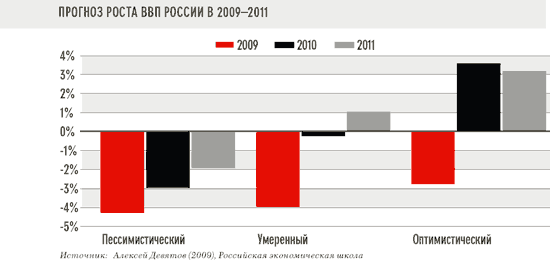
However, they will cut off everything , despite all the warnings of the head of the Ministry of Finance and the sober expert community, the government still does not believe that there will be no reserves at its disposal through a matter of months. Apparently, certain hopes are connected with our eternal “lifesaver”-the cost of oil. Now the cost of a barrel is not around $ 30, as it was at the end of the last - early this year, but around $ 60. Such prices are quite favorable for Russia. According to Evsey Gurvich, the head of the economic expert group, "calculations show that the reserve fund will be filled, even if the oil price is at $ 40 per barrel." However, this is rather an optimistic view of events. The calculations of Sergey Guriev from the Russian Economic School show that the drop in oil prices up to $ 50 will cost 9% of GDP in 2009 and another 6% next year. If in 2010 the price of black gold falls to $ 40 per barrel, then GDP losses will be 10% and another 9% for the next year. Another question is that no one knows how much black gold will cost in the near future. From multidirectional forecasts, ripples in the eyes: by someone by the end of the year, a barrel is seen for $ 20, someone is dreaming of $ 200.
But if hopes for expensive oil are not justified, the government has another “fire” remedy that has already been tested at the end of the last year: the ruble devaluation. This simple reception allowed from November 2008 to February 2009 to increase the reserve fund funds by 1.1 trillion rubles. As Natalia Orlova explained, the chief economist of Alfa-Bank, “due to the devaluation of the ruble, which was held by the Central Bank, the domestic currency weakened by about a quarter. The Ministry of Finance recalculated the volume of the reserve fund at the foreign exchange rate and received a plus of more than a trillion rubles. ” It is possible that the government will be forced to repeat this trick in case the reserve fund funds are melting faster than it calculates.
In any case, the budget of 2010 cannot avoid a thorough reduction in expenses. “A more conservative forecast can be taken for the budget,” the deputy minister Oksana Sergienko formulates this on the bureaucratic slang. “They will cut off everything except social,” Vladimir Tikhomirov, senior economist of Uralsiba, translates into a public language. However, whether there is enough money for social expenses in the volumes that are adopted today is also a big question.
“Russia, unlike many countries, met a crisis with money and, it would seem, could not transfer it so hard,” said Julia Trucheaeva, chief economist Merrill Lynch in Russia. In fact, thanks to the accumulated reserves, our country had in comparison with the rest of the world that finances budget deficits by building state borrowing (and often direct emission), a colossal head start in several years. However, the government makes one vicious decision after another: it pours money into the empty pipe of the stock market, then spends on AvtoVAZ and Rostekhnology, hoping that the world economy will begin to grow earlier than the country ends in the country. However, it is possible that the country is not at all interesting to the government, and it simply saves close businesses ...