
Translated material
Very secondary higher education
How the educational system reacts to changes in the labor market
67% of high school students believe that school knowledge is not enough for entering a university. Almost 70% of university graduates, leaving the walls of Alma Mater, work not in their specialty. Waiting for good news - asked The New Times 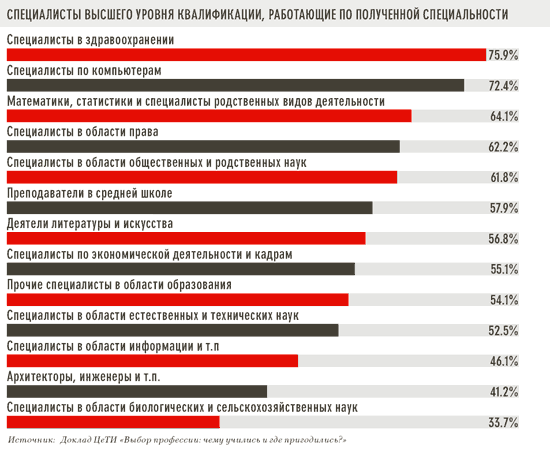
The quality of education can be evaluated in different ways. For this, there are ratings-domestic, according to which Moscow State University is better than Harvard University, and international, where Moscow State University takes 183rd place. One of the indirect indicators of the prestige of universities is participation in the exchange system. How many foreign bachelors come to Russia to study in a magistracy? How many teachers are sorted out of goodwill to our Palestines? Such statistics are not conducted, but experts believe that these cases are single. “Ours are still going there, and from there very few are going to us,” says Vadim Radaev, Vice Vis-VSHE Vice. Only the Russian Economic School (RES) leaves the exception, but it is not preparing bachelors - masters.
The Russian education system does not have enough flexibility, said Igor Fedyukin, director for applied research of the Center for Economic and Financial Research and Development (CEPER) of the Russian Economic School. The structure of university specialties is still determined by state ordering. Quotes to budget places are determined from above. State forecasts for the need for specialists of a particular profile are often erroneous, and often no studies are conducted at all and the budget quota is formed according to an arbitrary state order. “The labor market for 10 years is changing beyond recognition, lawyers and bankers who output 10 years ago, today no one needs to be,” says Rash rector Sergei Guriev. -The educational system reacts to some changes in the labor market, but slowly. With some delay, universities change the sentences of specialties, but the quality of teaching remains the same. ”
“The quality of education in Russia is sequentially deteriorating when the transition from one stage to another,” said the deputy director of the Center for Labor Studies (Tseti), the State University of Higher Professional Education Rostislav Kaplyushnikov. “Initial - good, incomplete average - so -so, the middle is bad, the highest - just out of hand.” The center, together with Rosstat, wondered: does the received higher education correspond to the real professions of graduates? The result was the report “Choice of a profession: what did you study and where came in handy?” It turned out: a little more than a third is retained by the received specialty, less likely to change the profile of diplomated doctors and teachers, lawyers and economists. The most “windy” were graduates of agricultural and engineering universities.
1 Exactly a year ago, Sergei Guriev published an article in The New Times on the problems of the Russian Higher School, but still there (see The New Times No. 22 of June 2, 2008).