
Translated material
Rest under the "palm trees"
The results of the Cannes Festival: directors put on shock and provocation
Cannes movie games. The ended world cinema championship in Cannes caused contradictory grades. The world press obviously declared him the best in half a century. We some appreciated his program as strong, others as the weakest over many years. The contradictions are generated not by the logic of the Cannes festival, which is still trying to show the best, but the situation in the cinema, more precisely, cinema. It is trying, but so far it cannot find new ways and forms 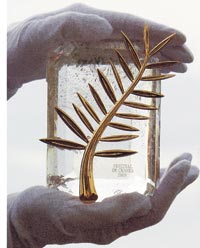
Nevertheless, this festival demonstrated at least three curious trends, three curious moves with which cinema is trying to stimulate or, if you want, simulate its movement forward.
Arts and shock some directors in search of new paths are shocked and provocative. So far from the cinema, but still a related form of art, like art (in particular, videoart), has long considered a provocation, even in its purest form, without much philosophical or social subtext, relevant artistic gesture.
So the masters of cinema art loved episodes that make the viewer in horror resume: “Not that!” - And even jump out of the hall with approaching nausea. Interestingly, a few years ago, a Cannes program warned of the presence of similar episodes. The “pianist” by the Haneke, “irreversibility” by Noe, “no matter what day, trouble” by Claire Denis accompanied notes that the film was not for the faint of heart and not for people with heart disease. Now there are no such notes. Despite the fact that by the middle of the festival it became clear: almost every film contains elements of hard sex and the highest violence. And more often both. Frank homosexual fuck. Frank sex with a minor. Blood from the eyes. Grounding the throat, etc.
The coil record, as always, was set by Lars von Trier. In his "Antichrist" the hall shouted "know!" In a thousand throat, immediately starting nervously laugh. The most intimate and even extremely tense parts of the human body are largely shown there. There, one of them is cut off with scissors (and you don’t guess which one. No, not at all!). There, the heroine of Charlotte Hensbur, who eventually received a prize for the best female role, passes through the goal of her husband Willem Defoe and inserts a heavy sharpened stone with a metal axis into the hole, tightly spinning it with a nut. And then, when the surviving husband is hiding in an animal hole, it desperately wets it with a shovel.
Those who do not like von Trier have long claimed that he is creating only provocations. Your humble servant is a fan of the Danish master. But it seemed to him that he first arranged a provocation for the sake of provocation. But no. In retroactively, you understand that this is a film with a deep, also provocative meaning. The point is not how you think at first that "the devil is a woman." He is (as exactly formulated in a preface to an interview with Charlotte Hensbur in the last issue of The New Times) that the world created Satan. Nature is a beast. And sex is nature. The official history of the universe formulated by religion, the radical von Trier turns out to be inside out. According to official history, the Lord created the world, and only then in the form of a snake-exceter a devil appeared, seducing Eve of Televoy. No, says von Trier: since nature is originally bodily, it means that it is from the devil. And then the Lord appeared, began to teach morality and spirituality as opposed to bodily; love - in contrast to sex; Fidelity in marriage is in contrast to random fornication. However!
I know that you know another Cannes move to overcome ... We will not say the “Cinema Crisis”, but the stamping on the spot can be called the Tarantino principle. He is not to spread oppression of the previous standards of cinema, but, on the contrary, with pleasure to play in them, to saturate at the same time with the real history of mankind with unprecedented plots, to create an unprecedented film cinema. Tarantino in Cannes was not the only master of this genre. But “inglorious bastards” is the most impressive movie that characterizes such a movie integration.
All films of Tarantino from “Frantic Dogs” to “Kill Bill” were guidebooks on the history of cinema, a tribute to the cinema of the past. But the "bastards", whose action is supposedly in France like in the second world, set a record. This is a tribute to Western, and films about military adventures, and real military dramas, and propaganda military satire, and the genre Noir, and the films of the 40s in general, and anti-utopias, and even modern clips. Shocking episodes fitting into the Cannes layout of this year are also enough.
Not everyone likes the film. But it is worth recognizing that Tarantino is a conceptualist. In “Frantic Dogs” and “Criminal Reading”, he was the first to come up with film records of a new human breed, sort of newwoods formed by mass culture, who feel and behave not as real people, but as characters of the mass -country, which makes them faintly immoral. The subtext of “inglorious bastards” can be described as follows: the cinema has always overpassed the story. So let's treat this soberly, without resentment and honestly creating such a story on the screen (even still painful Second World War), what we like.
The old, kind, also unkind, against the backdrop of these who are trying to look like innovative cinemas, won, however, long film prams - with a huge number of parallel lines and characters. This is the third trend of the festival. Such films also contain elements of shock or provocation (blood with a fountain is whipped from a cut throat, in the forest they find a dowry boy with groaned eyes). But they win (including, in the opinion of the jury) because they are primarily smart traditional cinema. Maybe Kinomir does not expect such radical changes?
Perhaps, only the long -standing “picnic at the hanging cliff” of Peter Wair gave rise to the same number of puzzles as the owner of the “golden palm branch” of this festival “White Ribbon” of the Austrian classic Michael Haneke. With the Picnic, the Hankee film is also related to the fact that he is also about the province of the past, where mysterious events begin: in the Puritan village in northern Germany, unmotivated evil suddenly manifests itself. It is somehow connected with the Gruniye, because the matter, as you do not immediately understand, occurs on the eve of the first truly cruel and all-winging world war. But this evil, obviously, addresses the remote nightmares of the 20th century. Apparently, the children of the local pastor are involved in bloody events. They are brutally vaccinated with high morality, forcing them to wear white ribbons on the sleeve as a symbol of purity and innocence. But in response to aggression, evil sprouts. Fact: it was from these children that crowds of those who greeted Germany in the 30th by the cry “Zig Hale!”
The “Prophet” of Jacques Odiara, who received the second most important Cannes Grand Prix, looks deceptive to the film about the prison-that is a special cinema. It is in it that the throat is cut so that the blood is whipping with a fountain. But in the end, he turns out to be an innovative “godfather”, modern, without romance, without literary cliches. At the same time, the godfather is an Arab guy who had enough brains, accidentally falling into a nightmare (by them, not our standards) prison, combine the interests of the enlightenment of the Corsican, Arabic, Italian, and Negro maiden. France should start. She, perhaps, shuddered when Odiara was given only the second, and not the first, as he hoped, the Cannes prize.
There is no new cinema. New cinema integrations are evident.