
Translated material
The book is a sentence
In the USSR, Roman-Generation became proof of the prosecution
Resistance mechanics. In the ranking of enemy literature of the Soviet secret police, the novel “1984” was at the top of the list - along with the “Gulag Archipelago” Alexander Solzhenitsyn and “Will the Soviet Union be allowed until 1984?” Andrei Amalric. There was a real hunt for these books: they were seized during searches, hemmed to business articles, included in the conviction. As it was - asked the former politicals of The New Times
In May 1976, 31-year-old Pavel Bashkirov, an artist-restorer of the Yakut Museum of Fine Arts named after Gabysheva, returned home from Moscow, where he treated his sick son. He returned to his wife and his books. To the tape recordings of Galich, to the materials in the case of Daniel -Sinyavsky. Among these papers there was a samizdat copy of the book of Orwell, printed on papier paper. Bashkirov was still unlearned then, and therefore did not hide anything. True, according to the Moscow habit, he left the “beacons” everywhere: the hair between the sheets of folders, a special ruler or a tied thread in a special way.
“In June, they began to come to me,” says Bashkirov, now Muscovite and human rights activist. - The “beacons” began to disappear. Then I left a message to the gabshniks: I drew a large figure and the inscription: “Sorry that you could not find anything, come back.” After my arrest, they laughed - they say, you are a guy nothing, with humor. In general, they liked this fig. ”
Bob took, Bob passed
One of his acquaintances brought to Bashkirov to the guard - either from meanness, or by stupidity. “He had a nickname Bob,” said Bashkirov The New Times. -I began to give him some articles, documents, books. When he searched, he voluntarily handed over to Orwell into the hands of the gabsniks. But on my process, he did not witness - he was on an internship in London. I think it was a reward for baking. ”
Bashkirov was judged under the famous article 190.1 of the Criminal Code of the RSFSR (“The spread of knowingly false fabrications defaming the Soviet state and social system”) for storage of 1984 and other enemy literature. He received for three years, sat in a Yakut prison, went out a and a half later. The dissidents and even Alexander Solzhenitsyn himself came to prison.
Dissent's subscription
The “undesirable” books were actually not accepted to keep at home. “In the late 1970s, a system of library subscriptions took place,” says Valeria Novodvorskaya, who was first arrested back in 1969 for the spread of anti-Soviet leaflets and who then spent two years in special buildings of Soviet punitive psychiatry. - The dissidents had nothing at home, everything was in the hands of readers: what was distributed is preserved. And at home there was a file cabinet with symbols of books (for “1984” - Tower, for “animal farms” - “bird's courtyard of Tatyana’s grandmother”) - and readers' pseudonymers ”.
“Writing and reading are two classes for which in the Soviet Union it was easy to get a term under a political article,” says another ZEK, Alexander Podrabinek, arrested in 1978, convicted by the same as Bashkirov, 190.1 and received more than five years of exile in Oymyakon (Yakutia). - True, it was difficult to understand the logic: they could find the Gulag Archipelago and let them go, but they could remove the universal declaration of human rights and plant. In 1977, “1984” was taken away, but they did not include the charge. ”
KGB rating
Orwell’s novel was included in the list of the most dangerous books. In this peculiar ranking of the fifth control of the KGB (“installations” came there from the Central Committee of the CPSU and Glavlit) in the first place - in terms of danger for the minds of citizens - stood the “Gulag Archipelago” Alexander Solzhenitsyn. ““ Archipelago ”was out of competition,” one of the former employees of the department, who spoke on the condition of anonymity, told The New Times. Next was the book of Andrei Amalric, written based on Orwell - "Will the Soviet Union will last until 1984?" and actually "1984". The President of the Effective Policy Fund, and then the student of the philosopher and dissident Mikhail Gifter, Gleb Pavlovsky says that Orwell’s book “was included in the five of the first books that a person read when he came to Samizdat.”
The Chekists themselves read “1984”: “In the First Glavka (the first Main Directorate of the KGB - Foreign Intelligence), this book was well known. The committees themselves introduced each other to this literature - the enemy needs to know by person, ”said Mikhail Lyubimov, who himself read“ 1984 ”in England in 1964, when he worked there in residency, told The New Times.
Freedom carriers ...
Orwell, like another Tamizdat, came to the USSR in the suitcases of diplomats and Western journalists - all whose luggage was in the USSR through the channels of the diplomatic, which means that the postal KGB not monitored. However, there were other ways. “There was a whole program financed by the American Congress. A little people were involved in it. One Czech was in charge of this, he had branches in London, in Rome, somewhere else. These were the bookstores of Russian-speaking books that they distributed free of charge to Russian sailors, and they somehow managed to transport forbidden literature to the country, ”says Disident Vladimir Bukovsky, who was first arrested in 1963 for the book of Milovan Dzhilas“ New Class ”. According to him, the Chekists, of course, knew that something was transported past their nose. “But you won’t keep track of everything and everyone,” says Bukovsky. - The Chekists sent their agents to diplomats and foreign journalists who have expected books. It was harder with the sailors. Firstly, during the shmon, the books could easily be thrown overboard, and secondly, the ship is not a car, there you can hide the line. ” And hid.
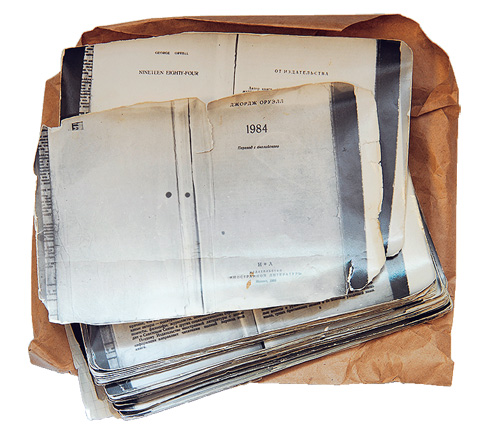
A typical example of Samizdat of the 70s (from the personal collection of Yuri Avrutsky). Photocopy from the Parisian publication “1984”, equipped with a camouflage title sheet for transporting across the border: “Moscow: Foreign Literature, 1959”. The customs officers did not check with the catalog of Leninka and did not look inside the book. Granted by the archive of the history of dissent in the USSR of the international "memorial"
... and its distributors
At first, Orwell came to the Union exclusively in English. And since the late 1950s, the book was actively translated in the USSR. “In a sense, it was the key moment of the Soviet samizdat: when people began not only to transmit literature, which suddenly became forbidden, and when the purposeful work of translators began, who obviously could not count on the publication,” says the historian of the dissident movement Alexander Daniel.
“The translation was often bad, clearly home manufacturing,” says Novodvorskaya. -I have never seen Orwell in the publication of YMKA-Press (the Paris publishing house of the Russian book, which was founded in 1921 in Prague, in 1925 moved to Paris) or “sowing” (the Publishing House of the People’s Labor Union, which actively published and distributed anti-Soviet literature). The copy was very poorly printed, and it was impossible to make photo and photocopies from it- unlike the “archipelago”, which appeared in compact and clear copies. ” Most often, 1984 was distributed in photocopies, from which enthusiasts were reprinted on a carriage of a carbon car - this, in particular, was now engaged in the chairman of the Moscow Helsinki group Lyudmila Alekseev, who in 1974 announced a warning for the "systematic production and distribution of anti -Soviet works." To Alekseeva, Orwell first came in 1962: “Despite the bad translation, the book made an impression,” says Alekseeva. “It became scary: everything was like what we saw here every day.”