
Translated material
Orwell on Lubyanka
On the relationship of the writer with the country of Soviets
Legally the novel "1984" was published in the USSR in 1988. However, he was translated into Russian back in 1959-on the instructions of the ideological department of the CPSU Central Committee. What attracted Orwell Soviet “Ministry of Truth” - The New Times was interested in
In fact, the works of Orwell could appear in Russian somewhere in the late 1930s.
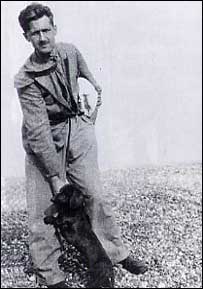 |
Then the young and little famous Briton, who professed a certain “democratic socialism” invented by him, had just returned from Spain, where he fought against the Francoists on the side of the Republicans. As it turned out - “wrong” Republicans: in Barcelona, “Free Journalist” George Orwell signed up in the ranks of the police, the united working Marxist party, which, like the detachments of the anarchists, was declared “Trotskyist”, and the members of the Umum began to be called “fifth column”, “traitors”, even “fascists”. However, the then editor-in-chief of the magazine International Literature (the magazine was published from 1933 to Russian, French, English and German) Sergey Dynamamov did not know about these details of the military biography of Orwell, and therefore wrote a letter to him to send the novel “The Road to Wigan-Pires”, which tells about the difficult life of the miners Lancashira and Yorkshire during the Great Depression, who thought to publish in the magazine. Orwell in a response letter honestly admitted in everything: “ I must tell you that in Spain I served in P.O.U.M., who, as you, undoubtedly, you know, was subjected to fierce attacks from the Communist Party and was recently prohibited by the government; In addition, I will say that after what I saw, I more agree with the policy of P.O.U.M., rather than with the policy of the Communist Party. I tell you about this, because it may turn out that your newspaper (so with Orwell: Paper. - A.B.) will not want to place publications of a member of P.O.M., and I do not want to represent myself in a false light . ” (RGALI (Russian State Archive of Literature and Art). F.1
Whether the intercourse with the “Trotskyist” was affected by the fate of Sergei Sergeyevich Dynamov, but he, a prominent expert on Western European literature and one of the largest Shakespearenes, was soon arrested and died in the Gulag in 1939. His successor as editor -in -chief Timothy Rokotov, having previously asked the sanction in the NKVD foreign department, answered Orwell as follows: “You correctly assumed, <that> our magazine cannot have any relations with members of the Umum, this organization, as confirmed by all the experience of the Spanish people against the intervention," who is "one of the detachments of the" fifth column ".
Taboo in the name
The exit in 1945 Animal Farm (“Animal Farm”) finally defined Orwell in the USSR as a “reactionary” writer-the certificate of the Pampflet book and its author, dated to the 1946 archive, which is stored in the archive of the foreign commission (Polchchet organization that studied political orientation and the mood of foreign writers), (SSP). It provides extensive quotes from a review published in the English literary journal, which confirmed the reputation of Orwell as an anti -Stalinist and anti -Soviet. This meant a ban on mentioning even the name of the writer in the Soviet press.
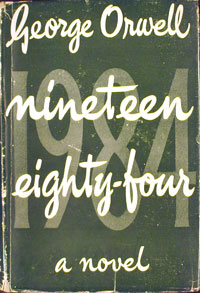 |
When the novel “1984” was released in 1949, VOKS (the All -Union Society for Cultural Communications with the abroad), describing the book as “Freepwented slander for socialism and socialist society”, sent a letter to the same Foreign Commission of the SSP with a recommendation to make the exposure of “slander inventions”. But even the Writers' Union did not dare to do this. Nevertheless, in the reviews, which were drawn up by the commission in 1949-1950 on foreign periodicals, information about the resonance that the 1984 slanderous book had in the world constantly appeared.
On a special list
However, the “meeting” of the Soviet reader - although very specific - took place with Orwell in the pussy times. In 1959, the ideological department of the CPSU Central Committee instructed to translate into Russian and publish the novel “1984”. Specialization totaled something about 200 copies and was intended exclusively for the highest layer of the party nomenclature, not tired, as Zoshchenko would say, knowledge of foreign languages. Such a technique is not new: back in the 20s, some books with the stamp “only for members of the CPSU (b)” were published. The novel was released by the publishing house of foreign literature with the vulture “is sent on a special list. No. ... ”, without specifying the circulation and the name of the translator. The book did not enter any of the libraries; Even in the former special guards of the largest bookstores, which had the right to receive a mandatory copy, it could not be found.
In 1962, the same “specification” was released in Russian (the same publishing house and with the same vulture) the book of Richard Rice “George Orwell. The fugitive from the camp of the winners. " In a small preface “from the publishing house”, in particular, it was said: “ ... Glory created the story“ Animal Farm ”and Roman 1984, which, in essence, represent a satire on Soviet society. Therefore, it is no accident that the 1984 book was adopted by bourgeois authors - prominent political and statesmen, economists, philosophers, journalists and turned into a desktop book of preachers of anti -Soviet propaganda. <...> It is characteristic that recently foreign reactionary writers have increasingly began to illuminate political issues in their works, at the same time resorting to a peculiar method of lies and gross falsification of history . ”
Forbidden fruit
The two most famous works of Orwell, “despised seal”, speaking by Pushkin’s words, appeared in the Russian Samizdat in the 60s. Occasionally in the USSR, Orwell Tamizdat also penetrated - his books published in Russian abroad. The KGB hunted for books. So, for example, on June 8, 1978, the KGB Directorate in the Leningrad Region requested a censor - Lensorlit: “In connection with the investigation in criminal case No. 86, please inform whether the following works are subject to publication and distribution in the USSR <...>” among the 17 books discovered during the search, there is a foreign publication “1984”. Leningrad censorship answered, of course, that “... all these books were published abroad, are designed to undermine and weakening the orders established in our country, and their distribution in the Soviet Union should be regarded as an ideological sabotage. Books in the USSR were not published, they are not subject to distribution. ” Another anti -utopia also appears in the same document - Evgeny Zamyatin’s novel “We”, characterized as “The Evil Pamphlet on the Soviet State”.
For the first time legal, 1984 was released in the publicity of the Soviet press only in 1988, in the third year of perestroika. It is characteristic that not in Moscow, but in the peripheral literary journal - the Moldavian "Codra". In the same year, the Soviet man was able to read the “animal farm”, published in the Latvian “spring”, without fear and looking back.
Since then, the works of Orwell have been withstanding dozens of publications. However, it is interesting that during these more or less free from censorship of the last two decades, our publishers are limited to the standard publication of two textbook works, only occasionally adding a dozen and a half stories and essays to them. Meanwhile, in London, a 20-volume complete collected works and letters of the great English writer of the 20th century was completed.
About the author:
Arlen Blum-Professor of St. Petersburg State University of Culture and Arts, Doctor of Philology, Author of Books and Studies on the History of Soviet Censorship:
“Behind the scenes of the“ Ministry of Truth ”. The secret history of Soviet censorship, 1917–1929. " (St. Petersburg: 1994),
“Soviet censorship in the era of total terror. 1929–1953 ". (St. Petersburg: Academic Project, 2000),
“Sunset of Glavlit: how the system of Soviet censorship was destroyed. Documentary Chronicle 1985–1991. ” (M.: Terra, 1995).