
Translated material
The right did not go out
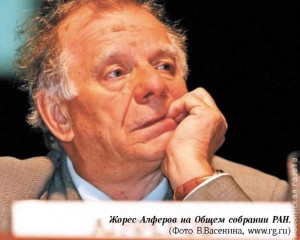
A few days before the general meeting of the Russian Academy of Sciences, the Presidium, at the suggestion of academician Alferov, decided to make an amendment to the RAS election. According to this proposal, it would be enough for the election to gain a simple majority of votes at the general meeting, instead of two -thirds, as now, and at the meeting of the department - two -thirds instead of the current half. The discussion of the amendment (in the section “Miscellaneous”) was included in the agenda of the meeting almost at the last moment.
President of the Russian Academy of Sciences Yuri Osipov motivated the need to amend by the fact that voting at the department is the vote of professionals, while at the general meeting those who "cannot even name the specialties of the candidate."
However, the amendment did not pass. According to Polit.ru, a number of academicians spoke out against it. In particular, Sergey Stishov indicated that the general meeting takes into account the reputation of the candidate; Alexander Spirin said that it was thanks to the rule of two -thirds that the general meeting sometimes manages to prevent the election of unworthy candidates; And Spartak Belyaev noted: “The pressure of the bureaucracy on the academy is very strong, and it is easier for him to resist the general meeting. And it is much easier to conduct your people through departments of the bureaucracy. ”
On an open vote, the amendment received 310 votes “For” and 229 “against”, and 41 people refrained. Although the “pros” was a small majority, the quorum was not enough to accept the amendment: more than a thousand delegates were registered at the meeting, and only about 600 voted instead of the necessary 800. This caused a sharp reaction of Yuri Osipov. “How the president should react if a carefully thought-out decision fails, and even due to the lack of a quorum,” he said. - I believe that the general meeting has lost its role in the Office of the Russian Academy of Sciences. This is a vote against the president. I declare that I will draw conclusions, including organizational. ”
Apparently, Academician Osipov is right-this is really a vote against him. Moreover, that, according to eyewitnesses, the Presidium voted for the amendment standing (so that the present could see how it should?), Many of those present did not vote at all. After the announcement of the vote, one of the academicians demanded from the hall so that the voters “against” stand up so that they could be re -counted (or rewritten for the adoption of those very “organizational” measures?).
Another thing is true: this amendment was really carefully thought out. At the level of three -traders. In order to understand this, it is enough to look at the results of last year’s elections to the Academy. The most prominent candidate, with a brilliance of voting at the section and the department, but not elected by the general meeting, was Mikhail Kovalchuk - he gained more than half the votes (204 “for”, 157 “against”), but did not reach the required, in the required position, 248. And without becoming an academician, he cannot be a candidate for the position of president of the Russian Academy of Sciences. Here we must recall that the correspondent of Kovalchuk was twice rejected as a candidate for academics by the department of physics (in 2003 and 2006), but shortly before the 2008 elections, he was appointed acting vice president of the Russian Academy of Sciences (position not provided for by the Charter). It has now become easier with the department: voting on this candidacy has moved to the newly created department of nanotechnologies and information technologies (Onit). But the general meeting remains with the general meeting.
Another victims of Rules 2/3 was the chairman of the Accounts Chamber Sergei Stepashin - he also received a majority of votes, but did not pass the threshold.
A more detailed look at the voting results is also very instructive. So, almost all academics gained more than 320 votes (with the required 248). There were only five exceptions: three candidates from the department of public sciences (economist Sergey Glazyev-272, internationalist Anatoly Torkunov-270 and the governor of the Khabarovsk Territory, and now the representative of the President of the Russian Federation in the Far East-254) and two candidates from the nanotechnical-laws of onitus: Mikhail Kovalchuk and his deputy in the Kurchatov Center Konstantin Vrryabin- 264. The record number of academics - 157 and 100, respectively, voted against the last two.
Apparently, it is not by chance that the head of the nanotechnology section Onit RAS Jores Alferov did not hide his negative attitude to the results of the elections. “I am not entirely satisfied with the results of the elections to the academy that took place in May of this year,” he said at the opening of the Science and Society forum in June 2008. True, he motivated this that only a few of the new members work in St. Petersburg-three academicians and ten corresponding members.
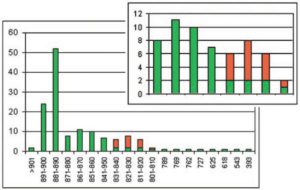
Moreover, five of the latter are engaged in nanotechnologies, like Petersburg Alferov. It would seem that everything coincided successfully. But it so happened that the candidates of this particular section enjoyed the least popularity at the general meeting in May 2008 - they all found themselves in the lower half of the list of votes (see histogram).
There is no reason to hope that this is where the story will end. CARTHAGINEM DELENDAM ESSE. Nanotechnologist Kovalchuk should be an academician, and then - the president of the Russian Academy of Sciences or what will remain from her during this siege. So far, the decision has been postponed to the fall. It was even expressed that the vote by amendment would be held by mail in the coming days, but this seems unlikely - the correspondence vote is not provided for by the Charter of the Russian Academy of Sciences. Although…
Mikhail Gelfand