
Translated material
London let in bees
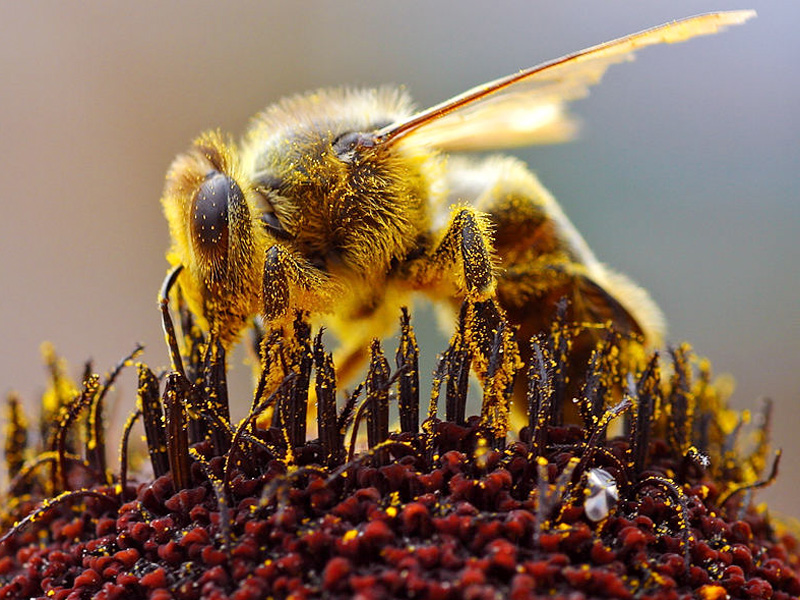
British bees on the verge of extinction. It is estimated that more than 200 types of bees and 25 types of bumblebees live in the United Kingdom. Over the past two years, their population has decreased by 15 percent.
The Committee on Public Affairs of the House of Communities of the British Parliament published a statement stating that a decrease in the population of bees leads to huge losses for the British economy. The extinction of these insects leads to insufficient pollination of gardens. In this regard, agriculture is losing 200 million pounds for a year, the committee notes.
The British environmental organization "Natural England" is in alarm and conducts a wide campaign for the preservation of bees. Her responsible secretary Johannes Paul in an interview with Radio Liberty explained the reasons for the catastrophic decrease in the number of bees in Britain:
- The population of bees decreases everywhere in the world. The reasons for this are the reduction of their habitat, which is destroyed by the expansion of urban construction and the creation of new industrial agricultural vehicles. At the same time, the possibility of bees is significantly reduced to find wild flowers and grass suitable for power. In rural areas, it is now customary to sow huge spaces with monocultures, which, it would seem, enables bees in a very short time to get a large amount of food. However, when the crop is removed, the bees find themselves on a hungry ration. So the fate of our bees is now absolutely unpredictable.
Bees are able to fly after a bribe five kilometers from the hive. "Natural England" calls the townspeople to install hives in their gardens, on the roofs of houses and even on balconies

Bees are able to fly after a bribe five kilometers from the hive. "Natural England" calls on the townspeople to install hives in their gardens, on the roofs of houses and even on balconies. Its call was followed not only by private individuals, but also by city companies and organizations. So, the famous London store Fortnum & Mason began selling its own honey received from the hives installed on its roof. In the Royal Lancaster-Hotel located in the center of London, to breakfast, honey from their own hives, also located on the roof of the building, is supplied to customers.
Boom of beekeeping in Britain is growing. This year alone, more than a thousand people listened to an introductory beekeeping course in 60 special centers in London. An example of the capital was followed by counties that opened beekeeping courses in cities throughout the country. Since 2007, the number of members of the British Association of beekeepers has increased from 10,000 to 14,500 people. Beekeeping courses are recorded already next year.
The designer company called Omlet has constructed a compact hive adapted to the city conditions with which the amateur beekeeper is easy to cope with. This is a plastic hive of bright colors: red, green, yellow, purple. Bees love him. Its creators argue that in one such hive you can collect on average 50 cans of honey over the summer, while it requires care for an hour only once a week.
But will the bees survive in the contaminated air of the Central London, where hives have already appeared on the roofs of houses? Johannes Paul and the organization "Natural England" believe that there are no problems here:
- I am absolutely sure that the bees will feel great in London, where there are a lot of gardens and parks in which they can collect nectar. This nectar is absolutely clean, gathering with numerous colors and therefore is completely safe. We advise the townspeople to plant plants in their gardens and front gardens, which the bees especially love: Buranchik, Nasturtium, Malva, Lavender, Heather. We recommend a new type of hive, the design of which is specially designed for urban conditions and which is created for amateur beekeepers. It can be installed on the roofs of houses. It is absolutely safe, protects the house from bees, is very clean and convenient for both bees and to collect honey. Its cost is 495 pounds, a special overalls and other necessary accessories are attached to it.
If the bees are comfortable in London, then how safe is this bee experiment for citizens? After all, the appearance of large ears of bees on London streets can become dangerous for people. Moreover, in the St. James Park and the Garden of the Buckingham Palace located in the center of London, the curses of bees have already been seen. Johannes Paul assures that there is no danger:
- Firstly, the bees will mostly live in gardens and parks, and not on the streets. Secondly, they fly quite high. So on the streets they will not have contacts with people. Well, the new hives are not at all dangerous.
(The plot from the heading "History of the West and the East" Programs of Freedom - Day release. " )