
Translated material
G20: The crisis has not ended, you still have to "go on pounds"
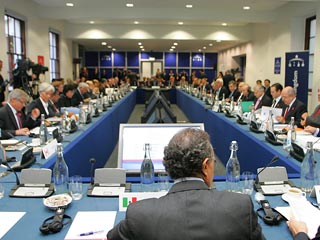
The Ministers of Finance and the Head of the Central Banks G20 decided that it was not the time to stop active support for the economy. It was this conclusion that was the most important result of the work of the financial G20 in London, said Deputy Prime Minister, Minister of Finance of the Russian Federation Alexei Kudrin.
“The most important thing is the assessments that we have received, that the crisis has not ended, that the uncertainty remains very high, the sprouts are still not very stable,” Kudrin said in an interview with journalists following the results of the meeting.
So, the ministers predict that "the financial sector will still fever, there were many comparisons that we will have to go on pagods, on the bumps, we will still be abandoned."
According to Kudrin, the meeting participants "tried to convince each other that it was still necessary to fully maintain the volume of support that the states of the global economy provide." “Everyone persuaded each other, which was still too early to relax,” he said.
The dispute of ministers arose on the question of whether it is necessary to begin the strategy for leaving the programs of active fiscal incentives for the economy. As a result, most participants agreed that it is necessary to develop such strategies, but it is too early to use them, Interfax reports.
The ministers also agreed that the exit from these programs would be very difficult. So, some countries, taking into account the fall of GDP and the growth of social expenses, the reduction in income will not be able to easily reduce budget deficit, Kudrin noted. They will have to either reduce expenses or increase taxes, which will “in any case with very painful measures of the crisis,” the minister said.
The impact on the economy of great liquidity, which is now given by the Central Bank and the state as part of the support, was also discussed. "It is clear that it would not be very simple to turn liquidity. There was a comparison that it was like to be tinned back in a tube," he said.
So, Kudrin noted, "the debts accumulated (during the crisis) will have to be broken for a very long time, the next generations will pay for this, and the measures that bring the economy to the pre -crisis state will have to be used for a long time."
The minister also stated that the public expectations of the G20 for bonuses to top managers of system-forming companies were exaggerated. He noted that this was far from the most important topic in the discussion of financial regulation.
According to the minister, "the problem is not in the amount of bonuses, but that the volume of payments depends on the level of risks - the higher the risks, the greater the reward." The minister believes that states are unlikely to limit the size of bonuses to the heads of large companies and banks. “We must ensure that the remuneration system does not create new bubbles. The key question is to cancel the system that stimulates the risks,” Kudrin emphasized.
In general, he noted that in comparison with the March meeting of the financial G20, the current meeting was more calm: "Then we met in conditions when the two quarters were a free fall in the economy, today everyone is calmer, because, finally, the fall stopped."
However, the minister considers an important past meeting. “We agreed to continue all measures to stimulate - this is very important, to work out the exit scenarios - another big result. We know clear positions on quotas in the IMF, from which we can go further in the discussion, we have worked on the rules of financial regulation,” the head of the Russian Ministry of Finance concluded.
In the communique, in addition, a decision was recorded on the need to maintain the G20 of lending countries, including taking measures in relation to "bad" assets and stress tests. The ministers agreed to pay attention to employment, conducting structural reforms, an active policy in the labor market, in education and training.
It also says that the G20 countries will strive to eliminate excessive volatility of the prices for resources, optimizing the work and increasing the transparency of commodity and financial markets, as well as establishing a closer dialogue between manufacturers and consumers.
Kudrin hopes for a smooth exit of the Russian economy from the crisis
Alexey Kudrin expects a smooth exit of the Russian economy from the crisis. "We hope that this trend will be constant, and we will leave the crisis on L (smoothly) or V -shaped (sharp resumption of growth) of the trajectory," Kudrin said.
At the same time, according to him, in the world, despite the improvement of the situation, the fear of the "second wave" of the crisis remains. “When they talk about uncertainty, this means that despite all growth, everyone is afraid that some new wave (crisis) can happen,” the minister said.
In this regard, Kudrin explained, anxiety about the W-shaped exit from the crisis, which implies the second fall after a small growth of the economy, remains in the Russian Federation. “I can’t say exactly if there will be a W -line of the crisis. We are all worried about it, but we hope that this will not happen,” he said.
Earlier, the minister said that the Russian economy would begin to leave the recession in the third quarter. He, in particular, noted that the tendency of GDP growth, which was observed in July and in August, will remain in September.
The Russian economy will reach the pre -crisis level at the end of 2012, Kudrin also said. "Our new forecast allows us to say that by the end of 2012, that is, the result of 2012, will be the restoration of Russia's GDP to a pre -crisis level," he said.