
Translated material
The world is without reconciliation
What Putin wrote about to the Poles
Unfinished war. It would seem that September, which happened 70 years ago, had to be buried under the grave plate of memory for a long time, to the fence of which they would come to raise the stack - in gratitude to those who saved Europe from the brown plague, and the reconciliation of all those who were then on different sides of the fronts. But the consent is not yet found. Both September 1 - the date of the beginning of World War II, and on September 17, when the Soviet troops invaded Poland, and the USSR became an ally of the same plague, which almost captured Moscow two years later, they continue to be the subject of political battles. The dead, of course, will not have a shame. And living? Tens of millions of dead - their ashes can not reach out to those who are subject to history under the current policy. The souls of the deceased on the field of battle burned in gas chambers who died under bombing - we owe them the truth about what happened 70 years ago. And to their children too. 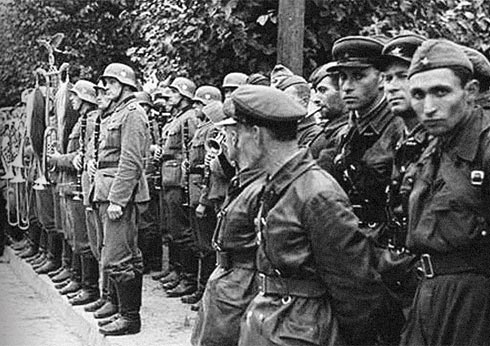
"Letter to the Poles." That is how the article of Vladimir Putin, dedicated to the 70th anniversary of the beginning of World War II and his visit to Poland, christened in Poland. She did not give peace with the past. Why - thinking The New Times
In the "copyright" heading of the article by Putin there is a question mark. It is called "Pages of History - a reason for mutual claims or the basis for reconciliation and partnership?" Although, from the standpoint of political rationality and diplomatic etiquette, it is assumed that the answer is obvious - for partnership, in fact it is not so smooth at all.
Excessed expectations
The Poles with growing trepidation awaited Putin. Their expectations would correspond to the second Munich speech - tough, nationalist, offensive. Of course, this did not happen, Vladimir Vladimirovich is not so simple. To humanize the background of the visit, an article was chosen in the main Polish daily edition of the Vykhovaya Gazeta. As the first deputy editor -in -chief Yaroslav Kursk, this “unexpectedly interesting” article was sent by the Russian embassy in Warsaw, said in his video materials on the newspaper website, and diplomats did not object to the preliminary publication of fragments before the “letters to the Poles” on Monday paper issue. Which, in fact, happened. The favorable background of the visit was provided, and Putin’s article and the words about the immorality of the Molotov -Ribbentrop Pact were commented on with all possible delicacy. The Russian prime minister did not leave the first lanes. The number of the “newspaper of the sample” for September 2 was decorated with a chic photograph of the prime ministers of Russia and Poland - Vladimir Putin and Donald Tusk, who were peacefully talking without an translator in the Sunny Shop in the city of Sopot. “The weather is good on the Sopot prayer,” the first strip hat reported. “Prime Minister Putin announced the possible discovery of Katyn archives.” “Such strong peoples as Russian and Polish are not afraid of the truth,” Donald Tusk said.
In contrast to the current head of the Polish government, the former prime minister and brother of President Yaroslav Kachinsky pathetically exclaimed: "Why did they invite Putin?" In the sense that the visit of the Russian leader overshadowed the meaning of celebrations, to which more than 20 delegations from different countries gathered. And President Lech Kachinsky equated the executions in Katyn to the Holocaust.
Putin and Polish history
Putin accepted the invitation of the liberal - in contrast to the conservative president - Prime Minister of Poland Donald Tusk, "because Russia and Poland were allies in that fair battle." Everyone now forgets about this on both sides of the border, and such a reminder was important. Although it did not start too well. At 3 o’clock in the morning of Moscow time on September 17, 1939, the Polish ambassador to the USSR received a statement from the Deputy Foreign Department of Foreign Affairs Vladimir Potemkin, which reported on the transition by the Red Army by the Soviet-Polish border to protect the lives and property of the inhabitants of Western Ukraine and Belarus. It was emphasized that as a result of the Polish-German war, Poland as a state ceased to exist and this creates a danger to the Soviet Union. Secret protocols for a friendship agreement and the border between the USSR and Germany on September 28 issued the fourth section of Poland. And I must say that the Stalinist logic was in line with old Russian prejudices against Poland. Pushkin’s poem “Borodino Anniversary” is mentioned less often than the “slanderers of Russia” with their “dispute of the Slavs between themselves”, but it was there that Poland, who turned into the Polish Duchy of the Empire, contemptuously said: “Go to us: Rus' calls you! / But know the guests! / Poland will not let you down: / Through her steps ... ”In September 1939, not as an example of the Napoleonic wars, the Polish army desperately resisted, and the threat from the East turned out to be completely unexpected. As a result, almost 250 thousand Polish soldiers and officers were captured. Then 22 thousand of them in April-May 1940 will be shot in Katyn, copper and Kharkov.
The misunderstanding of these nuances continues to annoy the Poles. Reproaches to the Poles in the reprisal of Czechoslovakia are recognized as fair (it was the struggle for the disputed Tessino region, which is called Corulzier in Poland), but, as Putin wrote in his response, the permanent chief editor of the newspaper Variant Adam Mikhnik, "no one shot there in the back of the head."
It was not very successful that the mention of Putin Versailles treaty as one of the minute mines, which became a distant cause of World War II, turned out to be very successful. The trouble is that the Poles well remember the classic definition of Vyacheslav Molotov: "Poland is the ugly brainchild of the Versailles Agreement." Mikhnik also reminded of this.
“It is extremely harmful and irresponsible to speculate on memory, prepare history, look for reasons for mutual claims and grievances,” Putin rightly wrote. But why, then in Russia, the information tsunami passed, which is the possession of the Molotov -Ribbentrop Pact, why was the myth that Poland provoked Germany on a campaign east in public consciousness? Why, by the way, is the holiday of November 4 as a day of victory over the Polish invaders? But this is also absolutely Stalin's logic. It was Stalin, as Mikhnik writes, in 1941 reproached General Vladislav Sikorsky Polish occupation of Moscow in the 16th century.
The common words said by Putin is the most important diplomatic instrument that allowed to at least partially melt the ice not just mutual distrust, but dislike. But as soon as the assessment of historical details begins, contradictions immediately arise. For example, the Russian prime minister writes: “And is it possible to close your eyes to the backstage attempts of Western democracies to“ pay off ”from Hitler and redirect his aggression“ to the East ”?” Of course, this circumstance was one of the reasons for the conclusion of the Pact about the non -aggression between the USSR and Germany, but not the secret protocols of Molotov -Ribbentrop. However, firstly, it must be understood that in 1939, Stalin, to put it mildly, was not popular in those very western democracies. Secondly, it was a mistake of specific Western politicians, who were then condemned by other politicians, their fellow citizens. Neville Chamberlain was one of the “pacifiers”, who was shortly believing that Hitler could be stopped. In his memoirs, the USSR ambassador to England, Ivan Maysky, mentions a private conversation with Winston Churchill, who said about Chamberlain: "Neville is a fool ... He thinks that you can ride a tiger."
Katynsky plot
“The people of Russia, whose fate was distorted by the totalitarian regime, are also well clear the aggravated feelings of the Poles related to Katyn,” Putin admitted, but did not write anything about the claims related to the fact that 116 of 183 volumes of the criminal case, which was closed by the main military prosecutor’s office, remain secret. Adam Mikhnik in his article, entitled “Everything was not entirely true, Mr. Putin ...” suggested that Russia and Poland mutually open the archives and all the materials regarding Katyn: “This would be a good sign for the Poles.” The day before, the deputy head of the government apparatus Yuri Ushakov announced the impossibility of such a development of events. But after a walk on Sopotsky praying and conversations with a stupid on a mixture of Russian, English and German languages, Putin made the possibility of continuing the discussion of the topic based on “mutuality”. Tusk agreed with such a principle.
So far, if anything remains mutual, it is “symmetrical” historical reproaches. You shot ours in Katyn, and you froze the hunger and typhus of the Red Army in Polish captivity. However, Donald Tusk did everything he could. And Vladimir Putin has a chance to move from words (articles) to business (declassify Katyn materials).