
Translated material
To the first anniversary "Vedomosti"
In society
 To the first anniversary "Vedomosti"
September 9, 2009 Vladimir Nadein
 The decade of Vedomosti gives a grateful reason to observe the slow front of our periodicals. It is not because, it is clear that the panorama of the Russian media is an affectionate pastoral. Quite on the contrary, from our media, built in a shaved nape, the picture is terrible. But the “Vedomosti” themselves is just a ray of light in the Dark Kingdom. Yes, so bright, so inspiring that it is not a sin to compare the brainchild of foreign investment with the famous Katerina from the famous drama "Thunderstorm" by the domestic playwright A.N. Ostrovsky.
Thomas Jefferson’s winged statement: “If I had to choose: to have a government without newspapers or newspapers without a government, I would, without hesitation, choose the second,” - this is not about us. Thomas has two “would” - a hundred will not help us. We did not have this in our homeland to be allowed to choose between the government and anything else. From the first Petrovsky “chimes” to the current “Rossiy newspaper” - always on the throat of our press lay a hairy paw of power. Private publications, usually a little more unreasonable than officials, were afraid of the royal stable to death. Stalin, if you remember, considered himself a journalist. At the same time, they began to shoot a professional for typos, which strengthened the spelling. The current leading publications, supposedly not entirely state -owned ones, tremble from the oblique gaze of the Putin administration without hesitation. And where the Kremlin eyes do not reach due to Russian vastness, there the local dignity of the satrapshop walks along the first pages. And they get him, they are too at a thunder. Not a day without a photo. Sponsor.
52 years ago, I started a regional journalist at the Cheremisinovo station, Kursk region. The station is the station, but the deaf-hakhoman was terrible-even at that time. My professional ignorance was flush with her. To close this topic: I myself, personally, through cruel intellectual self -torture, came up with a heading: "Walking towards the Moscow festival of youth." Honestly, I really did not suspect that my find is just a blurry newspaper stamp. The result of such creative torment was my appeal to the first secretary of the party district committee with a request to give an interview. The secretary walked in a green tunic, blue gallife and chrome boots. He smoked “gun” cigarettes, surprisingly beautifully, crosswise, passing through cardboard mouthpieces three times. I do not know what he thought about the interview. Without taking out the “guns” from the teeth, the secretary said that the newspapers should write about ordinary workers, and the interview, if necessary, he will give a party. Maybe he did not know what an interview is. Or maybe I guessed that I couldn’t take any interviews, but I just lied about the photo. Not only our peeling two -year -old, but also solid districts, such as Tim Pravda, ordered cliche in Kursk, in the regional printing house. But there were their lines. So from the moment of approval of each photo of the secretary of the district committee for propaganda to a muddy print in the newspaper, no less than eight weeks took place.
Fear of publicity was called party modesty. All the reserves of the glory and flattery that the public organism of the 250 millionth superpower produced, flocked to the foot of the first person. Everyone else was allowed to sniff the phimiam from a safe distance. Nowadays, this fear is uprooted with the root. In its place, cool biographies of provincial vassals of the chief president and national leaders, who are vassals of the main national leader, are violently blooming. Newspapers can, of course, publish a photo of the advanced milkmaid, but only if Putin kisses it. At the same time, Putin will be Anfas, and the milkmaid will be from the back.
This replacement of party fear of the media in the media led many people to the nostalgic conclusion that those “Izvestia” are more intelligent than these “labor” more people, and that “Komsomolskaya Pravda”, not as an example of modern, wrote the truth. Put the current editions and bells of those times nearby, and you will easily see that this nostalgia is deeply erroneous. Soviet newspapers were unbearable. It was not a week that two or three cellars of such monstrous boring did not appear in them that the hardened correctors fell asleep on the third paragraph. The hull of the planned economy. Continuous rise in living standards. The party’s concern for further ... "Two worlds are two tournaments." And essential snot about milkmaid - 350 lines in the third lane plus a photograph in an embrace with a cow.
“But still,” the fan of those newspapers will not agree. And, perhaps, not without reason. Those newspapers were read with the established public agreement of truth and untruth. In the words of L. Feuerbach, the reader himself determined when and under what circumstances this statement can only be true. The best newspapers were considered the best not because rather and more precisely others reported truthful information. Competitions of this kind were held on the party whistle and under the supervision of censorship. Therefore, all, without exception, the participants in the races came to the finish line first. The newspapers competed not in the newspaper, but in writers: epithets, metaphors, artistic comparisons, pictures of dawn and sunset, and more than the skill of subtext. The talent was manifested in the ability to leak through the smallest pores of censorship, and the thoughtful reader, who was prepared for solving political reboses with his whole life, made an unmistakable conclusion: how much they wrote in Pravda about the dog exhibition! This is not without reason. So, they will soon declare a relief for tourist trips to Poland.
This public consent inherent in an immature slave -owning system naturally collapsed and crumbled to dust. Newspapers, for a couple of years, broke from a leash, in cheerful packs were dancing at large, until they were stolen and began to look for new owners. The new owners were not so much dogcakes as dog shows. They did not need conscientious setters with friendly long ears. They needed to tear the one to whom they would indicate and not yet dragged. Liberal? Liberals. Bolsheviks? Bolsheviks. Pindos? Pindos. You will tear - we feed fat, with quails and Mercedes. You won’t tear it out - stop. The interests of the dogcase, naturally, turned out to be multidirectional, howl and binnings looked disgusting, which was why the audience was imbued with a new reverence for those Izvestia and that Komsomolskaya Pravda.
“Vedomosti” has never been “those”. They have no Soviet history. The popularity of Vedomosti shows that in that experience there is not the slightest need. It prevents honestly and simply to study with Western newspapers, which technically, organizationally and ethically are immeasurably higher than the wretched and showing off post -Soviet journalism. Of course, this sharp assessment is not applicable to such intelligent publications as the new “independent newspaper”, “New Izvestia”, “News Time”. Very strong newspapers come out in St. Petersburg, Kazan, Irkutsk, Lipetsk, but I will refrain from more clear assessments, since I am not their regular reader. Unfortunately, these rare lights are drowning in the darkness of the reptile press, which is not able to survive without state top dressing.
In the anniversary issue, Konstantin Sonin, professor of the Russian economic school and the permanent author of Vedomosti, emphasized the special role of money in creating a positive image of this newspaper. The fact that over the years of cooperation there was not a single case of ideological interference in its texts, Mr. Sonin led to the economic status of this project. As you know, "Vedomosti" is the fruit of cooperation between two colossians of world business journalism: American Wall Street Journal and British Financial Times . Their frank focus on profit, their capitalist greed, uncomplicated by any ideological tricks, the author considered the main success. Only a hardworking, skillful, decent newspaper brings a steady percentage to invested capital. Therefore, capital creates such a newspaper.
This, of course, is true - clean, but not all. What is true is proved by all world experience. The US government has not a single newspaper for internal distribution. The administrations of all 50 states have no newspapers. There are no self-government bodies of American counties, which are the size of three or four of our European districts. All of them are forbidden to spend money on taxpayers on their PR. The Russian picture is opposite to complete shamelessness. Our bosses are eaten in three poles under the pretext that you want to eat subordinates very much. The population allegedly lacks money for newspapers - hence, they say, subsidies. About the long-standing experience of the BBC, living with state money, but managed by an open and independent public council, they don’t seem to know here. Budget money distributed quietly and only with their own, they burn competition to the roots. Try it, overweight a competitor who, in the same kiosk, sells the newspaper thicker than yours, more colorful, with general “exclusive” interviews - but half as much.
A special merit of “Vedomosti” in the destruction of the myth that our reader does not want to pay. Wants. But not for bullshit, but for the goods.
A special merit of “Vedomosti” in the destruction of the myth that in our media market serious journalism cannot be earned. Can. But you have to work.
Nevertheless, Vedomosti was lucky that their bosses are overseas merchants. Our rich people showed out newspapers on their swollen pockets not at all out of love for a printed word. They brought successful editorial offices to the Kremlin cuisine, as a sake -based huntsman brings broken partridges to the bar table. They bought old Izvestia and Trud, they converted that Komsomolskaya Pravda into Komsomolskaya Pravda , too, so much because of money and also without looking at ideology. They all correctly and in advance - and without any computers, on an ambulance, steaming. What is more expensive-the innocence of some newspaper or the possession of a unique Norkel? What smells more appetizing - fresh typographic paint on a paper one -day or millions of barrels of Lukoil? Where is it more pleasant to sit - in Curules or in Krasnokamensk?
Vedomosti is a business newspaper, it simply has no right to deny monetary charms. But with all their experience, “Vedomosti” show that not only happiness in money. Acting according to journalistic standards that are generally accepted in the United States, Vedomosti graphically, lexically and, most importantly, politically separated information from personal opinions. The news has ceased to be convenient to cover both for panegyrics and for renunciation. News are highlighted at least on both sides, and if it succeeds, from three or even four. The brevity, simple speech, sufficient actual support, proportionality of the topic and size of publications, the resourceful of the headings and the high information of the subtitles - all this creates the atmosphere of a neat, well -groomed house, where you want to go and sit in quiet thought. On the Vedomosti website, where sometimes hundreds of readers gather, mutual rudeness is extremely rare, and anger causes rejection.
The special merit of Vedomosti is that they are both a compass and a tuning fork. They show how to become a newspaper that should be believed and worth paying for. In the image and likeness of Vedomosti, you can configure a blatant newspaper mechanism. And not only newspaper. I sometimes dream: I would have started a television channel with the standards and approaches of Vedomosti. Would he live to his bright decade or turned into an overwhelmed NTV?
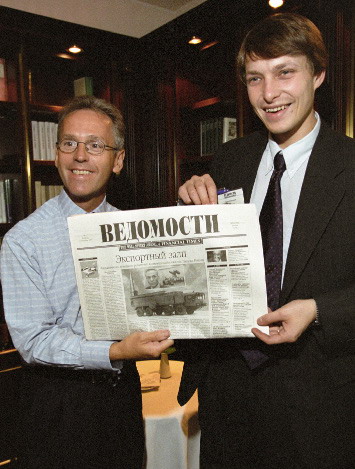
In the photo: editor -in -chief Leonid Bershid (right) and publisher DSC Sauer (Holland) (left) show at the presentation the first issue of the newspaper Vedomosti, 09/01/1999
Photo by RIA Novosti