
Translated material
My scientific grandfather
Semen Petrovich Shubin (1908-1938)
Improving the public structure with the help of revolutions is like repairing a spoiling TV, knocking on it with fists and stomping your feet on the floor. Sometimes it helps, for a while. Sometimes, however, there is nothing to lose. But then the TV still has to be thrown away.
To shake society, to jam stagnant water, to initiate a monstrous surge in human activity ... This can be useful in many respects. There are no doubts that in Soviet times, many sciences, especially physics and mathematics, received a powerful impulse and perished as they never dreamed of pre -revolutionary Russia. And so we made missiles, and blocked the Yenisei, and in the field of ballet, to say in good faith ... However, I do not understand the ballet. The scientists who survived in the shocks of the Soviet period turned out to be well done. The trouble is that very much, many have not survived, and you can only guess what fellows they could become about. And it is not only about the goal and means. Terror, among other things, is inappropriate and ineffective. Soviet science subsequently, under the first blowing relatively fresh wind, demonstrated the complete absence of a margin of strength. Too many died. Too many, as Choran said on a similar reason, is even worse.
However, progress is evident. Such nonsense as during the French Revolution about the execution of Lavoisier (“The Republic does not need chemists”), it seems, no longer said. “We don’t have irreplaceable”, of course, is also stupidity, but still less. And “personnel decide everything” - in general, it looks like a pure truth. The republic needed chemists. And in physicists I needed, and in mathematicians. And if there was enough intelligence to evaluate the possibilities of genetics to develop biological weapons - you look, and in biologists it would be ... Fortunately, it was necessary to need. Initial. And then they would have looked at who - the corrupt girl of world imperialism, and who - the corrupt girl is quite the opposite.
Last year, a centenary of birth was noted, undoubtedly the greatest of the Soviet and Russian physicists, Lev Davidovich Landau. Having accepted the ideals of the revolution too close to the heart, in his youth he actively plunged for a short time in politics, was arrested in 1937 (however, without real passion for politics), spent a year in prison and miraculously escaped.
Semen Petrovich Shubin, the same age as Landau and, according to his teacher, the Nobel Prize laureate Igor Evgenievich Tamm, the physicist of the potential comparable to Landau, went a similar path, but he ended, so to speak, by the death in Kolyma camps at the age of thirty, “from the frostbite and decline of cardiac activity”, as the official certificate of about the official certificate of about death. He managed to publish several outstanding works and create a scientific school, which is still alive. He is my scientific grandfather, through Sergey Vasilievich Vonsovsky, the closest student and employee Shubin and my teacher. When in 1988, abusing the mercifully bestowed freedom, we spent in Sverdlovsk a scientific assembly of Shubin’s memory (80th birthday from the day of birth, the 50th anniversary of death), and then prepared and published a book about him, responded and sent materials, among others, such unconditionally great physicists as Yakov Borisovich Zeldovich and Rudolph Pyerls. Now, it seems, Shubin began to forget. What do you want - half the work, as you know, do not show fools, and he did not fully fulfill his ideas. Did not give. “It is well known that the detailed development of these issues brought to the English theorist Neville Mott Nobel Prize. Soviet physicist Semen Petrovich Shubin went to prison, and from there to Kolyma and to the next world ”(from the letter of Ya.B. Zeldovich).
In 1953, mass elections of physicists took place at the Academy of Sciences of the USSR. The creators of atomic and thermonuclear weapons were awarded, however, not only them. Vonsovsky was then elected, then, as far as I know, he had nothing to do with nuclear matters. Tamm then became an academician, as well as his student Andrei Dmitrievich Sakharov. Of course, many congratulated him. The widow of Shubin also sent a congratulatory telegram, Lyubov Abramovna (after the death of Semyon Petrovich, Von-Sovsky married his widow, adopted and adopted the children of S.P., while he was left the name of his father; he saved his teacher’s family, exposing himself to serious danger). In a response letter, Tamm called Semyon Petrovich "the most talented not only from my students - and I am spoiled by them - but of all our physicists who are in their age corresponding to my students."
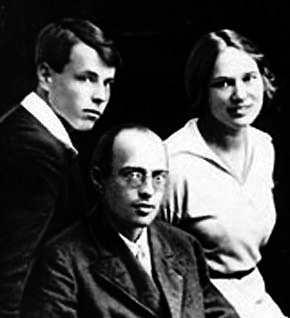 Semen Petrovich Shubin was born on July 18 (31), 1908 in Libava (now Liepaya). Shubin - the pseudonym of his father, Pyotr Abramovich Vilensky, an active participant in the student movement and revolution of 1905, an employee of the liberal newspaper Kiev Thought. For a short time, P.A. Vilensky - Shubin was forced to switch after the defeat of the revolution to an illegal position. For participation in the student movement in the historical conditions that changed after the victory of the next revolution, his son paid then much more.
During the Civil War, the Shubin family wandered around Ukraine until in 1920 it settled for some time in Kharkov. According to the memoirs of Brother Semyon Petrovich, Evsey, at this troubled time, the children of the Shubin managed to get a very decent home education, having learned English, German and French and engaged in mathematics on books on his own, which was brought by the father from the university library.
In 1923, Shubin moved to Moscow, where the father of S.P. I got a job in the foreign department of the newspaper Pravda. At the age of 16, Semyon Shubin enters the Physics of the Moscow State University and becomes a student of wonderful physicists Leonid Isaakovich Mandelstam, the creator of the world famous school in the theory of oscillations, and already mentioned by Igor Evgenievich Tamma. In his student years, Shubin was especially friendly with A.A. Andronov, one of the largest mechanics-mechanics of the 20th century. (The general public was known in Soviet times mainly as the prototype of the main character of the film “Everything remains people”). In 1924, Shubin joined the Komsomol and was actively engaged in political activities. Like most young enthusiasts of communist beliefs (including Landau), Shubin adjoins the Trotskyists. Everything ends (nothing actually ended ...) with arrest and reference to Ishim in 1928. In 1929, he was invited to participate in the construction of Magnitogorsk (by the way, my hometown), first as a concrete worker, then an employee of the factory multi-line. In Magnitogorsk, he fell ill with a rash typhus, from which he almost died.
He managed to maintain scientific contacts with Moscow State University and engage in physics, publishing in 1930-1931. Six articles, including the most famous work with I.E. Tamm on the theory of the photo effect and the outstanding work “On the tones of the membrane, fixed in the final number of points” (its co -author in this article, A.A. Vutt, also died later, during the years of “Big Terror”). His teachers continued to bother about their talented student, and in 1932 their efforts were unexpectedly crowned with success. It was decided to create the Ural branch of the Leningrad Physical and Technical Institute (subsequently-the Institute of Physics of Metal, where I had to work for many years), and S.P. Schubin was appointed head of the theoretical department of the newly created institution, and in 1934 he became, without the defense of the candidate and doctor's dissertations, the doctor of physical and mathematical sciences and professor. The mysterious bends of the Stalinist personnel policy. Assigned then, for the proletarian origin and party science, the director of the newly created institute, the graduate student (!) Mikhail Nikolaevich Mikheev was, I must say, a worthy person; Subsequently, academician L. Arzimovich called him the best director of the Scientific Institute of the Soviet Union. Politically suspicious Shubin, almost instantly into the scientific Olympus (and physically destroyed five years later, when the logic of the class struggle took its own), became the main theoretician of the newly created institute.
Vonsovsky, two years younger than Shubin, became his closest student and employee. In 1934-1936 A series of works by Shubin and Vonsovsky according to the so -called “polar model of metal” appears. At the same time, Shubin publishes the most important (unfortunately, very underestimated) article “To the theory of liquid metals”. It is inappropriate to explain the scientific significance of these works. I will only say that they laid the foundations of that scientific direction, the development of which subsequently brought Nobel prizes to the largest physicists of our time, the Englishman Neville Mott and American Philip Anderson. The concepts of what is now called "Mottovsky" and "Anderson" transitions of metal - isolator are clearly contained in the works of Shubin. He did not have time to develop his ideas.
April 24, 1937 S.P. Shubin was arrested. He did not admit anything, which explains the relatively soft sentence - a link to eight years in the Kolyma Territory with the right to correspond. As Vonsovsky later explained to me, scientists and engineers exiled to Norilsk (where Zenyagin reigned) had good chances to survive - there were cherished specialists, in reasonable, of course, limits, without rotten liberalism. There were practically no chances on Kolyma.
Mikhail Katsnelson