
Translated material
Atu.exe
It turned out to be relatively simple with Viktor Erofeev - and, for the writer, is familiar. Some employees and graduates of the Moscow State University once again accused Erofeev of inciting ethnic growth and arousing of Russophobia. To do this, they chose one of the tested paths: they wrote an open letter to the newspaper "Soviet Russia" - there is, there is one more. Graduates and teachers who do not want to act as principles have failed the writer to blame the novel "Encyclopedia of the Russian Soul". The book, however, was published ten years ago, but there are eternal values. The letter is addressed to Nikolai Gubenko - the remarkable artist and deputy of the Moscow City Duma. The addressee is not accidental: Gubenko has long believed that Erofeev should be responsible for his books, and the novels themselves should be removed from the sale.
After reading the letter, Oleg Proskurin - by the way, also a graduate of Moscow State University - presented the verbal portraits of many signatures in his blog. Some portraits turned out to be political: it turned out, for example, that one of the authors of the letter is the spouse and ally of the notorious ultranationalist Boris Mironov. The rest of the authors were a little better. It is unclear whether this will help Erofeev; However, any clarity - especially in such a case as clarifying the individuals of the organizers of the persecution - is more likely to plus than in anything else.
“I would never have thought that something could be on the side of the writer V. Erofeev,” one of the commentators wrote. “Yes, and I, in general, would never have thought,” Oleg Proskurin answered. However, to take the side of the one who is beaten in a blade is no less Russian than to beat someone in a crowd.
* * *
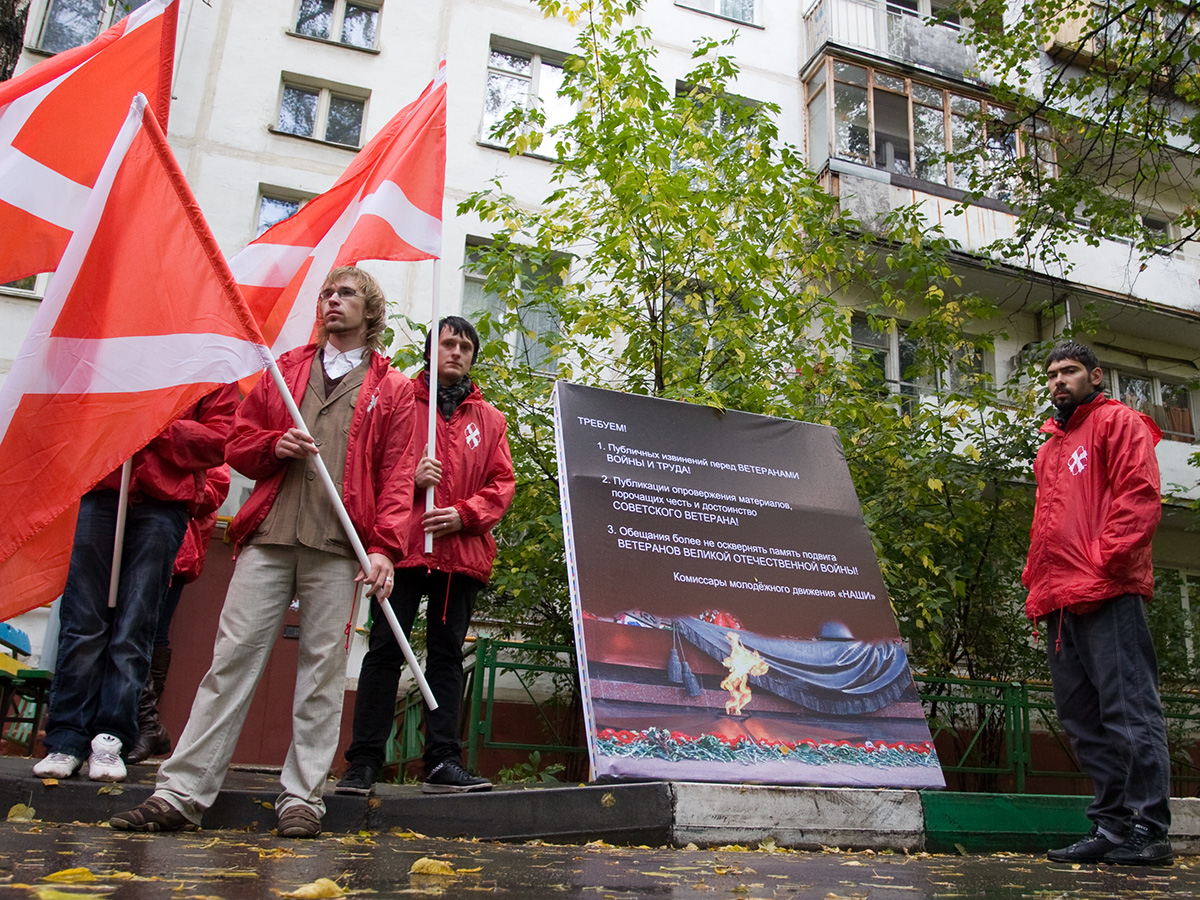
But the story with Alexander Porobinek turned out to be unprecedented - at least because his persecution lasts more than a week and is not going to curl up. Recall that Alexander Podrabinek on a private material-the Bessed liquidation of the barbecue "Anti-Soviet", against which veterans were supposedly outraged-published an article on the role of veterans in the life of modern Russia on one of the Internet resources. The article turned out to be a hobby and - given the dissident past of the suburban - uncompromising, to put it mildly. Pigobink, in particular, wrote:
"It is time to stop hypocritical lamentations about the feelings of veterans who are insulting attacks on Soviet power. Evil should be punishable. The ministers are also. The contempt of descendants is the smallest of what the builders and defenders of the Soviet regime deserved."
I must say right away: about this passage, I would meet the author in one on one mode. Just clarify positions, talk. About who the veterans are, what they did-and for what reasons, if they did not succeed, neither I, nor anyone else, most likely, would not have the pleasure of asking Alexander Podrabinek what he actually had in mind. For the complete absence of participants in the conversation in the space of the millennium Reich, for example. And, judging by the responses in the blogosphere, many have this opinion.
Unfortunately, the events went beyond the limits of civilized discussion of this, more than controversial, thesis: the pickets of the Prochrevsky "of our" near the apartment of the suburban, psychological pressure on his family and other abominations. Here the conversation is impossible: either "ATU!", Or "Hands off!" - Especially from the family. Actually, so the blogosphere was polarized; Not surprising.
However, the blogger Mike67 - in the world of Mikhail Solomatin - still managed to call users of network diaries to the conversation:
There was no such discussion about Russia for a long time. Every day it becomes more and more obvious that the scandal around the letter of the sub -Rabinsk has become a historically important event. So important that it is just right to include in textbooks. The main result of the "public discussion" was the impossibility of its conduct. The scale, intensity and orientation of the social reaction are impressive. The Pigobink, of course, was inaccurate, showing where the main abscess was on the body of Russia, and scratched the scalpel not quite there, but as a result it was revealed that now you could not worry about accuracy.
Now there is no longer any doubt that Russia is on the verge of fascism. I'm not talking about the so -called "Russian fascism", which in a multinational state has no chance to become a state ideology, but about the universal state of minds. Fascism is not just an extremely right ideology, not just revenge, but, as Roger Gryffin correctly noted, the recreation of the nation again. Such a reconstruction is characterized by the replacement of historical memory with a mythological memory, even where the “living fabric” of historical memory, it would seem, is strong enough. Moreover, not "even there", namely there.
Something unprecedented, in fact, happened: Mikhail Solomatin succeeded-on the material of the story with Porobinek-to return to the field of a real, full-fledged discussion, the discourse has long left it: "fascism in Russia." This topic was so trampled over the years of the new Russian statehood - and the trampled, it should be recognized that not by statesmen - that, it would seem, any appeal to it can cause at least a soreness: well, yes, “wolves, wolves”.
And - nevertheless:
When in a country with a completely barbaric attitude towards living veterans and to the graves of the fallen, adults suddenly begin to cry with thoughts about the war - this is not good, but terrible. This cannot but scare, because such an exalted reaction is a symptom of the most severe disease of society. Fascism, as a disease, is dangerous because blood begins to pour at its late stage when you no longer stop it. First, an influx of excellent feelings is necessarily going on, and only then the sobriety of reason quickly disappears. <...> The recreation of the nation and the state, the substitution of reality by the dream of it inevitably leads to a shift in priorities from real to fictional, from living veterans - to the memory of the Great War. Therefore, the flip side of this mythologization naturally turns out to be extreme cynicism. <...> A fusion of holiness and cynicism gives rise to fascism. It is important to understand: in society, as in chemistry, even the most terrible muck can be made up of completely ordinary components.
So, according to Blogger Mikhail Solomatin, it is the current painful perception of the war that destroyed German fascism that can lead to similar processes in the winning country. More precisely, in her direct heiress. Four pages of comments - and, a rare case, almost all of them in the case, and from completely different positions - confirm the relevance of this seemingly paradoxical gaze.
Well, a paradox on the paradox: if the vile, in no way justifying the persecution of a person who wrote a very ambiguous article can still lead third -party observers to the exact and adequate conclusions that it was and what we should be afraid of all, which is not so bad so far. And in the blogosphere - and in the surrounding reality.
In the end, everyone-pah-pah-pah-are alive. Including Alexander Podrabinka, so that he is healthy. So, you can still argue. And in disputes to find something lift over the fact of persecution and helps to realize both himself and fellow citizens. Not "ours" in quotation marks - but simply their own.