
Translated material
Play the map of the world
With whom and against whom the Russian authorities are friends
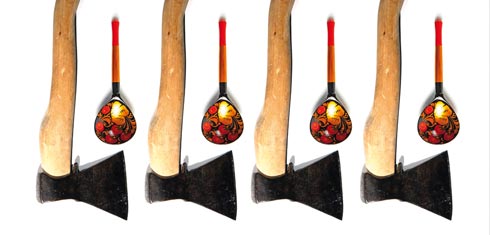
With whom and against whom is Russia friends? Who is her allies, fellow travelers, opponents? Some in response quoted Alexander III: “Russia has two allies - the army and the fleet,” others talk about anti -Western instincts and mental thrust for Iran’s modes (read the discussion on page 10) or Venezuela (p. 17), the third mourn the disappearing “brotherhood” with neighbors. The population has a full cavard in the brains: we love democracy, but democratic countries are not (p. 14). How in that joke: “Do you like tomatoes? “I like to eat, but no - no.” However, the conformism of the West also helps, the political scientist Lilia Shevtsova (p. 20) believes. Meanwhile, the power endlessly sets the image of the enemy, which is again "at the gate." Russia in the surrounding world - in the main topic of The New Times
In the conceptual apparatus of Moscow-2009, in fact, there are no friends, no allies, nor how many certain ideological attitudes. There is no well -thought -out strategy or clearly marked goals. Russia sees around its aggravation of anarchy, unpredictability, accelerating the decay of the world device. Partly catastrophic perception is a consequence of their own past experience - few of the powers experienced collapse, comparable to the collapse of the USSR in scale, and such psychological trauma is healed for a long time. This is partly a reflection of the real confusion in which the entire international system of the early 21st century is abstained.
Crazy, crazy world ...
In this system, the once established rules cease to operate (from the inviolability of the boundaries to the inviolability of sovereignty), the institutions are subjected to erosion (from the UN to the WTO) and the usual alliances are shaken (from NATO to the CIS). The shakiness of the world soil evokes mixed feelings. On the one hand, fear of a global environment is unpredictable and invading all aspects of life. Hence the sensation of the besieged fortress, the desire to fence off from foreign influences. On the other hand, a foreboding that, following the decay of the previous system, a certain new one will begin to form and it is important not to miss the moment, to stake in it an appropriate place, to take revenge for the fiasco of the end of the last century. Hence the impulsive desire to strengthen the position wherever the opportunity seems to be.
If the world is fluid and unstable, unions are obviously confusing. Therefore, the concepts of “ally” or “strategic partner” are either a declaration of intent (for example, until recently the relations of Russia and the European Union), or a propaganda stamp (Russia and Belarus), or a product of the coincidence of quite specific interests (business of Russia with some European countries).
The post -Soviet space 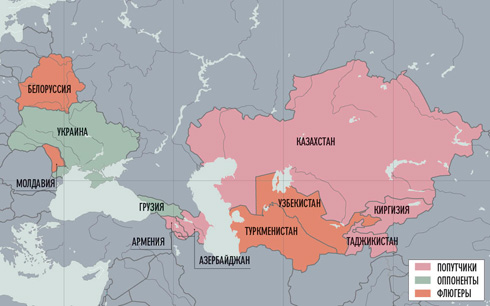
Here, the main goal of Russia is to maintain a dominant influence on the provinces of the former empire. But Russia is not strong enough and knew how to impose its own patronage to neighbors, and competitors (USA and the European Union) are not able to “take them along”. As a result, the form of the existence of almost all CIS states is constant maneuvering, and the more skillful they do it, the better their relationship with Moscow.
The most successful are Kazakhstan and Azerbaijan, which demonstrate the real art of maneuver. At the other pole - Georgia and Ukraine, who tried to rush straight to the west.
There is an objective coincidence of interests - in Central Asia. The worse things are in Afghanistan, the more relevant the question is who is able to continue to guarantee security border countries with it. CSTO, * * Organization of a collective security agreement, which includes a number of countries of the former USSR. For many years, he played the role of the virtual “tiger”, it may finally be in demand. True, she will have to go through the process of restructuring: neither Belarus nor Armenia has reasons to risk the lives of her citizens on the Afghan border. But Uzbekistan, which seems to be completely confused in the turns of his own foreign policy, may be among the most interested. True, there are also contradictions: if the needs of security and fear of China’s growing claims to the role of the main Asia are pushed closer to rapprochement, then the struggle for markets for energy resources is turning Russia and the neighboring country, which it is going to protect, into competitors.
To call Minsk an ally of Moscow, given the nature of relations with Alexander Lukashenko, the language does not turn, although Belarus has nowhere to go from Russia. The highest priority for the Belarusian president is the preservation of personal power, and if anyone can guarantee him, then only the Kremlin. But at the same time, the Old Man understands that to “open” the country for Russian capital, which Moscow has long been achieving, means to sacrifice the economic basis of its own position. But Russia no longer wants to buy promises.
Middle East
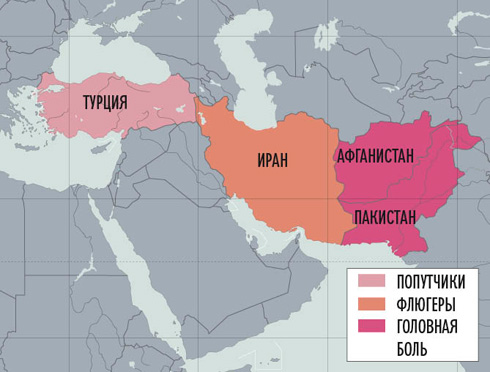
Türkiye adjoins the post -Soviet space - the most promising of the new partners of Russia. In recent years, Ankara’s ambitions have grown sharply, it, like Moscow, sees herself as an independent center of force, independent of either from the United States or from the EU. Türkiye seriously aimed at taking the place of the chief conveyor of oil and gas from the countries of the former USSR, and these plans are not fully fed by the forgotten traditions of the Ottoman Great Power. Another key player in the neighborhood is Iran. Relations between Moscow and Tehran - a mixture of traction to each other of two influential regional forces, deep mutual suspicion, attempts to use a partner and the desire to increase their status in the eyes of the rest of the world. New Russia rather has a positive experience of interacting with Iran and in solving regional problems (civil war in Tajikistan, non -interference in Chechnya), and in the field of business. But in the case of Tehran, Moscow has to maneuver in the post -Soviet style: how to maintain the potential of cooperation, while remaining an accomplice to the US effort to prevent the creation of Iranian nuclear weapons.
The Middle East
Everything is still incomprehensible and unsteady here: the usual system of relations is clearly destroyed, but the new one does not yet arise. There is a kind of model of the world in miniature - there are opportunities for Russia, but no one knows how to use them.
European Union
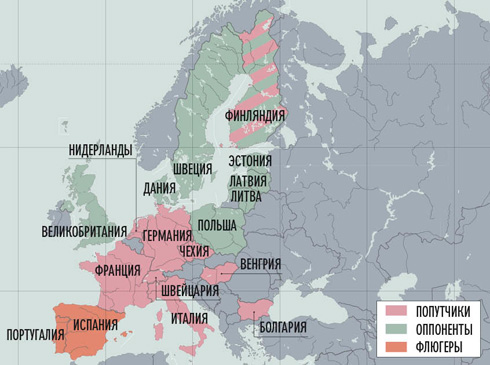
The era of the desire for integration with Europe, which lasted one and a half post -Soviet decades, ended by 2008. There is no question of any “strategic partnership” with the European Union, negotiations on a new agreement were stalled. Russia does not consider the EU to be neither a significant political entity, nor the effective side of negotiations - too many different countries, opinions and interests, and even when the “smallest common denominator” is achieved, the case is not moving.
The rate is made on interaction with individual states of Big Europe. The main interlocutors are countries where large capital traditionally has a strong influence on the government - Germany, Italy, as well as France, whose policy is always built on diversification of external vectors in order to increase its own influence. In other words, Paris always needs Moscow to increase its own actions in Washington’s eyes, and vice versa. This course is notive, although large countries have to overcome the resistance of small and medium. In Europe, Russia is always striving to focus on business relations, which brings local successes, including with obviously wary countries of the former socialist camp (Hungary, Czech Republic, Bulgaria) or Finland. However, there is no pan -European project with the participation of Russia and is no longer discussed. However, it does not seem to believe in the bright future of European integration and Moscow.
Far East
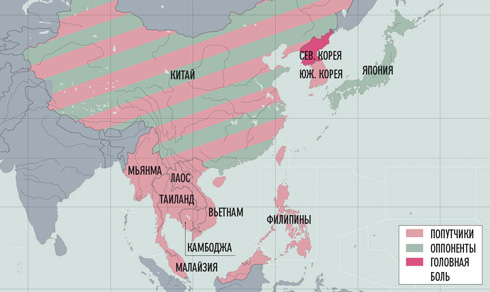
In this region, everything is overshadowed by China. There is no other country with which Russia's political relations would be so good, and the potential for a conflict crossing economic and even strategic interests is so great. Beijing’s foreign policy is impressive by an incredible sequence: its task is really the creation of conditions for internal development (access to resources and providing sales markets), without any side ambitions. But by the degree of determination of the PRC, it resembles an asphalt skating rink with which you can interact, but there is practically no chance to influence its movement from outside.
Most likely, a few years later the challenge that China quits will make Russia choose - to move in the Kutka wake or look for partners (Japan, USA, Europe) to try to increase its own weight. So far there is no answer, but if the solution is not found, then nothing will remain, how to cling to this asphalt rink and supply resources to it.
America
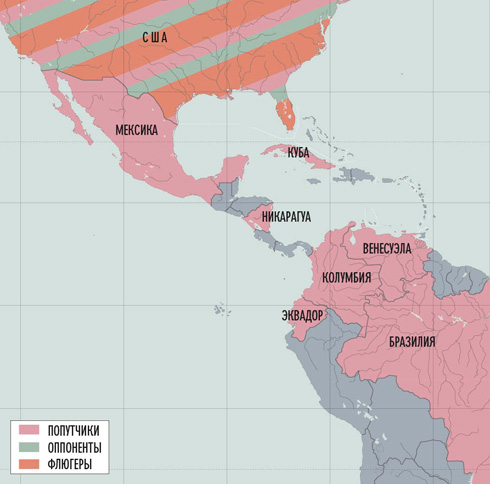
Moscow’s attitude to Washington can be described for a long time and multifaceted, but if you try to summarize it in one phrase, then this is the expectation of the end of the American century. Not active opposition (with the exception of the post -Soviet space) and not a systemic confrontation. Rather, the idea that the peak of America’s power has been passed, which means that gradually everything in the world will change in favor of others. And Russia should not be put on the United States to the detriment of relations with their opponents (Syria, Venezuela, the same Iran), although Moscow does not seek specially in the back - the consequences are too non -evident.
Russia carefully monitors how the United States faces growing difficulties not only in crisis centers, but also in relations with once supporting allies - Europe, which is ready to support Obama in words, but not in practice, Saudi Arabia, Israel, Turkey, Pakistan and even Japan. So far, nothing critical (with the exception of Pakistan), but everywhere unpleasant bells that only confirm the general idea: the stable world of the alliances is a thing of the past, it is replaced by uncertainty with threats and opportunities. Now Russia is adopted by Donald Ramsfeld’s credo, proclaimed in 2001: the permanent allies are not needed, “the mission determines the coalition”. Russia does not yet know his mission, but is ready to consider almost any coalition in each case.