
Translated material
From love to hatred
Foreign policy sympathies and antipathy of Russians
Who do we love, who we hate and, most importantly, for what? The New Times sorted out the foreign policy sympathies and antipathies of Russians
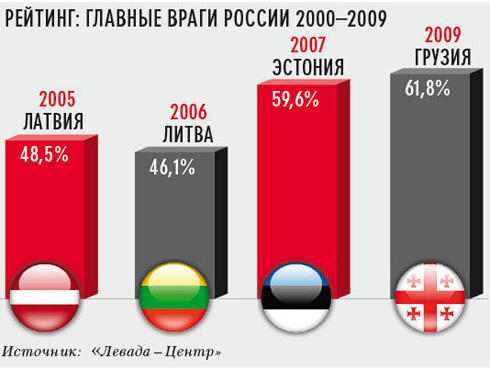
Georgia is the main enemy of our country, so 62% of Russians think. This “leadership” is unlikely to be able to challenge in the near future-last year’s war in South Ossetia is still occupied by the central place in the media. In second place in the list of "unloved" countries are the United States. In the submission of many Russians, last year’s war was not only, but maybe not so much a conflict between Georgia and Russia as a clash of the United States and Russia. When sociologists asked about the reasons for the war, most of the US policies surveyed, who are trying to supplant Russia from the traditional zones of influence, that is, from the Caucasus and from the near abroad. Closes the three Ukraine. After the “Orange Revolution” happened there, the Russian media gave the go -ahead: to wet! Back in March 2005, only 22% of Russians were negative about Ukraine, and in May 2009-already 56%. The Russians also recorded the Baltic countries: Latvia (35%), Lithuania (35%), Estonia (30%).
Black and white
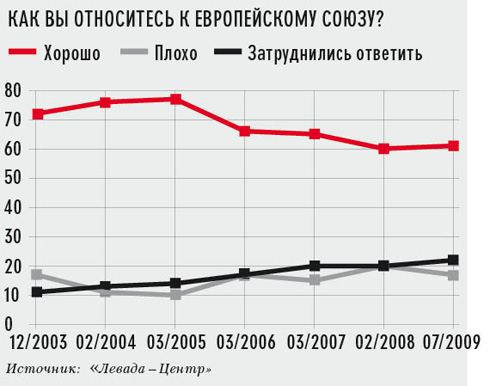
At the same time, citizens are more neutral to the European Union. Only 22% of respondents are negative to united Europe. The European Union is perceived more like an economic, state association of countries, which, in general, does not hurt the great -power consciousness of Russians.
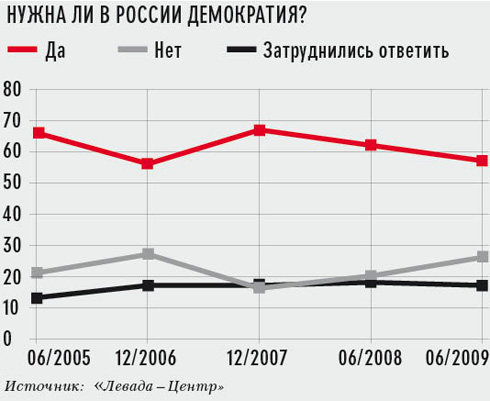
It is curious that with all the negative in relation to the United States or the closest neighbors who headed for European integration, Russians are positively related to democracy. 60% of citizens are interested in living in a democratic country. Only 29%do not attach importance to the political system. Most Russian citizens, 67%, consider it important that people of various views, including those who go against the mainstream, could express them without fear of persecution (in the rest of the adherents of freedom of speech there are 86%). However, respondents call the main friends of Russia to authoritarian regimes - Belarus (50%), Kazakhstan (38%), China (18%).
Such a mishmash in the brains is largely explained by the fact that Russian public opinion, his sympathy and antipathy are extremely dependent on the rhetoric of the first persons of the country and news, which 80% of compatriots receive exclusively through state television channels. Another reason - over the past 10 years, only 25% of respondents have visited abroad. Moreover, for the vast majority of them, abroad is limited to Turkey and Egypt. The third reason is the uncritical perception of information, which makes state propagand especially effective.
Here is a visible example. In 2007, when television actively covered the conflict with Belarus due to oil prices, the country suddenly abruptly fell in love-only 38% remained loyal to the previous attachment. But as soon as the criticism of Lukashenko with the Russian media ceased, so immediately the closest neighbor with the plus sign began to evaluate 50% of the respondents. During the “Milk War” -2009, the State Goskanals began to focus not on the country, but on the Old Man: as a result, Russians began to treat Lukashenko with less sympathy (28% versus 34% in 2008), and accordingly the share of those who believed that Belarus was needed (from 13% to 18%).
Hatred as an idea
But even 20 years ago, society was very different. Only 13% then affirmatively answered the question: "Does the country have enemies?" In that full hope of 1989, the USSR stood on a fracture: citizens understood that 70 years of the communist regime pushed the country to the side of history. The United States had only 7% of respondents negatively to the United States. The previous belief supported by the communist propaganda that the USSR was “in the ring of enemies”, crumbled literally before our eyes. There was a hope that it would be better further, at least because there was nowhere worse.
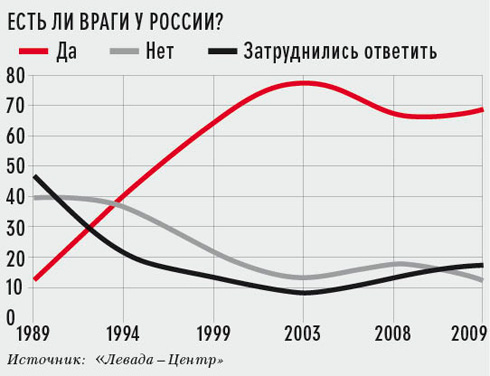
But in 1994, the most important factor affecting public opinion was the war in Chechnya. Already 41% of respondents said that Russia has an external enemy who armates and prepares militants. Since then, such moods have only grown. Partly contributed to the West. The bombing of Serbia by NATO countries caused a wave of protests in Russia. Then Prime Minister Evgeny Primakov, having learned about bombing, on March 24, 1999, made his famous U-turn over the Atlantic, abandoning negotiations with the United States. This demarche caused a sharp surge of anti -National sentiments, encouraged by anti -Western propaganda. In 1999, more than half (53%) of Russians were negatively related to the United States, while the year before that there were only 23%. In the first years of the reign of Vladimir Putin, a turn in moods was again outlined: in 2000-2002, 67%, 59% and 48%, respectively, were positively about the United States. This was explained by sympathy for the tragedy on September 11, when Putin was the first of the world leaders called the US President and expressed his condolences, and the beginning of the operation in Afghanistan, which Moscow at first actively supported. But in society there was a request for anti -American sentiments, and the Kremlin had the need to tighten the regime. We must pay tribute to Vladimir Putin, he always knew how to and can sensitively hear the mood of the crowd: with the outbreak of war in Iraq in 2003, only 27%announced his positive attitude towards the United States. And then the struggle against international terrorism is a kind of phantom, or an universal devil who does not have an outlined face. This horror story was successfully used by the governments of both the USA and Russia - primarily for the purposes of internal consolidation, for the perception of the actions of the authorities as a necessary evil, as a force that protects the country. Not news: nothing contributes to the consolidation of the nation as the presence of an enemy factor. It was then that the words began to sound that Russia should rely on national traditions, that we have nothing to be ashamed of the past, that Russia rises from the knees and affirms itself as a great power. There was a resuscitation of imperial consciousness. Nostalgia for the Great Power became the leitmotif of the Putin statement in power. At the same time, a sense of danger emanated from Europe and the West as a whole, and from some dark forces, hidden enemies - either international terrorists, or Chechens, or migrants. Hence the rallying of society on the basis of hatred of others. So the national idea was formed.
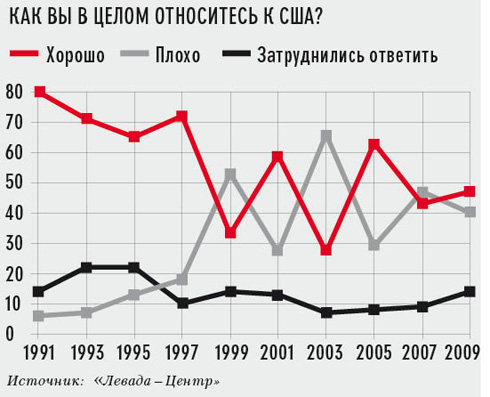
The demonization of the United States has become an effective PR driver: it worked and works to strengthen its own ideas about itself and the roles of Russia in the world. Despite the fact that the technological, economic, industrial power of Russia is very small, its economy is 2% of the global GDP, in the minds of many Russians we regained the status of a great power that could dictate our will to the world - America, including. Rivalry with the United States creates a collective sense of significance, gives a scale. It arises of what can be called schizophrenia of mass consciousness. The scheme works simply: if we are in a state of confrontation, then any need for reforms, the end of the changes that began in the 90s disappears: what does it all matter, if the enemy once again at the gate? So it is removed from the agenda and the problem of building a legal society. Is it before him now?
Enems-suits
After Putin began to build the vertical of the authorities (establishing control over the media, the abolition of the elections of governors, regional and local self -government, tightening electoral legislation), the authorities took on the function of the main protective principle and increasingly needed a constantly reproducible image of the enemy. Who will be - not so important. It is important that it is. In the end, as already mentioned, enemies were the closest neighbors - the Baltic countries, Ukraine, Georgia. The first place was firmly taken by Latvia in 2005, it was attributed to the enemies of 49% of respondents, then Lithuania went. After the scandal around the dismantling of the monument to a bronze soldier in Tallinn, Estonia confidently entered the leader. Inside the "enemy" six (Georgia, the USA, Ukraine, the Baltic countries) of the country change places, but this is due only to the momentary political conjuncture. Poland is also in the negative sector. During the next economic war for the “meat”, the Russian authorities, abolishing the holiday on November 7, was appointed a holiday on November 4. The Day of National Unity was timed to the Victory Day of the People’s Militia over Polish intervention in 1612. The Poles on counter -excavations will also not skimp, and criticism of the authoritarian trends characteristic of present -day Russia sounds from Warsaw more and more often. Now Poland is holding a confident seventh place in the list of “enemies of Russia”, but if the relations of the two countries continue to deteriorate, the Russians may well reconsider their attitude towards the Poles. Who will be next to the role of a foreign policy devil will tell time.
Photo by RIA Novosti