
Translated material
Klyamkin VS Shevchenko
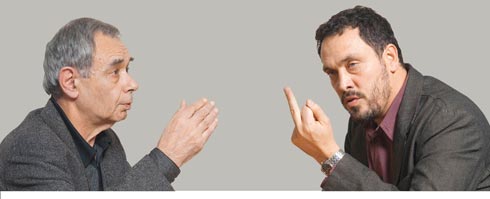
Who Russia has friends and whom does she consider her enemies? Search for potential allies in the West or in the East? What leads the choice of partners in foreign policy - the situation or the interests of the country? The newspaper Igor Klyamkin and TV presenter Maxim Shevchenko argued about this in the editorial office of The New Times
Who can be considered friends of Russia today?
Maxim Shevchenko: It depends on what we mean by Russia.
Igor Klyamkin: In politics, friends and enemies are a conditional concept. There are allies, partners, opponents.
At a dead end?
Nevertheless, Russia has friends?
Shevchenko: There are people who believe that Russia has the same friends that the Soviet Union had. Others see friends in the West. Still others believe that Russia should in no way become part of the West, they have their own set of friends. Russia is a project concept, it always exists as a kind of space unfinished in history. From my point of view, Russia is alternative Europe. It is rather oriented to Asian spaces, while combining European values associated with an understanding of the role of a person’s personality, freedom, but at the same time the Asian property to subordinate human nature and the human person to megazadac who transform the world and to some extent-human nature.
Then who are the enemies of Russia?
Shevchenko: Those who encroach on its territory, on its resources, sovereignty, after all. Over the past two hundred years, these have been Western countries. They always wanted to dismember our country, to divide its population. From the Islamic world, from China, such a threat did not come back to the time of Timur. For the East, Russia was a kind of bridge to social growth, to technologies, to new types of social development, and so on.
Klyamkin: We have allies in the CSTO. There are partners who periodically change depending on the political conjuncture: either they are partners or go to the opponent camp. The United States mainly other Western countries. And Russia has, more precisely, the country's political elite has opponents. The Russian leadership considers Georgia to be an impudent, as well as Georgia considers Russia to be the enemy. Russia considers the enemy part of the Ukrainian establishment, and part of the Ukrainian establishment considers Russia to be the enemy. Indeed, in the past, Russia positioned and affirmed itself as a certain megaproject, and on this it existed for many centuries. But she was not an Asian power in the strict sense of the word. She managed to modernize in the military-technological region through the use of Western technologies. At the same time, she acted quite barbarously in relation to her population.
Do you mean Peter's reforms?
Klyamkin: both Peter and Stalin. There were no precedents of such large -scale modernization in any country. The only trouble is that such megaprojects do not create incentives for their own innovations: they can only borrow, copy. Peter borrowed, borrowed Stalin - 300 thousand machines were brought to the country. And they could not come up with their own. And therefore, the country, having caught up, lagged behind again. Now this kind of modernization is no longer possible. Modern technologies cannot be implemented through direct coercion. This means that the project “Russia as an alternative to the West” has exhausted its historical role. We now see that Russia is stuck between its past and European project.
That is, pragmatically Russia is interested in the West?
Klyamkin: As it was in the 90s, less percent of high-technology exports, and now less percent, despite the fact that even in the most developed countries of Europe-10–20%, in Finland-30%. Now floundering is at an impasse: the country's setting in direct continuity to the Stalin era speaks of the absence of a project.
Modernization options
If technological innovations for modernization are in the West, what can we give us the east?
Shevchenko: A human resource that has access to mechanisms to increase social energy. This is the most important treasure of the modern world.
How can we use it?
Shevchenko: First of all, a bet on highly developed, modern education systems through which the huge masses of students from Central Asia, India, China, Africa, and the Middle East will be involved. I would like Russia to be the center of modernization, increasing the intellectual and technological level. We have, despite the destroying nineties, quite original scientific base and a scientific school. Of course, much is destroyed, destroyed, but people still remained. If the country turns into a bunch of merchants and lawyers, no one will need it at all, then we only remains to buy technology in the West. But the West will never allow the countries non-west of modern technologies. They did not destroy the Soviet Union and an alternative system of scientific and technological progress, which did not belong to Western corporations, so that it is now restored with their own hands.
Why then allow the Chinese to send 15 thousand students a year at the best American universities?
Shevchenko: China needs engineers, because China is a factory. It is clear that Russia cannot be a factory. You can be a manufacturer of resources, a supplier of resources, but then why do you need a population? In the raw material country, it is only a burden: these little men need to build schools, some institutions, all this is an extra load on budgets. And there is a third opportunity-this is a myth that has remained since the time of socialism, that Russia is a country in which the idea of modernization still exists. And what is happening in Russia now is just a crisis that is already passing. In the third world countries, they still believe in Russia as the possibility of a modernization project-and for themselves too. Because they clearly understand that the West will never allow Islamic countries or the countries of the Far East to high technologies of the 21st century.
Klyamkin: The problem of Russia was always not that they did not give innovation, but that there was no innovative environment, which means that the development of these technologies did not occur. Russia faces a fundamentally new task for it: to generate new technologies themselves. Can this be done with our political and legal system? Their modernization by the president is assigned to some future, first it is supposed to make a technological breakthrough. This is a completely unrealistic formulation of the issue. No intensification will happen, there will be one thing - degradation.
Why? We will sell resources and buy comfort, technology, cars ...
Shevchenko: Shirpotreb technology, consumer goods comfort, consumer goods.
Klyamkin: This is degradation from the point of view of a progressive lag from developed countries. Previous modernization was also made by the state. With modern technologies, the state will not be able to play this role. As for human capital, we do not have any civilizational attractiveness, intellectually and qualifyingly advanced east will go to the States, not here. There are different salaries.
Shevchenko: Degradation will be in any case, no matter what type of bureaucracy is in power. If the bureaucracy is a market liberal, monetarist, Chicago school, a special services school or something else-another world of Mazana. But dominance over the country of liberal elites, focused on globalism, did not give a chance to the country. And this nomenclature, at least, preserves the resource and leaves hope for the emergence of a future development project. They do not let predators here.
Predators from the west?
Shevchenko: any predators, from the mouth of which you can no longer tear the piece. And a piece is a country, its resources.
Are you not afraid that China will begin expansion in Siberia? Steve Hawking warned that this is the main threat to Russia.
Shevchenko: China will begin expansion under one condition: if Russia disappears as a political subject. China will take control of Siberia and the Far East only in the worst version for itself, because this is a load that they cannot digest. China understands this perfectly.
And the threat of Afghanistan, Pakistan with nuclear weapons?
Shevchenko: Pakistan is not a threat to Russia, but for India. And Afghanistan is not at all a threat. Not so long ago, the Taliban leadership issued an appeal to the SCO countries with the assumption that there would be no expansion to the north, nor east, nowhere. They are interested in a single Afghanistan, with a single government, and will calm down on this.
Another democracy
Does this mean that today Russian foreign policy is driven by interest, not values?
Shevchenko: Yes.
Klyamkin: The main problem of Russia is reduced to the modernization of the state. With the monopoly of one group, there can be no modernization in other areas for power. In this sense, Europeanization is a movement towards the legal, democratic state and the transformation of society from the object of manipulation into a political entity. Now everything is done exactly the opposite.
Shevchenko: The Western type of democracy is manipulative, in it the people turn into a lot of consumers guided by myths that are broadcast to him with the help of powerful media resources. I would prefer to talk about a different type of democracy, about the democracy developed by local self -government in the presence of a fairly strong private entrepreneurship.
Give an example of this regime.
Shevchenko: Iran. He may not like it due to the clericality of the regime, Islamic radicalism, the statements of its president, but in Iran the huge masses of the people are involved in direct democracy through democratic procedures. Not only thanks to the elections, but also thanks to the overall design environment that exists thanks to Shiite Islam, for example. The problem of Russia is that the huge mass of the people is simply turned into a population, into a sociological mass and cut off from the political fate of the state. In the Caucasus, by the way, this is not. There are natural forms of democracy associated with the place of residence, with an ethnic group. In Dagestan, relatively speaking, 80% of the population is involved in politics.
Klyamkin: Western democracy, like any other, is not perfect, but the population has the opportunity to change people in power. Here this opportunity is blocked in principle. This is the main barrier to modernize the political system. So we will not even come to the imperfect Western type of democracy.
Shevchenko: We will go to other forms of democracy.
Klyamkin: To what others? To the Qur'an?
Shevchenko: Well, as an example ... why not?
Yesterday's friends
Where did democratization help modernize the country?
Klyamkin: In the Baltic countries and Eastern Europe. Over the past 20 years, more than 120 million people have entered the Western, European civilization.
Shevchenko: So on loans entered! Having destroyed the economy, taking loans secured by land.
Klyamkin: There is Data of the IMF on the Docryisial, 2007. In Russia - $ 13.5 thousand annual GDP per capita, and in the post -socialist countries entering the EU - from $ 16 thousand to $ 26 thousand, except for Bulgaria and Romania, which were delayed with reforms. In these countries, different political forces in power, but there is no monopoly on power, it can be changed there. And with a monopoly, the authorities are forced to appeal to traditionalist moods, blocking the forces that are capable of economic, technological and other modernization.
Shevchenko: Any state that relies only on efficiency is doomed either to dependence on an external, more effective partner, or sooner or later on degradation, because efficiency depends on the market, on the conjuncture. The problem of the modern state in Russia is not that it is liberal or Feesbashno, not whether it introduces democracy or does not introduce. The problem is that people do not exist for him, for him there is only effectiveness, and people interfere with effectiveness. And the so-called illiquid assets with which you need to do something also appear. They decided that Central Asia is an illiquid asset, and cut off. Now about the Caucasus are the same conversations. There are such leaks - they say, we do not know what to do with the Caucasus. Let's cut off the Caucasus. When they refuse to be the center of attraction of peoples, then I personally don’t care where to live in Latvia, Poland, in the Smolensk region, because it will still be a stronghold, life after death.
Klyamkin: Two -thirds of the population are expressing for a priority partnership with the countries of the European Union.
Shevchenko: There is a fundamental difference between partnership and threat. Partnership - with anyone. I am a supporter of partnership with the West, but I am not a supporter for Russia to become part of the West - this is a threat, death.
Civilization conflict
How did it happen that we have such wild relations with the closest to us Ukraine and Belarus?
Klyamkin: With Belarus, situational relations, two authoritarian regimes play on the tug of rope. With Ukraine, a slightly different situation, related to the fact that we cannot accept such a simple thing that this is another state.
Shevchenko: I do not think that we have a bad relationship with Ukraine and Belarus as with peoples. We have a very pragmatic conflict of enough liberal elites, which depict conservative rulers, but in fact are, in fact, marketers.
That is, it is an elementary mismatch of business interests? Shevchenko: Absolutely!
Klyamkin: There are business interests. But in Ukraine, after 2004, the political monopoly is broken. This is not only a conflict of business interests, it is a civilizational conflict. The current Russian government cannot allow Ukraine to become a European country. In Russia, political elites claim a monopoly, and in this sense they are civilized further than the elites of Ukraine, who are also not a gift, are also selfish and also broke away from society. But there is still political competition, opposition.
Shevchenko: There is no political, there is resource competition ...
Klyamkin: The fact that the opposition can come to power in Ukraine is a huge step compared to Russia.
Maxim Shevchenko is a journalist leading the political current show of Channel One "Judge for yourself." Head of the Public Center for Strategic Research of Religions and Politics of the Modern World. Member of the Public Chamber of the Russian Federation.
Igor Klyamkin is a political scientist, vice president of the Liberal Mission Foundation. Doctor of Philosophy. In the 90s - the head of the analytical center of the Public Opinion Foundation. The author of more than 300 scientific and scientific and journalistic works.