
Translated material
The lobbyists collided with their foreheads
Retailers and suppliers share future income in the corridors of the State Duma

Lobibists got confused in networks. On November 11, the State Duma should take a second reading of the bill on the regulation of trading activities. Around the document, fights unprecedented in its intensity are carried out. Who fights for what - found out The New Times
The text of the bill was originally a field for “tug of war” between manufacturers and suppliers of products, on the one hand, and retailers-seller-on the other. The played prize is considerable: in whose benefit, profit from sales in the most popular chain stores in the country will be redistributed, which account for 30% to 60% of the trade turnover of large cities. However, the lobbying process has gone so far that none of the participants is taken to predict its result.
Access to the ear
It all started with the memorable summer raid of Prime Minister Putin in one of the capital's "intersections". His indignation at the 120-percent trading margin on meat products found an instant response in the State Duma: the draft law “On State Regulation of Trade Activities in the Russian Federation” was immediately introduced by the government to parliament. Naturally, the document was aimed primarily at curbing the arbitrariness of retail chains, which did not suit manufacturers and suppliers. The elements of such arbitrariness include primarily all kinds of bonuses, for example, entrance fee, layout in the most profitable places, as well as deferrals for payments and the conditions for the reverse redemption of goods (see more than the New Times No. 23 of June 15, 2009).
The current edition of the bill attributes bonuses to “unscrupulous practitioners”, introduces stiff accounting deadlines with suppliers, and most importantly, limits the number of stores that one network can own within the boundaries of the municipal district (if the circulation of this network exceeds 1 billion rubles, and its share in the market of this region is more than 25%). These are the most painful innovations for Russian chain stores, the adoption of which will lead to the destruction of their business. It is not surprising that in the struggle for their interests the parties involved all possible resources.
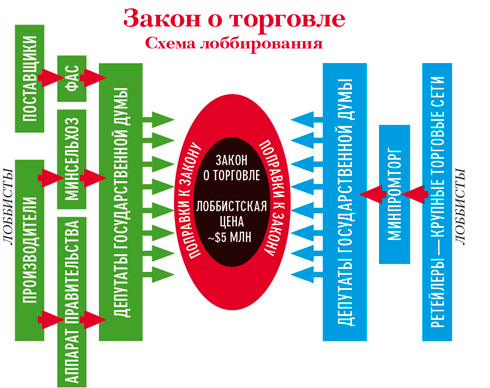
“The struggle between suppliers and retail chains is involved in the connection of lobbying groups,” says Pavel Tolstykh, head of the Center for the Study of the Interaction between Business and Power, Associate Professor of the State University of Higher Professional Education. “Moreover, federal departments are used as the main“ shock forces ”.” According to the expert, the alignment of forces is as follows: the Ministry of Industry and Trade defends the interests of retailers, the Federal Antimonopoly Service (FAS) - suppliers, the Ministry of Agriculture traditionally lobbies the interests of large manufacturers of agricultural products, therefore also performs on the side of suppliers. “After the trade issues transferred from the Ministry of Economic Development to the Ministry of Industry in 2008, the Department of State Regulation of Internal Trade appeared there,” explains Alexey Tretyakov, the head of the St. Petersburg Small Business Association in the Consumer Market. - He was headed by Oleg Sazanov, the former Executive Director of the Association of Retail Companies (Acort). When the former, but one of the main networkers of the country is responsible for all trade in the state, it is even difficult to call it lobbying. The phrase of Satyric Zadornov is more suitable: "It's hard to fight the Communist Party under her leadership."
However, even such a powerful administrative resource did not save retailers. The lobby of large manufacturers, primarily agricultural, turned out to be more powerful. “As soon as the bill on trade fell into the State Duma, it became clear that our capabilities are weaker,” the head of one of the largest network companies shared anonymity on the basis of anonymity. - What do you want, even if the speaker of the parliament Gryzlov publicly declares that it is time to “deal with the trade mafia”? The long -standing populist slogan "Trading in everything is to blame" was very convenient to achieve political interests. " According to the interlocutor of The New Times, a powerful agricultural and industrial lobby represented by the Ministry of Agriculture, which spends huge state money, shifted its responsibility for increasing prices for the shoulders of retail chains. According to some reports, in the lobbying struggle, the Ministry of Agriculture found support in the person of the First Deputy Prime Minister Viktor Zubkov, who has a direct “access to the ear” Putin.
The price of a compromise
The deputy corps showed extreme sensitivity to the signals from the White House. Voting for the draft law in the first reading on September 11 showed a predictable unanimity: 350 - for, 4 - against. Not surprising: the bill came out of the White House, outraged by the arbitrariness of retailers, which means that the party of power, with all the variety of interests of its individual members, voted, as ordered. During the debate on the draft law, the deputy from United Russia Irina Yarovaya distinguished her special zeal: the number of her performances in the press in defense of the domestic manufacturer beats all records. In response to accusations of lobbying, the deputy Yarovaya at the parliamentary hearings on October 20 noted a large number of “custom -made research” under the draft law on trade allegedly submitted by the deputies in order to “put pressure”.
Each bill in Russia, as you know, has its own price. But running lobbyists along the corridors of the Duma with bags stuffed bills, yesterday. Today's practice is as follows: the ministry-fuelman reduces those whom it is lobbying, with interested deputies, indirectly having any business. If the necessary amendments pass, the “debtor” of the deputy concludes a profitable transaction with the people's deputy. There are also your dachshunds. “The adoption of the bill in the State Duma costs from $ 150 thousand to $ 5 million,” Pavel Tolstoy enlightens. - The price depends on the presence of system opponents. The stronger they are, the greater the amount. ” It is clear that the law on trade falls under the highest dachshund. However, the interlocutors of The New Times are convinced, the decisive role in the wording of the law can play not so much money as the obvious order “from above” for lobbying for the interests of manufacturers.
Moreover, the ranks of the networkers also crumpled heterogeneous interests in their environment, says Yevgeny Mingchenko, director of the International Institute of Political Expertise. According to him, the restriction of the market share for networks within the framework of the municipality within 25% is disadvantageous of the company X5 Retail Group (owns Pyaterochka, Perekrestkom and Carousel), which occupies about 30% of the St. Petersburg market, but beneficial to the owners of the Seventh Continent (Alexander Zanadvorov and State Duma deputy Vladimir Gruzdev), since the share of this network in Moscow is small and restrictions on the expansion of competitors increase its cost. Also, this norm is quite satisfied with Western networks that use large formats-hypermarkets and create no more than one or two stores within the municipal district. This was openly stated, in particular, representatives of Auchan.
Unnecessary law
Unfirectional lobbying attacks led to the fact that the bill overgrown with a giant number of amendments - there were about 400 of them, of which during the discussion on the working group, according to Viktor Zvagelsky, deputy chairman of the State Duma economic policy, about 150 remained the most scandalous article 16, which determines the threshold of the network dominance of 25% and causes a maximum of disputes, for the time being, for the time being It hung: the Federal Antimonopoly Service received a warning from Rosstat that statistics do not have a methodology to calculate the share of networks. Now the FAS is inclined to delay the entry into force of this article for several years.
The main fight on the working group went on several questions. “Bonuses, that is, input tickets on the network, will be hardly canceled,” promises Victor Zvagelsky. “Throughout the world, the networks create preferences for beginner brands, we have the opposite the contrary.” The maximum margin of socially significant goods is also introduced - if their price jumped by more than 50%within a month. “This is very important for the agricultural producer,” the deputy notes. - It is on his products that the margin is now being made 140-150%. That is, a three -ruble carrot is sold on a network of 27 rubles. for kg ". Finally, the harsh payment deadlines are determined: 10 days - for perishable goods, 40 days for everyone else. “Today, the network may not pay the supplier if the goods are not sold or spoiled through its fault,” says Zvagelsky. “With the new law, she will be obliged to give money anyway.”
However, in Russia, as you know, there is a large distance between the law and its execution. “Suppliers will push in the direction of gray and black forms of trade, since they will become more difficult to work with civilized retail,” said the New Times Yuri Kobaladze, managing director of X5 Retail Group. - The government version of the draft law was a painful, but real compromise, balancing the wishes of all participants in the process. The amendments made recently put a cross on this compromise. No one needs this law - neither we, nor manufacturers and suppliers, nor consumers. ”
The most paradoxical: as a result of lobbying fights under the carpet, the bill ceased to arrange even those who were originally interested in it. “Due to the illiterate actions of legislators who can regulate the market, prices will rise and the presence of goods on the shelves will be reduced,” concludes David Jacobashvili, chairman of the board of directors of the company “Wimm-Bill-Dann”.
Trade in Russia accounts for 20.7% of GDP and 70% of enterprises in the field of small and medium -sized businesses. Today, trade provides 18% of all jobs in the country. For the first half of 2009, the industry brought 316 billion rubles to the state budget. However, from January to August of this year, the drop in the industry amounted to 5.3% (compared with the same period last year).
Source: Ministry of Industry and Trade