
Translated material
Domino effect
Hidden springs of the process that changed the world order
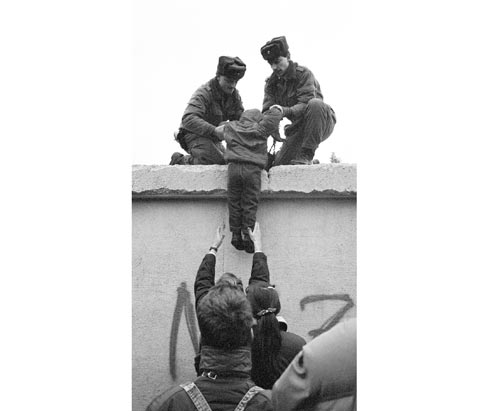
Make Love, Not Wall make love, and do not build the walls (English)-this periphrase of the famous slogan of the anti-war movement of the 60s has become a symbol of a radical change in eras. With the fall of the Berlin wall, the Age of Cold War, divided by Europe and divided peoples ended. What springs changed the world order - the New Times sorted out the movement to freedom in Poland, took 10 years, in Hungary - 10 months, in East Germany - 10 weeks, in Czechoslovakia - 10 days and Romania - 10 hours. This is an elegant metaphor for the line of 1989/1990. The time when the “velvet revolution” happened-by the definition of the former dissident and playwright Vaclav Gavel, who in December 1989 became the president of Czechoslovakia.
The Ich Bin Ein Berliner 1989 was somewhat similar to the 1968th-it was not by chance that the head of the Czech parliament after the “velvet revolution” became the leader of the Prague Spring Alexander Dubchek. Only autumn-89 turned out to be much more successful than spring-68. Revolutions of varying degrees of “velvet” swept throughout Eastern Europe: communist regimes poured like Domino knuckles. “Velvet” did not work out only in Romania - Nikolai Chausko and his wife were executed.
The signal to the avalanche was the solution to the “Berlin issue”. In essence, the whole post -war history, the confrontation of the two systems - this was the Berlin crisis, the tragedy of the divided city. The rapid construction of the wall in 1961 became the same symbol of the Cold War as the definition of Churchill-the "Iron Curtain". Actually, then the peoples of the world saw what this curtain looks like: nothing majestic, no theatrical velvet and tragic pathos - just a dull wall.
The Euro -Atlantic world opposed the world to Soviet and communist. Kennedy spoke about the solidarity of Western civilization, which turned out to be on one of the sides of the wall, when in 1963 he spoke to the inhabitants of West Berlin and said: Ich Bin Ein Berliner, “I am a Berlin”. And he explained: "All free people, wherever they live, are today citizens of West Berlin."
Therefore, the fall of the wall meant more than the end of the Cold War. It meant the collapse of communism, which on November 9, 1989 was not obvious to everyone. (A rare exception is the insightful assistant to President Gorbachev Anatoly Chernyaev. An entry in his diary: “... here is not about socialism, but about a change in the world balance of forces, here is the end of Yalta, the final of the Stalinist heritage.”) It warned of the imminent collapse of the USSR.
"Gorbachev, save us!" In the records of the meetings of the Politburo of the Central Committee of the CPSU, it is difficult to find any significant references to the Berlin wall and “velvet revolutions”. The Soviet bosses were too immersed in the discussion of internal problems: interethnic relations, a crumbling economy, the situation in Lithuania, and the requirements of economic independence from the Baltic republics. Even then, it was obvious that the USSR was a bankrupt country, only Soviet leaders did not dare to admit this to themselves. It was urgent to liberalize prices and begin reforms, but neither Mikhail Gorbachev nor Nikolai Ryzhkov could decide to do this. Inflation at artificially restrained prices remained low, but rising prices on the collective farm market-9.5% for 1989-signal that the situation is about to get out of control. High pace in 1989, the budget deficit grew-8.5% of GDP and 51% of the income of the union budget. In 1989, industrial production ceased to grow, and food supplies began to decline. The currency crisis was not far off: external borrowing grew, and the country could not pay debts. By 1990, the negative balance of the USSR payment balance was $ 17.1 billion. It was the way to a full -scale economic crisis, to state bankruptcy.
* * Gaidar E.T. The death of the empire. Lessons for modern Russia. M., 2006; Financial stabilization in Russia. Under the general. Ed. A.N. Illarionova, J. Sax, M., 1995; Yasin E.G. Russian economy. The origins and panorama of market reforms. M., 2002. At a meeting of November 3, questions about the grain, about the creation of the State Committee on National Relations were considered, about whether Lazar Kaganovich is deprived of a personal pension. (They did not deprive, by the way.) A briefly discussed the issue of Egon Krenza, who replaced the head of the socialist single party of Germany (SUPG) by Erich Honecker, who, since then, only remained to be imprinted in postmodern pictures depicting his passionate kiss with Leonid Brezhnev. KGB Chairman Vladimir Kryuchkov and Mikhail Gorbachev exchanged replicas about whether Krenz will be held or not, when the situation in Germany pushes hundreds of thousands of people requiring changes in Germany. Foreign Minister Eduard Shevardnadze suddenly remarks: "It is better to remove the wall yourself." “If you remove it,” the strikingly short -sighted Kryuchkov retorts, “it will be difficult for the Eastern Germans.”
* In the Politburo of the Central Committee of the CPSU ... According to Anatoly Chernyaev, Vadim Medvedev, Georgy Shakhnazarov (1985–1991), M., 2006. A few days later the wall “cleaned” itself.
Honecker did not take perestroika well. In 1987, he forbade printing the materials of the next Plenum of the CPSU Central Committee. He blocked the channels of information about democratic changes in the USSR. On October 7, 1989, during a torch march on Unter-de-linden on the occasion of the 40th anniversary of the GDR, Berliners, and from among the specially selected party youth, they began to shout something to Gorbachev. The last communist prime minister of Poland Mechislav Rakovsky approached the Soviet leader and translated that they shouted in the crowd: “Gorbachev, save us again!” “Mikhail Sergeyevich,” said Rakovsky, “is the party’s asset!” This is the end! "
Honecker fiercely resisted the changes. In Poland, the consensus of political forces was already reached and there was a gradual transfer of the power of “solidarity”, and the Rakovsky government managed to prepare the ground for liberal reforms that Tadeusz Mazovetsky and Leshku Balcerovich: many have now forgotten that it was the last communist cabinet that began the liberalization of prices. In Hungary, a reform had long been going on, and the country is soft, softer than velvet, passed from a semi -nuclear version of communism to capitalism. True, there was still Czechoslovakia, which lagged even for the GDR: as one journalist said, “a million people have already participated in Berlin in the manifestations in the manifestations. And here on October 28, the police beat all the same five thousand with sticks, and the rest were silent and waited. ”
* Quote by: Travin D., Margina O. European modernization. Book 2, M., 2004. In the future, during the polls, 63% of the Czechs admitted that the Events in the GDR were decisive to begin with a “velvet revolution”.
However, the domestic political chronicle of the USSR those months and the revolution in Eastern Europe are related things. In the Soviet Union, which the whole world was watching then, troops from Afghanistan were withdrawn in 1989, the first free elections, the first congress of people's deputies were held, the State Commission of the Council of People's Commissars of the USSR on economic reform was created, in November the law on the economic independence of the Baltic republics was adopted, and in December a political assessment of the Molotov-Ribbentrop and the input of the Soviet troops in the Soviet Afghanistan. The fall of the wall and the “velvet revolution” were organically woven into this chain of events. Bottom line: During the December meeting, Mikhail Gorbachev and George Bush in Malta, the leaders announced the cessation of the Cold War. And the practical meaning has gained the question of the unification of Germany.
The end of the era of Berlin was of fundamental importance for the history of world civilization. In May 1989, George Bush Sr. said: "The Cold War began with the division of Europe, it can be finished if the split of Europe is overcome." Overcoming the split is to start the destruction of the wall, the reunification of the city, divided after the war.
The reunification of the two Germany seemed utopia not only in the East, but also in the West. In any case, for the Chancellor of Germany Helmut Kolya, the fall of the wall was a complete surprise, he was even forced to interrupt his visit to Poland. Already on November 28, going beyond the events, since he released the principles of rapprochement of two parts of the divided nation. The leaders of France and Great Britain Francois Mitteran and Margaret Thatcher were not enthusiastic about the potential strengthening and territorial expansion of the state, which in the 20th century had already created many problems to Europe and the world.
However, the end of the era was nearing. In October, powerful manifestations began, first in Leipzig. The 17th was shifted by Honecker. On November 4, almost a million inhabitants came to the demonstration in Berlin. On November 9, the door opened in the wall ...
The wall was built so that people would not run away from East Germany to West. And it was worth destroying it, like a human “canopy”, accumulated over the decades of the existence of a concrete obstacle, poured from east to west.
On November 17, 1989, a student demonstration began in Prague, which grew into a “velvet revolution”. The German example was contagious. In addition, what was happening was superimposed on the Czech traditions of 1968.
The world in front of the amazed public and even with her participation became different - one. It was already a question of uniting two Germany, but about the very “end of history” that was proclaimed by Francis Fukuyama. At that time, it really seemed that in all post -Soviet countries the Western model of democracy wins. This postberlin world lasted until the states of the former Soviet bloc and the former USSR ended their transit.
The result was very different. And this is another story. But communism finally retired.
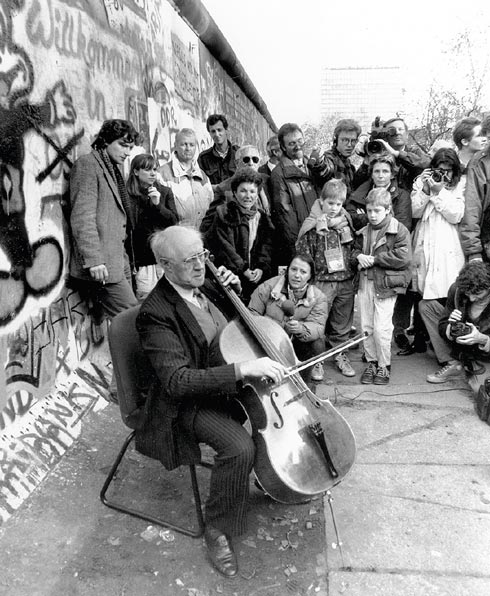
November 9, 1989 Mstislav Rostropovich
He flew from Paris to play already
not separating the Berlin wallSocial -camp: from thorns to sunset
June 16-17, 1953. Berlin uprising. The reason for it was an increase in prices and production rates in the GDR. The uprising was suppressed by Soviet tanks. The number of dead in East Berlin is 125 people. The German classic Bertolt Brecht said then: “If the government is displeased with its people, it must dissolve it and choose a new one.”
June 28, 1956. Unrest in Poznan (Poland). The performances of workers demanding improvement of working conditions were suppressed by force. More than 50 people died.
October 23 - November 19, 1956. Hungarian uprising. Suppressed by Soviet troops. The number of those killed is more than 2500 people, about 200 thousand fled from the country.
June 1-2, 1962. Events in Novocherkassk. In response to a significant increase in prices, the working cities demanded an increase in wages. The troops were introduced. 24 dead, 7 executed by the court sentence. January 5 - August 20, 1968. Prague Spring under the slogan "Socialism with a human face." On August 21, 1968, the troops of the organization of the Warsaw Treaty were introduced. 72 people died. About 300 thousand emigrated from the country. August 25, 1968. Demonstration on Red Square in protest against the introduction of troops into Czechoslovakia under the slogan "For your and our freedom." Seven of its eight participants were convicted as criminals. January 16, 1969. Student Jan Palarh performed self -immolation in Prague on Vaclavskaya Square in protest against the occupation of his country. August 1, 1975. The “Final Act on Security and Cooperation in Europe” (Helsinki Act) was signed, which imposed on the USSR obligations in the field of compliance with human rights and fundamental freedoms. May 12, 1976. The Moscow Helsinki group was created. November 1980 * . The authorities of Poland, in order to bring down a wave of strikes, are forced to register the independent union "Solidarity", which was headed by Lech Valens. The number of members of the trade union quickly reached 9-10 million.* On December 13, 1981. General Yaruzelsky, in response to an announcement of a universal strike, introduces martial law in Poland and internides with the leaders of "solidarity". July 22, 1983. The abolition of martial law in Poland, the liberation of political prisoners. March 11, 1985. Mikhail Sergeyevich Gorbachev was elected general secretary of the CPSU. February 25, 1986. In the report of Mikhail Gorbachev at the XXVII Congress of the CPSU, the following words were heard: “Thus, objective ones have developed - I emphasize, objective - conditions in which the confrontation between capitalism and socialism can only proceed and exclusively in the forms of peaceful competition and peaceful rivalry.” The Secretary General also announced "unconditional respect in the international practice of the rights of each nation to choose the ways and forms of their development." For the countries of the social camp, this served as a sign that the USSR would no longer impose the socialist order in them by the power of weapons. December 19, 1986. Andrei Sakharov is allowed to return to Moscow from the Gorky link. December 23, 1986. The USSR Foreign Minister Eduard Shevardnadze announced that the USSR did not intend to continue to intervene in the internal affairs of other countries, including the countries of the Warsaw Treaty. March 19, 1987. GUSHOVAKI General Secretary of the Central Committee of the Communist Party of Czechoslovakia, Gustav Gusak announced the beginning of political and economic reforms. June 12, 1987. US President Ronald Reagan during a visit to West Berlin called on Gorbachev to destroy the Berlin Wall. June 25, 1987. The Prime Minister of Hungary becomes Kara Gros, a supporter of radical economic transformations. March 25, 1988. Mass anti -communist demonstration in Bratislava (Czechoslovakia). May 15, 1988. The beginning of the withdrawal of Soviet troops from Afghanistan. November 16, 1988. The Supreme Council of the Estonian SSR proclaimed the sovereignty of the republic. June 4, 1989. "Solidarity" wins the first free elections in Poland. August 23, 1989. On the 50th anniversary of the signing of the Ribbentrop-Molotov act, the Baltic Way action took place: about 2 million inhabitants of the Baltic republics built a living chain almost 600 km long. November 9, 1989. The Berlin wall was destroyed. November 10, 1989. Todor Zhivkov is shifted from the post of Secretary General of the Bulgarian Communist Party and put under house arrest.
The country has announced the transition to a multi -party system and a market economy. November 17, 1989. The massive student demonstration in Prague is brutally dispersed by the authorities: the beginning of the “velvet revolution”. December 2-3, 1989. The meeting of M. Gorbachev and George Bush Sr. in Malta, who marked the end of the Cold War.
There, Bush, in particular, expressed his readiness to conclude a new trade agreement as soon as the USSR adopts the liberal law on entry and exit. December 16–25, 1989. The revolution in Romania, on December 25, the dictator Chausko and his wife were shot. March 11, 1990. At the first meeting of the newly elected Supreme Council of the Lithuanian SSR, where the vast majority received the Sayudis, an act was adopted on the restoration of Lithuanian independence. In response, Moscow introduced landing units into the capital of the republic. March 14, 1990. Article 6 was excluded from the Constitution of the USSR on the leading role of the CPSU. June 12, 1990. The first congress of people's deputies of the RSFSR adopted a declaration of state sovereignty of the RSFSR. October 3, 1990. The unification of Eastern and Western Germany. January 13, 1991. The assault by Soviet soldiers of the television tower in Vilnius. 15 people were killed and over 600 were injured. January 28, 1991. President of the USSR
Mikhail Gorbachev confirmed the constitutional right to withdraw the Union republics from the USSR. April 1, 1991. The military structures of the Warsaw Treaty are dissolved. April 9, 1991. The withdrawal of troops from the countries of the Warsaw Treaty has begun. August 19, 1991. GKChP. August 20, 1991. The Supreme Council of Estonia adopted a decision to restore independence of the Republic of Estonia. August 21, 1991. The Latvian Republic announced the restoration of independence. December 8, 1991. The heads of Belarus, Russia and Ukraine were signed in the whiskers (Belarusian) of the Belovezhsky agreement, according to which the USSR ceased to exist.